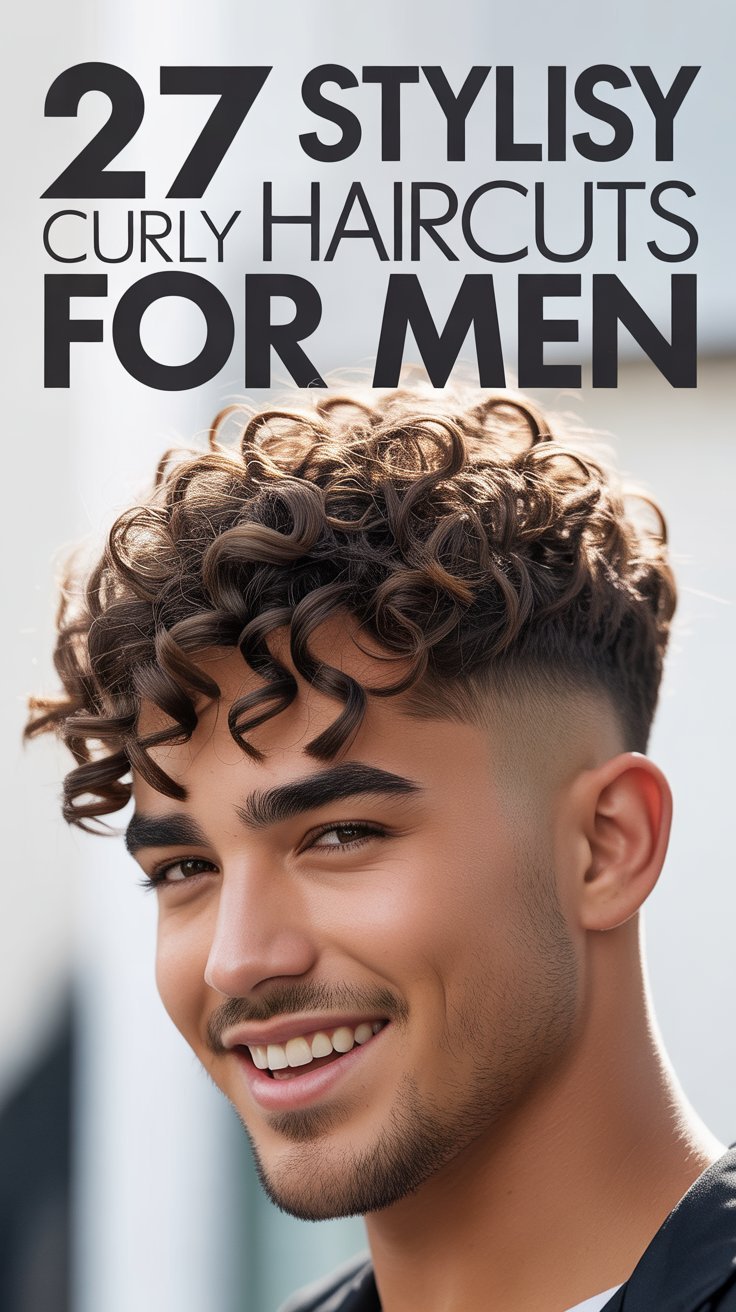
Curly hair has long been misunderstood, with many men struggling to find the right cut that works with their natural texture rather than against it.
The truth is, curly hair offers incredible versatility and character that straight hair simply cannot match.
Whether you have loose waves, tight coils, or anything in between, the right haircut can transform your curls from unruly to utterly sophisticated.
This comprehensive guide to 27 Stylish Curly Haircuts for Men will walk you through classic cuts, modern fades, professional styles, and bold statement looks that celebrate your natural texture.
You’ll discover how to choose the perfect cut based on your curl pattern, face shape, and lifestyle, along with styling tips and maintenance advice for each look.
From the timeless curly undercut to the contemporary textured fringe, these curated styles prove that curly hair is not a challenge to overcome but an asset to embrace.
1. The Classic Curly Undercut
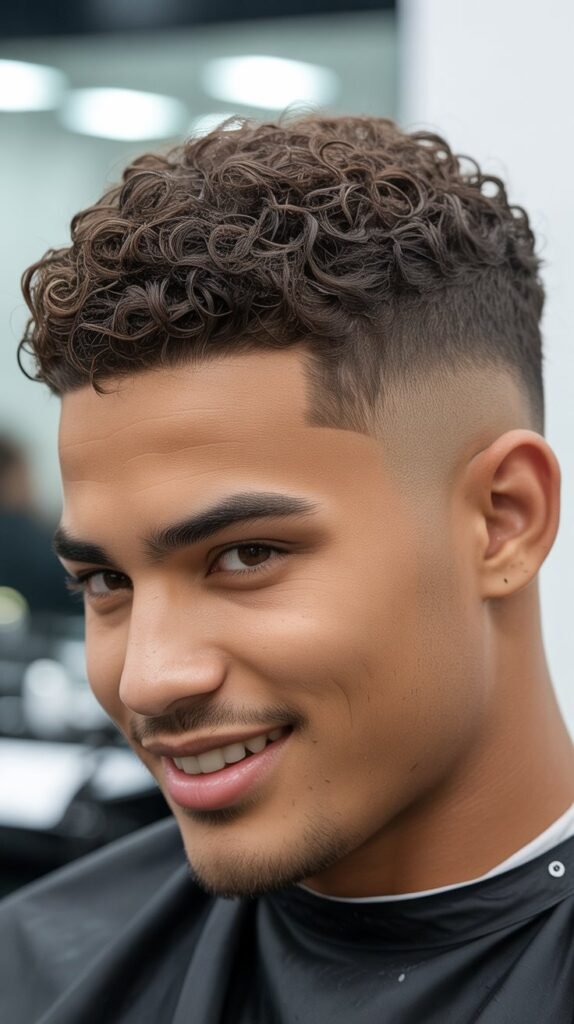
The curly undercut combines old-school sophistication with modern edge, creating a striking contrast between closely cropped sides and voluminous curls on top.
This versatile cut works exceptionally well for men who want a professional look that still showcases their natural texture.
Key Features:
- The sides and back are trimmed short (typically to a #1, #2, or #3 guard) while leaving substantial length on top
- The top section maintains 3-4 inches of length to allow curls to form naturally and create volume
- The transition between the short sides and long top can be subtle or dramatically defined depending on personal preference
- This cut reduces bulk on the sides while emphasizing the natural curl pattern on top
Styling Approach:
- Apply a curl-defining cream to damp hair, working it through from roots to ends
- Use a diffuser attachment on low heat to dry the curls while maintaining their shape
- Scrunch the hair gently while drying to enhance curl definition
- Finish with a light-hold hairspray to control flyaways without creating stiffness
- For a slicked-back variation, use a medium-hold pomade and comb the curls backward
Ideal For:
- Men with medium to thick curl density who want a balanced look
- Professional environments that require polished appearance
- Oval, square, and heart-shaped face structures
- Those willing to maintain regular trims every 3-4 weeks on the sides
2. Curly Taper Fade
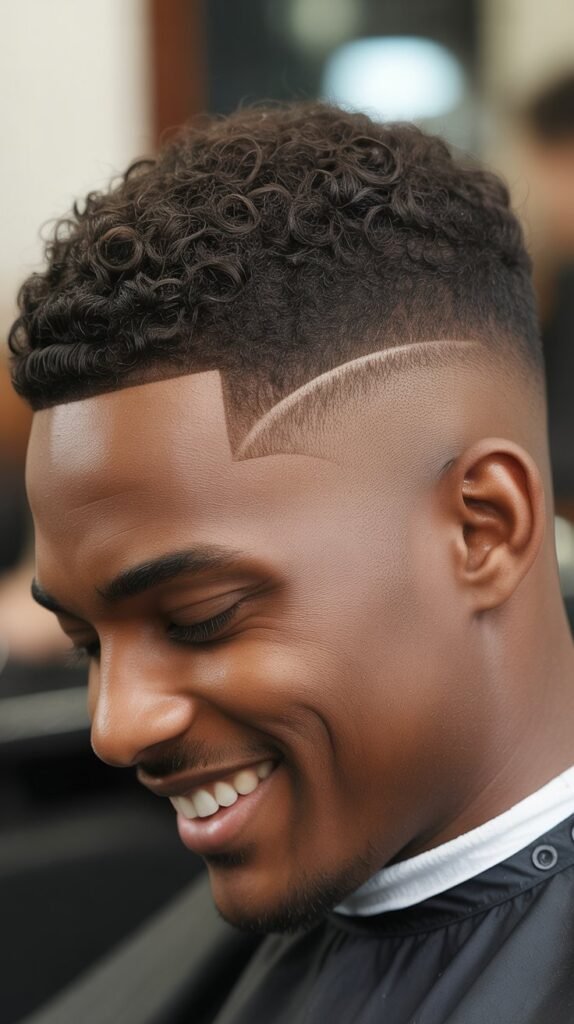
The curly taper fade seamlessly blends the hair from longer curls on top to progressively shorter hair down the sides and back, creating a gradient effect that’s both clean and contemporary.
This cut offers a more gradual transition than the undercut, making it ideal for men seeking a refined yet natural appearance.
Fade Variations:
- Low taper fade begins just above the ears and gradually shortens toward the neckline
- Mid taper fade starts at temple height and creates a more noticeable contrast
- High taper fade begins near the top of the head, maximizing the length difference
- The fade can be skin-tight at the bottom or maintain slight stubble depending on preference
Styling Requirements:
- Requires less product than many other curly styles due to the reduced overall volume
- A lightweight curl cream or mousse works best to define curls without weighing them down
- Air-drying is often sufficient, though a diffuser can speed up the process
- Regular edge-ups every 2 weeks keep the fade looking sharp and intentional
- Night-time maintenance with a silk or satin pillowcase helps preserve the style
Face Shape Compatibility:
- Elongates round faces by creating vertical emphasis with the taper
- Balances wider foreheads when combined with textured top styling
- Complements angular jawlines by softening the overall silhouette
- Works universally across most face shapes with proper customization
3. Textured Curly Fringe
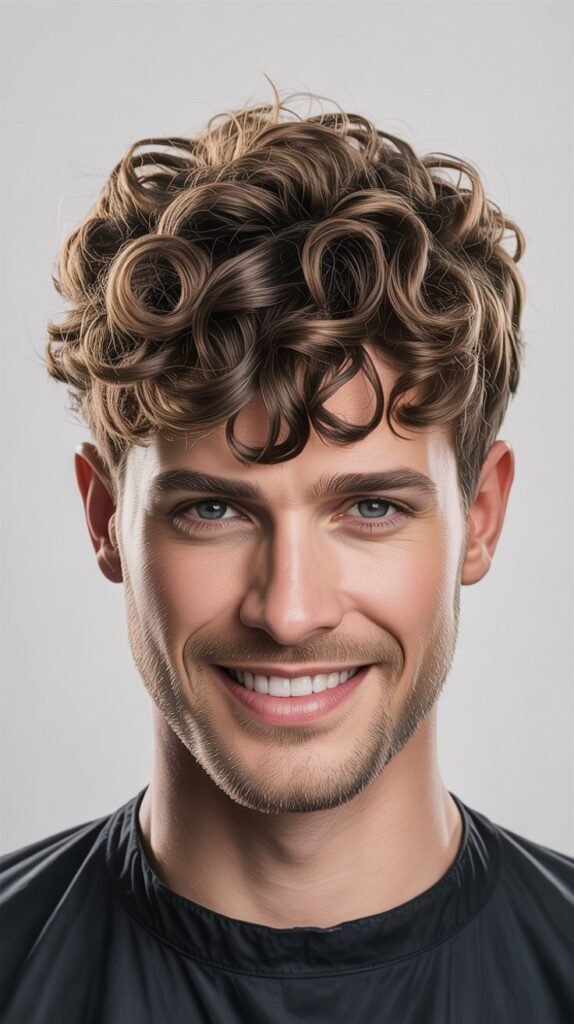
The textured curly fringe brings forward-swept curls to the forehead, creating a youthful and modern aesthetic that works particularly well for men with naturally wavy to curly hair.
This style adds dimension and movement while maintaining a relaxed, effortless vibe.
Cut Specifications:
- The fringe section extends from the hairline back approximately 2-3 inches
- Curls are typically cut to fall just above or at eyebrow level when styled
- The sides can be tapered, faded, or kept longer depending on the desired overall shape
- Layering throughout prevents the fringe from appearing too heavy or blocky
- Point-cutting techniques enhance the natural curl pattern and reduce bulk
Styling Method:
- Work a curl-enhancing product through towel-dried hair, concentrating on the fringe area
- Direct the curls forward using fingers or a wide-tooth comb
- Allow curls to air-dry or use a diffuser with the airflow directed toward the face
- Separate and define individual curls with fingertips for added texture
- A matte finish product helps maintain the casual, lived-in appearance
Best Suited For:
- Younger men or those embracing a more casual, creative style
- Medium to loose curl patterns that hold shape well
- Oblong and diamond face shapes that benefit from horizontal width
- Those comfortable with hair partially covering the forehead
4. High-Top Curly Fade
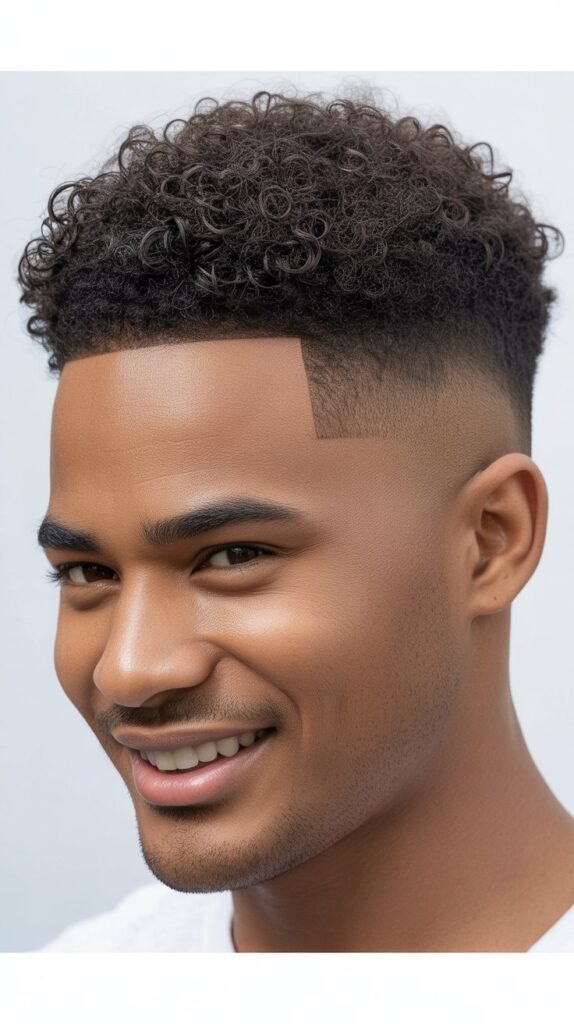
The high-top curly fade is a bold statement cut that features dramatic height on top while the sides are faded down close to the skin.
This iconic style, rooted in hip-hop culture, celebrates natural curl volume and creates an unmistakable silhouette.
Structural Elements:
- The top section is grown out to 4-6 inches or more, allowing maximum vertical height
- Sides are faded to the skin or kept extremely short with a #0 or #1 guard
- The fade transitions sharply from the top, creating a defined flat-top appearance
- The shape can be squared off or rounded depending on head shape and preference
- Regular shaping appointments are essential to maintain the geometric structure
Maintenance Requirements:
- Daily moisturizing is crucial due to the significant length and density of curls
- A pick or wide-tooth comb is used to lift and shape the curls into the desired height
- Edge control products keep the hairline crisp and defined
- Deep conditioning treatments weekly prevent dryness and breakage
- The style requires commitment and frequent professional maintenance every 2-3 weeks
Cultural Significance:
- Represents empowerment and celebration of natural Black hair texture
- Popularized in the 1980s and 1990s, experiencing modern revival
- Makes a confident style statement that demands attention
- Works best for tighter curl patterns (Type 3B to 4C)
5. Curly Man Bun
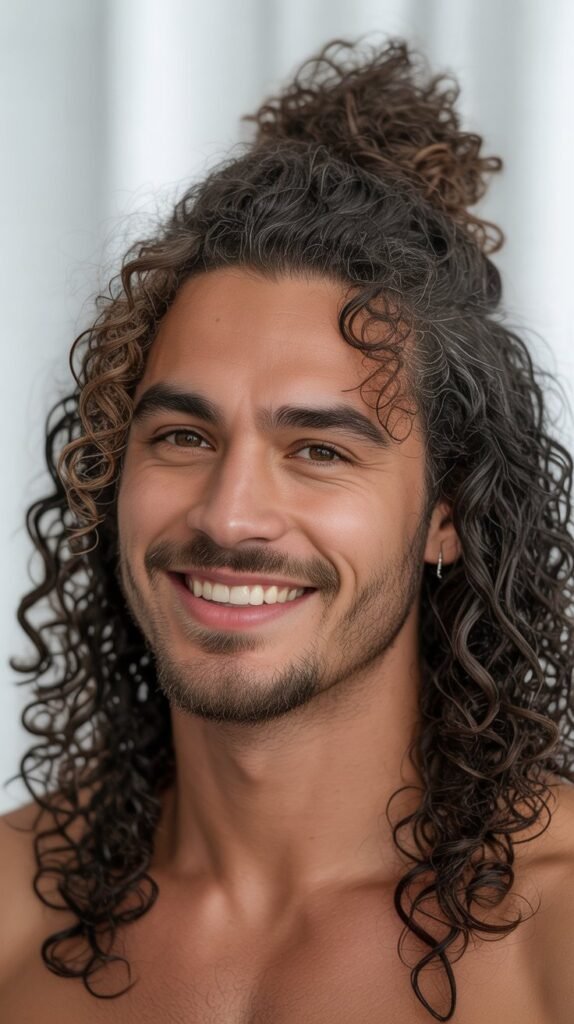
The curly man bun offers a practical yet stylish solution for men with longer curly hair who want versatility in their styling options.
This look transitions seamlessly from casual to formal settings and provides relief during hot weather or active pursuits.
Length Requirements:
- Hair should be at least 6-8 inches long to achieve a full bun
- Shorter curls (4-6 inches) can create a smaller, topknot-style bun
- The sides can be kept long and pulled back or trimmed shorter for contrast
- Gradual growth is recommended to maintain hair health and manageability throughout the process
Styling Variations:
- Full bun: All hair gathered at the crown or back of the head
- Top knot: Only the top section is tied while sides remain loose or short
- Half-up style: Front and top sections secured while back curls hang free
- Messy bun: Loosely gathered for a relaxed, undone appearance
- Sleek bun: Smoothed back with gel or pomade for formal occasions
Execution Steps:
- Apply a leave-in conditioner or curl cream to slightly damp hair
- Use fingers or a wide-tooth comb to gather hair at the desired position
- Secure with a hair tie, avoiding tight elastic bands that cause breakage
- Allow some face-framing curls to escape for a softer appearance
- Use bobby pins to secure any shorter sections that won’t reach the bun
6. Short Curly Caesar Cut
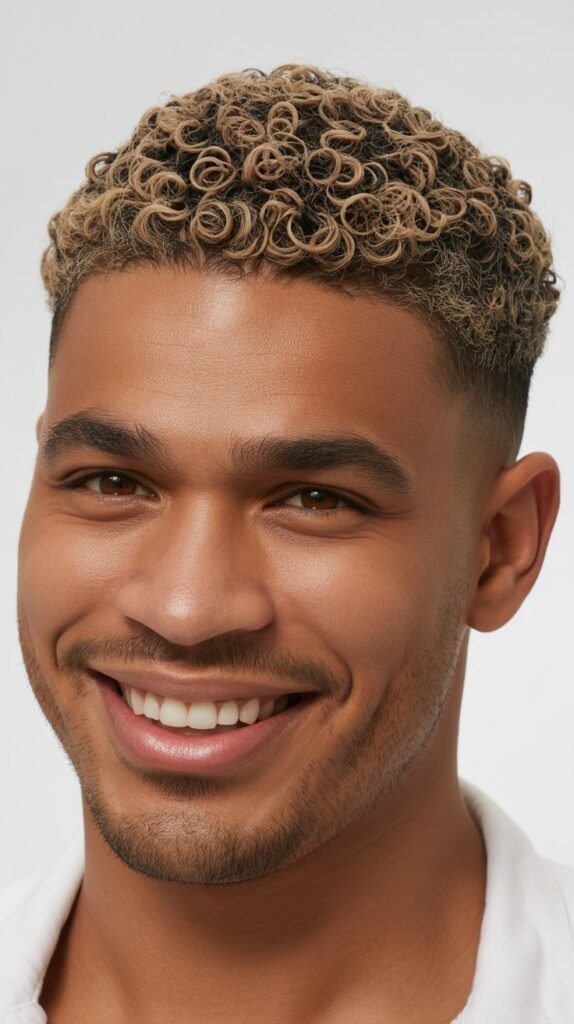
The short curly Caesar cut is a low-maintenance option that keeps curls tightly controlled while maintaining style and sophistication.
Named after Julius Caesar, this timeless cut features uniformly short length all around with a slight fringe at the front.
Cut Characteristics:
- Hair is typically cut to 1-2 inches in length all over the head
- The front section is left slightly longer to create a subtle forward-facing fringe
- The entire cut follows the natural curve of the head for a rounded appearance
- Curls remain visible but are kept compact and manageable
- Blunt cutting techniques preserve curl integrity while maintaining uniform length
Advantages:
- Minimal styling time required—often just wash and go
- Reduces frizz and curl unpredictability through shorter length
- Professional appearance suitable for corporate environments
- Easy to maintain with home trimming between barber visits
- Works well for active lifestyles and athletic pursuits
Product Recommendations:
- Light curl cream or moisturizer to prevent dryness
- Minimal product buildup due to frequent washing
- Optional: light pomade for the fringe to create definition
- Scalp health products since more of the scalp is visible
Best Candidates:
- Men with tighter curl patterns who want simplified maintenance
- Round or square face shapes that suit the horizontal fringe line
- Those preferring conservative, neat appearances
- First-time curly hair embracers transitioning from very short cuts
7. Curly Pompadour
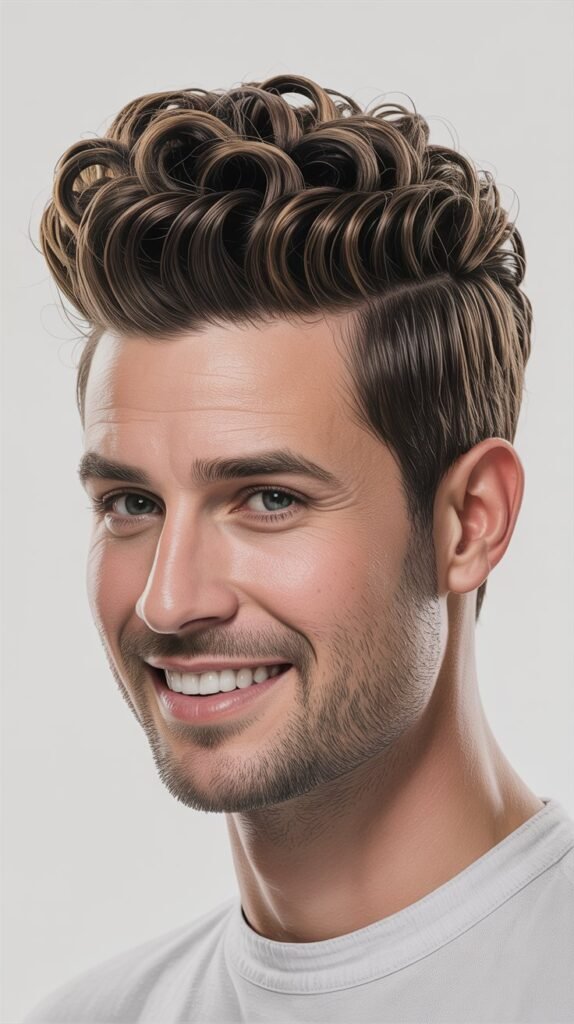
The curly pompadour takes the classic vintage style and adapts it for natural texture, creating a voluminous swept-back look that exudes confidence and sophistication.
This dramatic style works the curls upward and backward, adding height and presence.
Construction Details:
- Front section is grown to 4-5 inches minimum to achieve proper lift
- Sides are typically shorter—either tapered or faded—to emphasize the top volume
- Curls are directed upward and backward rather than forward
- The shape should be fuller at the front and gradually decrease toward the crown
- Layering throughout prevents excessive weight that could collapse the style
Styling Process:
- Start with towel-dried hair and apply a volumizing mousse
- Use a blow dryer with diffuser attachment, directing airflow upward and backward
- A round brush can help train curls in the desired direction (for looser curl patterns)
- Tighter curls benefit from picking the hair upward while drying
- Finish with a strong-hold pomade or gel to maintain the swept-back shape throughout the day
- Hair spray adds extra security for special occasions or long wear
Maintenance Considerations:
- Requires daily styling commitment and proper product application
- Works best for special occasions or professional environments
- May need touch-ups throughout the day depending on curl resilience
- Regular trims every 4-6 weeks maintain the proper proportions
8. Natural Curly Afro
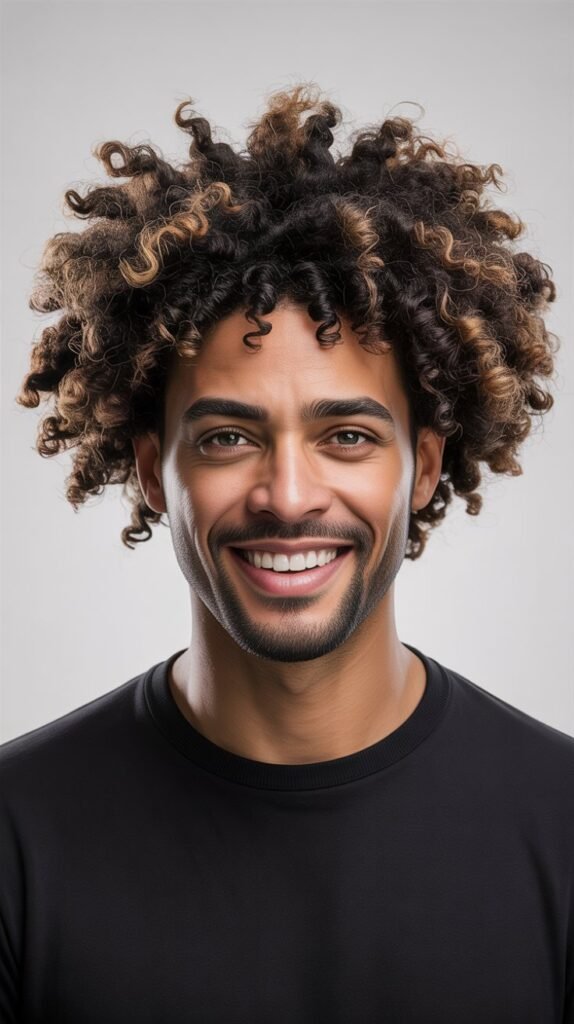
The natural curly afro celebrates unrestrained curl volume and natural texture in its fullest expression.
This iconic style represents cultural pride and natural beauty, requiring specific care techniques to maintain health and shape.
Growth and Shaping:
- Requires patience to grow hair to 3-6 inches or longer all around
- Can be shaped into a rounded dome, oval, or geometric form
- Regular shaping appointments trim damaged ends while maintaining overall length
- The perimeter can be defined sharply or kept naturally soft
- Individual curl definition varies based on natural curl pattern
Essential Care Routine:
- Deep conditioning treatments at least weekly to maintain moisture
- Wide-tooth comb or pick used exclusively to prevent breakage
- Moisturizing products applied daily, focusing on ends
- Protective styling at night with silk or satin bonnet or pillowcase
- Gentle cleansing with sulfate-free shampoo to avoid stripping natural oils
- Regular protein treatments strengthen curls and reduce breakage
Styling Techniques:
- Picking out the afro creates uniform volume and rounded shape
- Finger coiling defines individual curl sections
- Shingling method creates smooth, defined curl clumps
- Wash-and-go with curl cream for natural definition
- Twist-outs or braid-outs create defined curl patterns
9. Curly Mohawk
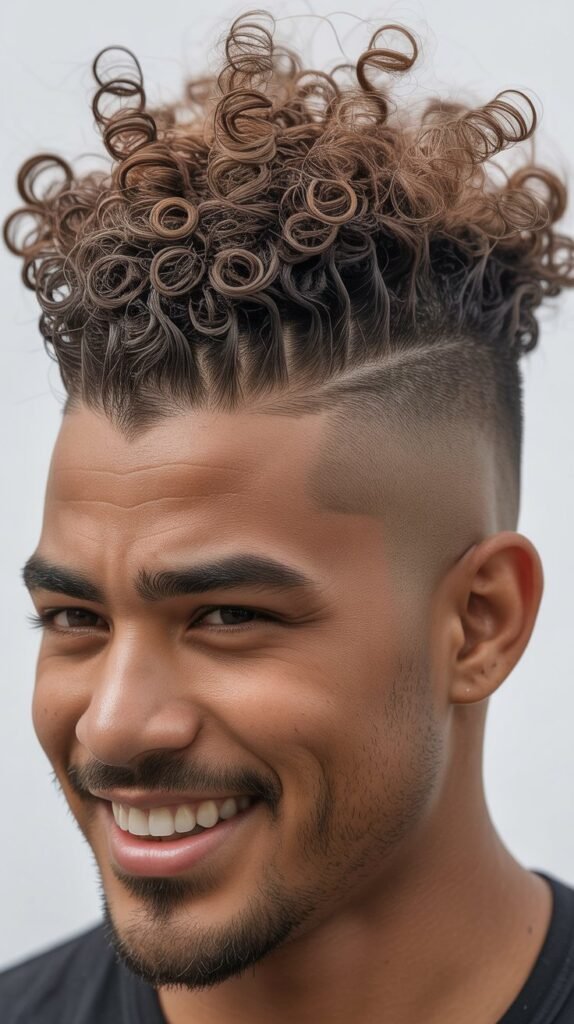
The curly mohawk makes a bold statement by contrasting shaved or faded sides with a dramatic strip of curls running from forehead to nape.
This edgy style combines rebellion with sophistication when executed properly.
Structural Design:
- The center strip typically measures 2-4 inches wide
- Curls in the mohawk section are grown to 3-6 inches for impact
- Sides are either completely shaved, skin-faded, or buzzed very short
- The mohawk strip can be uniform width or taper from front to back
- Height can be natural or styled upward for increased drama
Styling Approaches:
- Defined curls: Use curl cream and allow natural curl pattern to show
- Spiked: Apply strong-hold gel and lift curls upward with fingers or pick
- Sleek: Smooth curls backward with pomade for a more conservative look
- Textured: Rough up curls with matte paste for an undone appearance
- The sides require regular maintenance shaving or fading every 1-2 weeks
Personality and Lifestyle:
- Best suited for creative professionals or casual environments
- Makes a strong personal statement about individuality
- Requires confidence to carry the dramatic aesthetic
- May not be appropriate for conservative workplace settings
10. Messy Curly Top with Fade
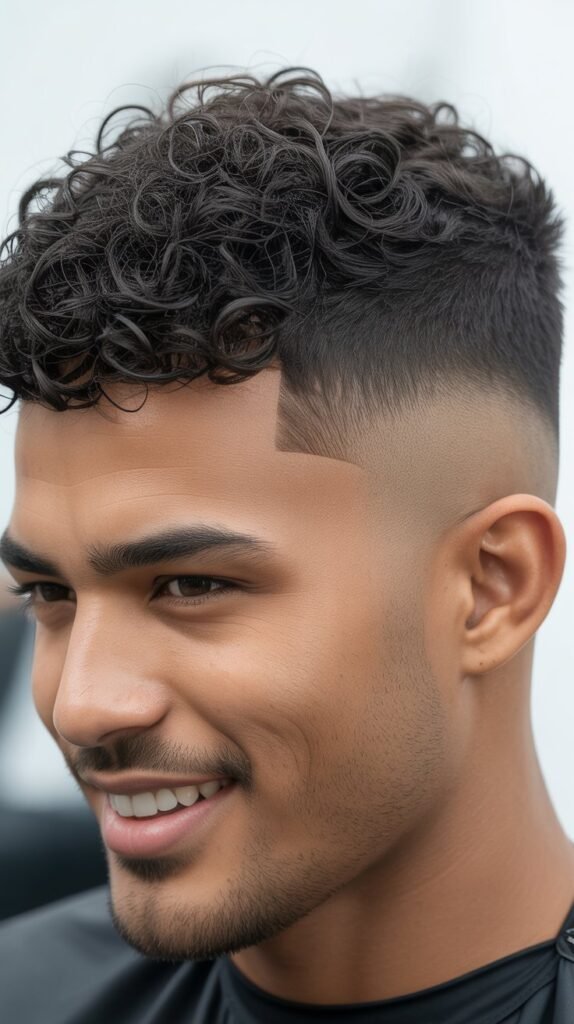
The messy curly top with fade embraces intentional dishevelment, combining groomed sides with deliberately tousled curls on top.
This contemporary style balances polished and casual elements for effortless cool.
Cut Elements:
- Top section maintains 3-5 inches of length for adequate curl movement
- Fade or taper on sides creates clean contrast with messy top
- Longer curls are point-cut to create varied lengths and enhance texture
- No uniform pattern—randomness is encouraged
- The fade height can be adjusted based on how much contrast is desired
Creating the Messy Effect:
- Apply a light curl cream or sea salt spray to damp hair
- Scrunch and tousle hair randomly while drying
- Avoid combing or brushing for authentic messy appearance
- Use fingers to separate and position individual curls
- A small amount of matte clay or paste adds texture without shine
- The goal is “styled to look unstyled”—effortless but intentional
Practical Benefits:
- Forgiving of imperfect styling techniques
- Adapts well to different hair textures and curl patterns
- Transitions easily from casual to slightly dressy occasions
- Requires minimal daily maintenance once the technique is mastered
11. Curly Quiff
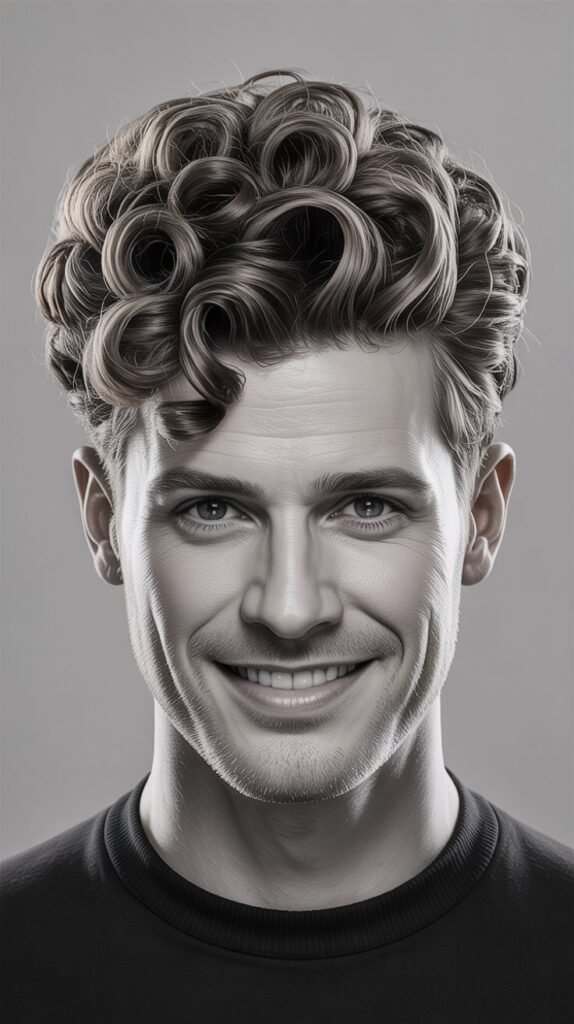
The curly quiff elevates the front section of hair upward and slightly backward while keeping sides and back more controlled, creating a sophisticated style that works in both casual and formal settings.
Proportions and Structure:
- Front curls are left longest at 4-6 inches to achieve proper height
- The quiff section extends back approximately 2-3 inches from the hairline
- Sides are cut shorter—typically 1-3 inches depending on desired contrast
- Back can match the sides or gradually blend into the top length
- Strategic layering prevents excessive bulk while maintaining volume
Styling Instructions:
- Apply volumizing mousse to damp hair, concentrating on the front section
- Blow-dry while directing curls upward and slightly backward
- Use a round brush for looser curls or fingers for tighter textures
- Once dry, apply a medium-hold pomade to shape and define the quiff
- The front should stand up and back while maintaining natural curl texture
- Sides can be smoothed down for contrast or left slightly textured
Versatility:
- Professional enough for business environments
- Stylish enough for social occasions
- Can be dressed up or down with product variation
- Works across a wide age range from 20s through 50s
12. Long Curly Layered Cut
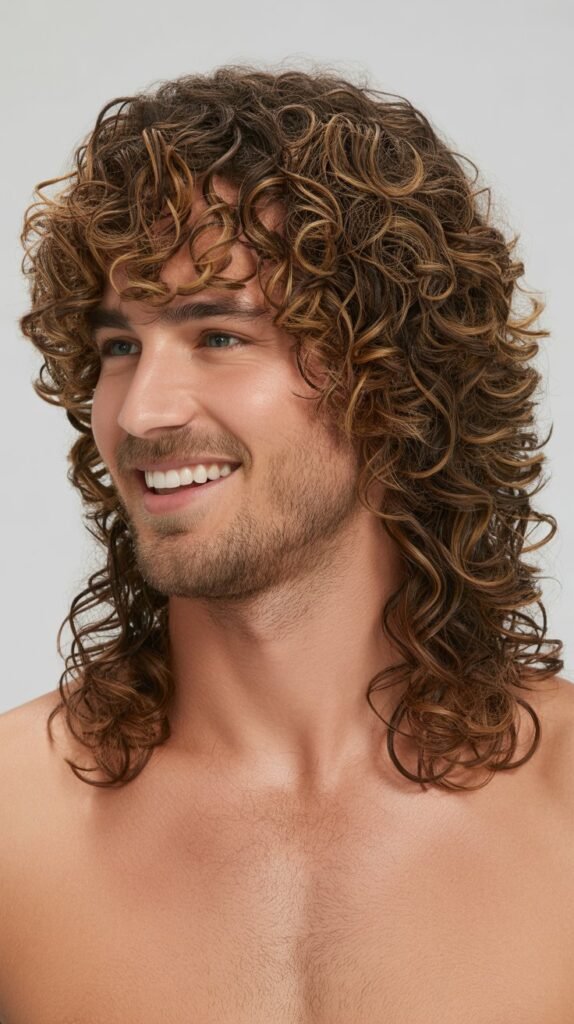
The long curly layered cut embraces length while using strategic layering to prevent the triangular shape that often plagues longer curly hair.
This cut celebrates curl length while maintaining movement and manageability.
Layering Strategy:
- Multiple layers are cut throughout, starting shorter at the crown
- Face-framing layers soften the appearance and highlight facial features
- Weight is removed from the bottom to prevent the dreaded pyramid shape
- Layers are cut to work with natural curl pattern, not against it
- The overall length typically extends past the ears, often to shoulders or beyond
Styling Considerations:
- Apply curl-defining products to soaking wet hair for best absorption
- Use the “squish to condish” method—squishing products upward into curls
- Air-drying is preferred to maintain natural curl pattern and reduce frizz
- Diffusing on low heat is acceptable if time is limited
- Refresh second-day curls with water spray and additional product
- Sleep with hair in a loose pineapple on top of head to preserve curls
Length Management:
- Regular trims every 8-12 weeks prevent split ends and maintain shape
- Deep conditioning treatments become increasingly important with length
- Protective styles occasionally give hair a rest from daily manipulation
- Silk or satin materials for sleep reduce friction and breakage
13. Curly Side Part
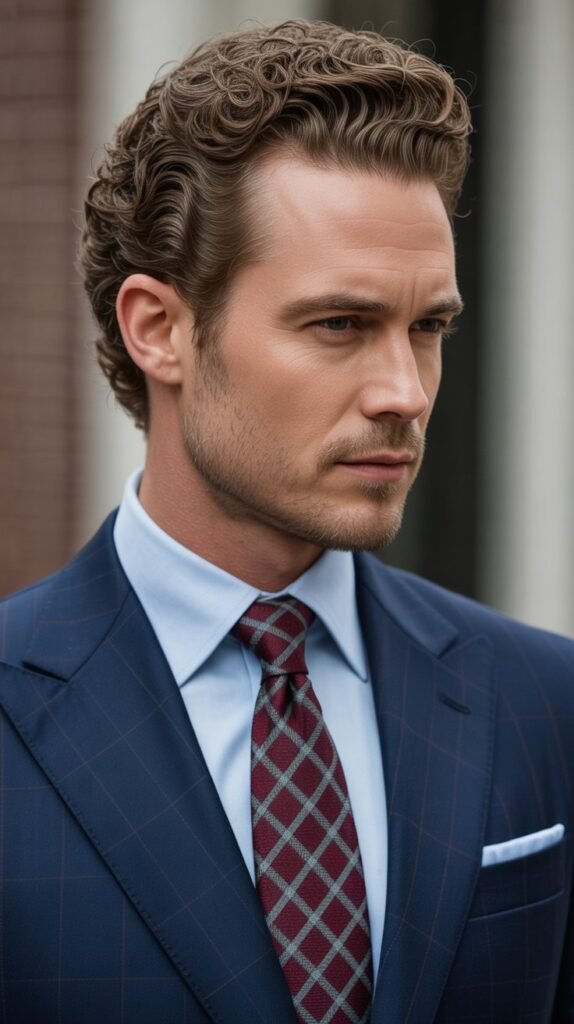
The curly side part brings classic sophistication to curly hair by creating a defined part on one side and directing curls across and away from it.
This timeless style works exceptionally well for professional environments.
Creating the Part:
- The part is positioned approximately 1-2 inches from center, on either left or right
- Can be created with a comb immediately after washing when hair is most pliable
- For very curly hair, the part may need to be re-established each styling session
- A small amount of gel or pomade helps define the part line
- The part should follow the natural hair growth pattern when possible
Styling the Two Sections:
- The larger section (opposite the part) has more volume and curl definition
- Curls are directed across the head, following the part line
- The smaller section is often smoothed closer to the head
- Both sections can be left natural or styled with additional products
- For formal occasions, the larger section can be swept back
Professional Applications:
- One of the most workplace-appropriate curly styles
- Conveys maturity and polish while celebrating natural texture
- Easy to recreate consistently for a signature look
- Works well with business and business-casual attire
14. Tapered Curly Temple Fade
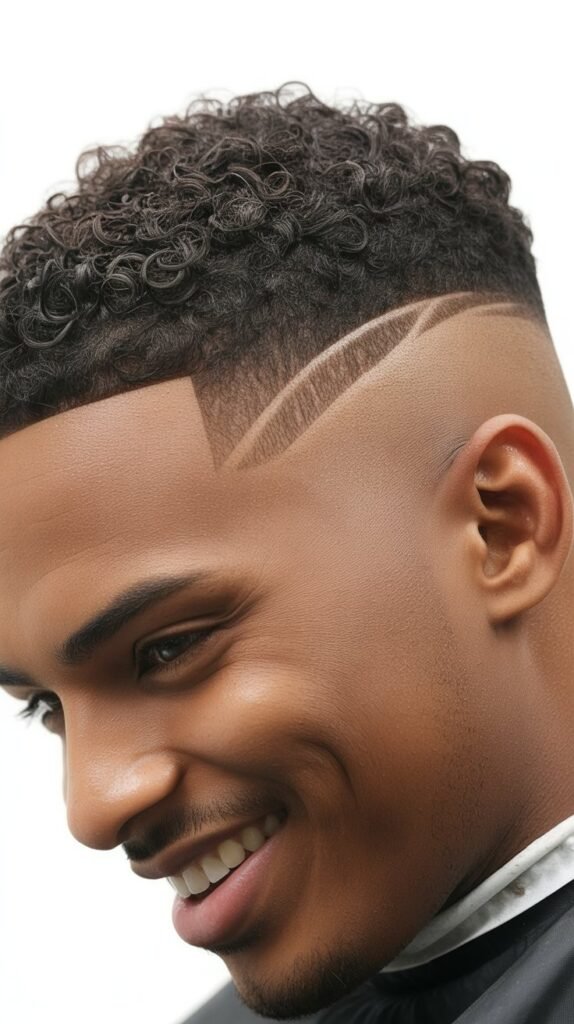
The tapered curly temple fade specifically focuses the fade on the temple area, creating clean lines and sharp angles while maintaining substantial length and volume on top and back.
This style offers edge and precision while showcasing curls.
Fade Specifications:
- The fade begins at the temples and extends back toward the ears
- Can be taken to skin or left with slight stubble
- The fade angle creates sharp lines that frame the face
- Top and crown sections maintain full length—typically 3-5 inches
- Back section can be faded, tapered, or left long depending on preference
Line Work Details:
- Sharp edge-up at the hairline creates defined borders
- Temple points can be squared, rounded, or angled based on face shape
- The line between faded and long sections should be crisp
- Regular maintenance every 1-2 weeks keeps lines sharp
Styling the Top:
- Curls on top can be worn forward, backward, or natural and free
- The contrast between faded temples and full curls creates visual interest
- Minimal product needed since volume is built into the cut structure
- Works well with various curl patterns from wavy to tight coils
15. Curly Slick Back
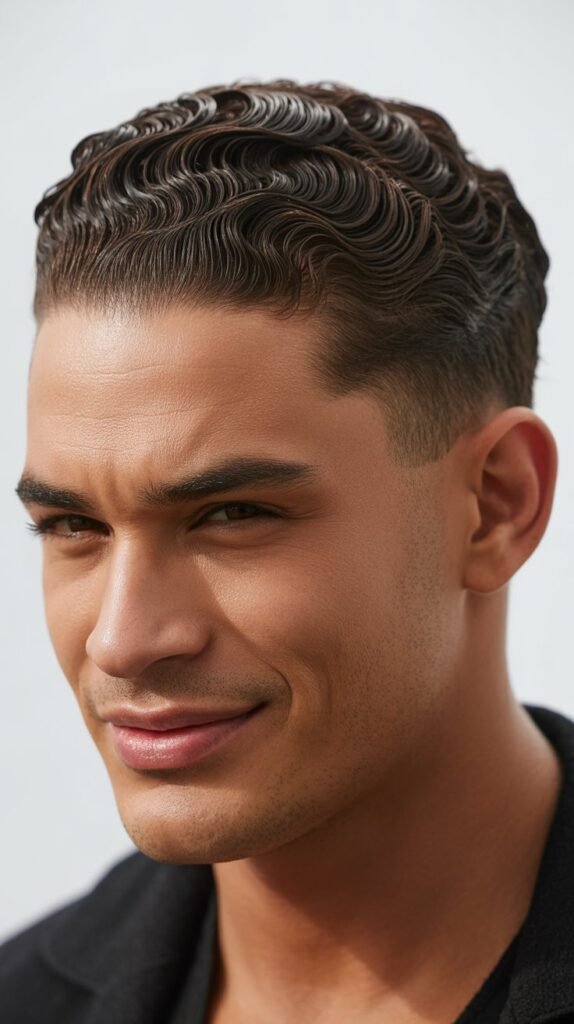
The curly slick back channels old Hollywood glamour by smoothing curls backward away from the face while maintaining their texture and definition.
This sophisticated style works for formal occasions and upscale environments.
Preparation and Application:
- Start with damp, freshly washed hair for best control
- Apply a generous amount of strong-hold gel or pomade
- Use a wide-tooth comb to direct all curls backward
- For tighter curls, a brush can help smooth the hair
- Work in sections to ensure complete coverage and control
- The goal is smooth appearance while maintaining visible curl texture
Hold and Finish:
- Strong-hold products are essential to combat natural curl spring
- Multiple product applications may be needed for very tight curls
- A finishing spray adds extra security
- Allow hair to air-dry in the slicked position, or use a blow dryer on low heat
- Throughout the day, keep a small amount of product for touch-ups
Occasions and Styling:
- Ideal for weddings, formal events, and upscale dining
- Works exceptionally well with suits and formal attire
- Can be adapted for business presentations and important meetings
- Creates a more mature, sophisticated appearance than loose curls
16. Curly Faux Hawk
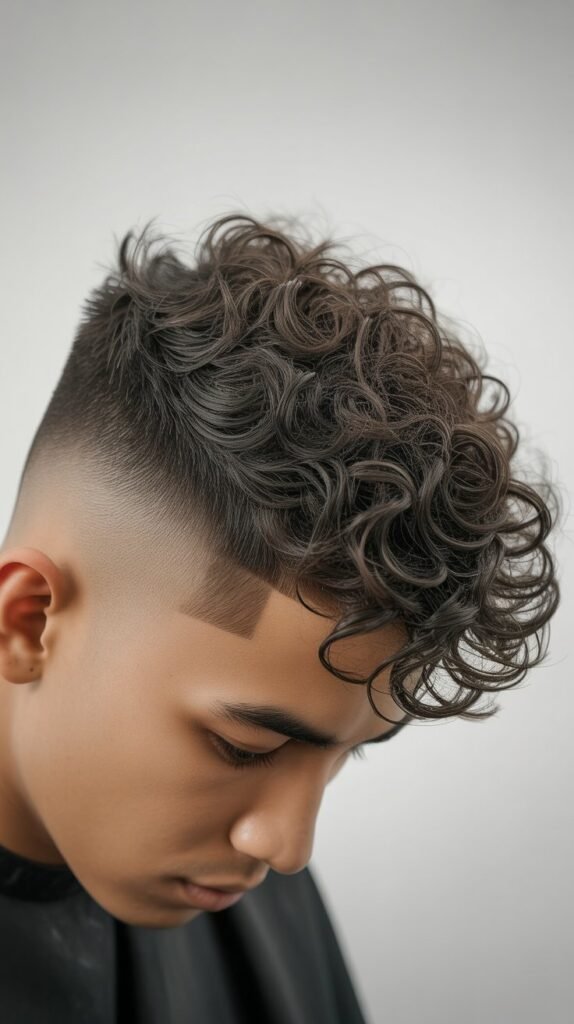
The curly faux hawk creates the illusion of a mohawk without the commitment of shaved sides, offering edge and personality while maintaining more versatility.
This style uses product and styling to create height in the center while keeping sides controlled.
Cut Foundation:
- Sides are cut shorter than the top but not shaved—typically 1-2 inches
- The center strip from forehead to crown is left longest at 3-5 inches
- The cut creates natural height potential in the center section
- Graduation from sides to center provides the foundation for the hawk shape
- Can be worn casual when unstyled, edgy when styled up
Styling Technique:
- Apply strong-hold gel or pomade to damp hair
- Use fingers or a comb to direct center curls upward and inward
- The sides are smoothed down or left slightly textured but flat
- Create height in the center while maintaining natural curl texture
- Some men add spikes to the center for increased drama
- The style can be adjusted from subtle to bold depending on product amount
Flexibility:
- Can be styled into a faux hawk for evenings and weekends
- Worn casually for work by simply not adding styling products
- Offers more versatility than a committed mohawk
- Easier to grow out if style preferences change
17. Curly Crop
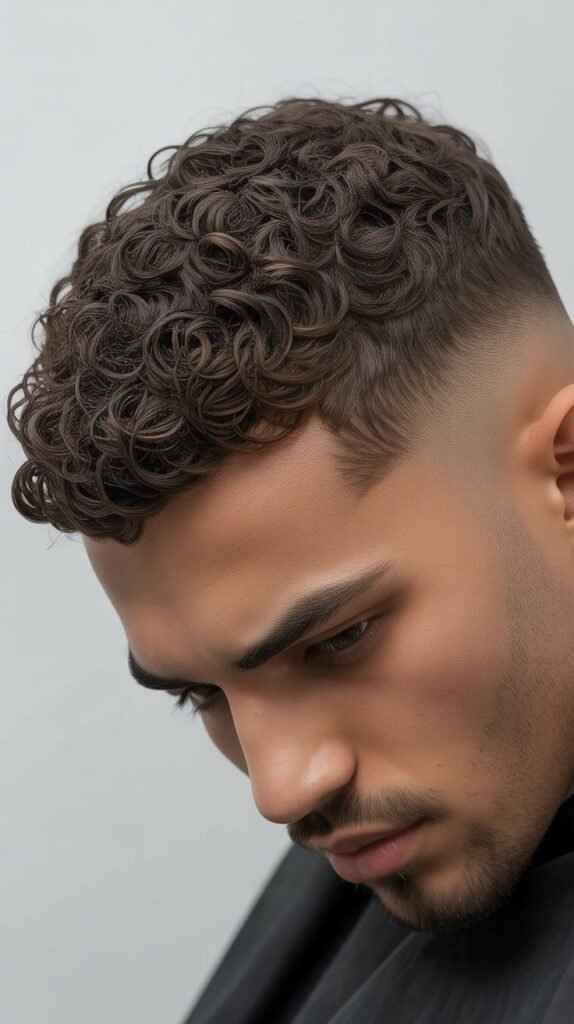
The curly crop is a contemporary short style that keeps curls compact while maintaining texture and definition.
This European-influenced cut offers a modern, fashion-forward alternative to traditional short curly styles.
Cut Characteristics:
- Overall length is kept between 1-3 inches throughout
- Slight length variation with marginally longer top section
- The fringe is cut to sit just above or at the eyebrow
- Sides and back are kept short but not faded
- Blunt cutting preserves curl weight and definition
- Creates a boxy, geometric silhouette
Styling Approach:
- Requires minimal styling effort—often air-dry is sufficient
- A small amount of curl cream enhances definition
- Matte paste can add texture and separation
- The fringe can be styled forward or slightly to the side
- Natural curl pattern is celebrated rather than manipulated
- Very low maintenance for busy lifestyles
Fashion Integration:
- Pairs exceptionally well with modern menswear and streetwear
- Popular among younger men and fashion-conscious individuals
- Works well with contemporary glasses and accessories
- Complements a variety of personal styles from minimalist to bold
18. Curly Bowl Cut
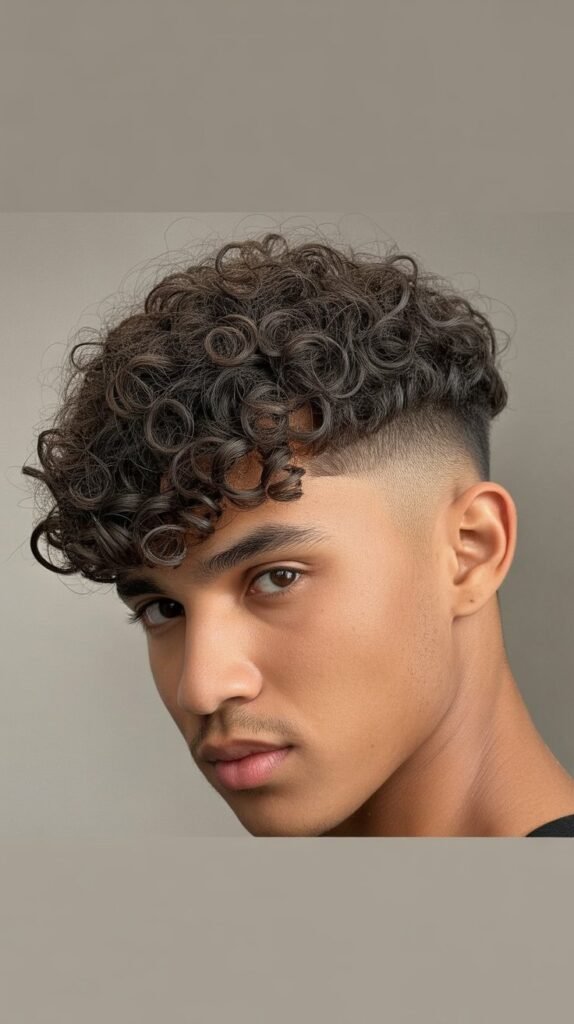
The curly bowl cut reinterprets a retro classic for modern curly hair, creating a rounded silhouette that celebrates volume and natural texture.
When executed properly, this cut is fashion-forward rather than dated.
Modern Interpretation:
- The cut creates a dome-like shape that follows the head’s curve
- Curls are typically 2-4 inches long all around
- The perimeter can be soft and natural or more defined
- Unlike traditional bowl cuts, this version works with curl patterns
- Layering throughout prevents the heavy, one-length appearance of vintage versions
Customization Options:
- The bowl can sit at various heights—above ears, at ears, or below
- Nape area can be tapered or left following the bowl line
- Face-framing curls can be left slightly longer for softness
- The overall shape can be perfectly round or slightly oval
Maintenance:
- Regular trims every 6-8 weeks maintain the circular shape
- Daily moisturizing prevents frizz and maintains definition
- Styling is minimal—natural curl pattern creates the shape
- Works best for those with uniform curl pattern throughout
19. Disconnected Curly Undercut
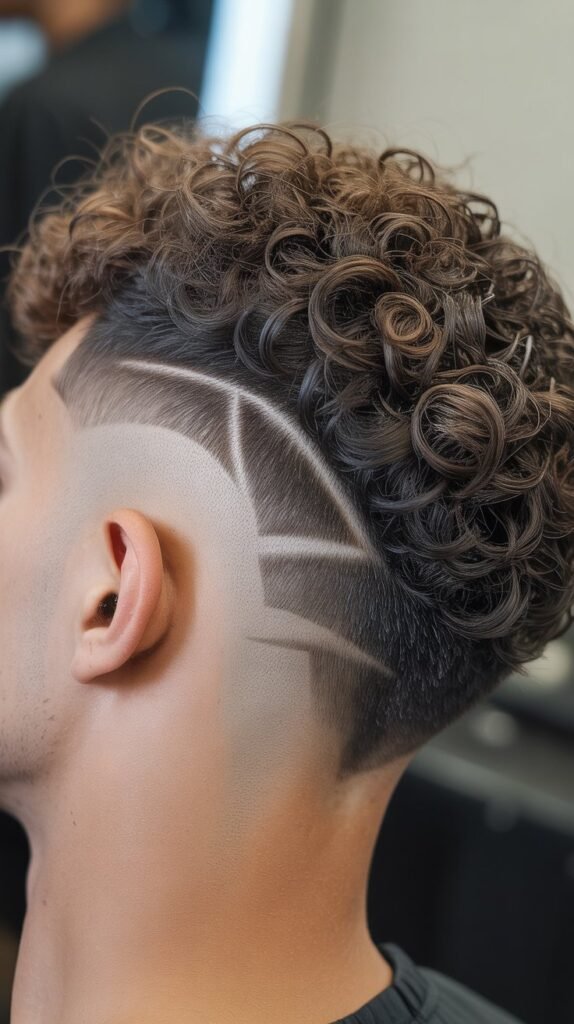
The disconnected curly undercut creates dramatic contrast with no gradual transition between the long top and very short sides.
This bold style makes a statement through its intentional abruptness and architectural quality.
Disconnect Features:
- Sides and back are buzzed very short or shaved completely
- Top section maintains significant length—4-6 inches or more
- There is NO fade or blend between the two sections
- The line of disconnection is sharp and clearly visible
- Creates maximum contrast and visual impact
Top Section Styling:
- Can be worn forward, backward, to the side, or natural
- The substantial length allows for multiple styling variations
- Use strong-hold products to emphasize the architectural quality
- Curls can be defined individually or left in natural clumps
- The weight of longer curls creates interesting movement
Commitment Level:
- Requires confidence to wear such a stark style
- Sides need frequent maintenance to keep the disconnect clean
- Not easily grown out—requires going through awkward stages
- Makes a strong personal statement about style preference
20. Curly Buzz Cut
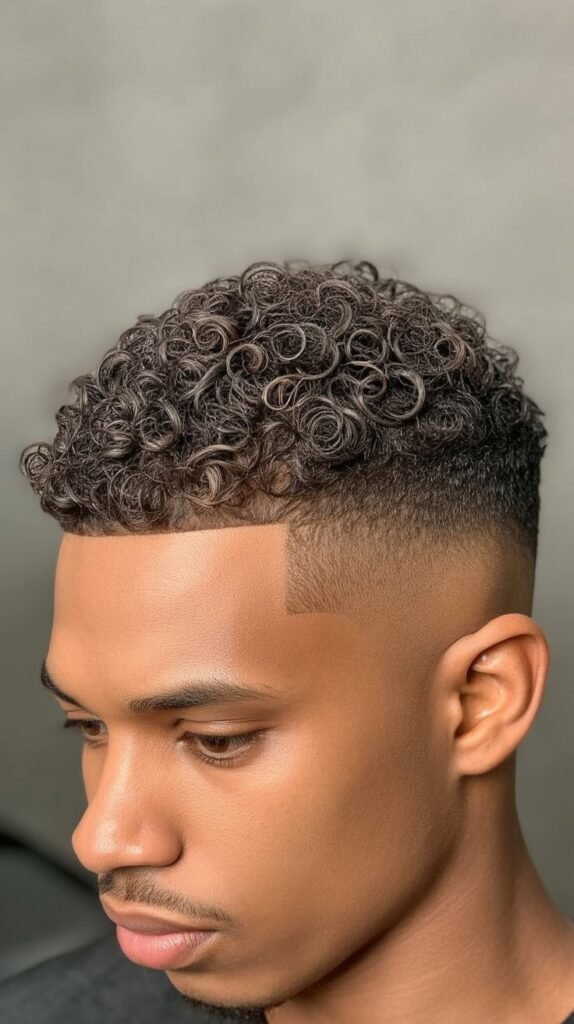
The curly buzz cut keeps hair uniformly short all over, allowing just enough length for curl texture to be visible while providing maximum ease and minimal maintenance.
This practical style works exceptionally well in hot climates and for active lifestyles.
Length Options:
- #2 guard (1/4 inch): Curl texture barely visible, mostly shows curl direction
- #3 guard (3/8 inch): Curls begin to form, creating subtle texture
- #4 guard (1/2 inch): Clear curl pattern visible with mini-curl formation
- #5 guard (5/8 inch): Full small curls create textured appearance
- Can use different guard lengths on top versus sides for dimension
Benefits:
- Extremely low maintenance—wash and go daily routine
- Dries quickly without need for products or styling
- Cools and comfortable in warm weather
- Ideal for athletes and military personnel
- Requires minimal product investment
- Regular haircuts easy to perform at home
Growing Out:
- Provides a fresh start for those wanting to embrace their curls
- Shows natural curl pattern clearly as hair grows
- Makes transitioning from relaxed/chemically treated hair easier
- Even growth allows for easier styling as length increases
21. Curly Ivy League
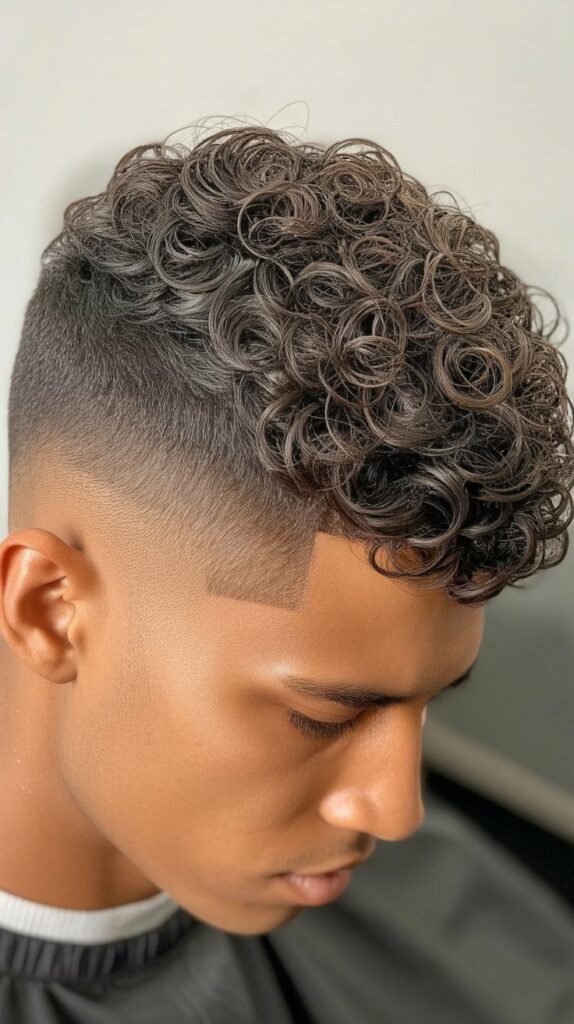
The curly Ivy League takes the classic collegiate cut and adapts it for textured hair, creating a sophisticated style that’s slightly longer than a crew cut with a subtle side part.
This versatile cut bridges casual and formal aesthetics.
Cut Specifications:
- Top section is 1-2 inches in length, allowing curls to form but stay controlled
- Front section is slightly longer than the back
- Sides are tapered short but not faded
- A subtle side part can be created or implied
- The overall shape is neat and proportional
Professional Appeal:
- Quintessentially appropriate for business environments
- Conveys maturity, trustworthiness, and competence
- Easy to maintain consistent appearance daily
- Works well from entry-level to executive positions
- Transitions seamlessly from office to after-work activities
Styling Requirements:
- Minimal—a light pomade or cream for definition
- Can be combed into place or left natural
- Takes 2-3 minutes to style each morning
- Holds shape throughout the day without touch-ups
- Works with or without product depending on curl tightness
22. Curly Textured Crop with Fringe
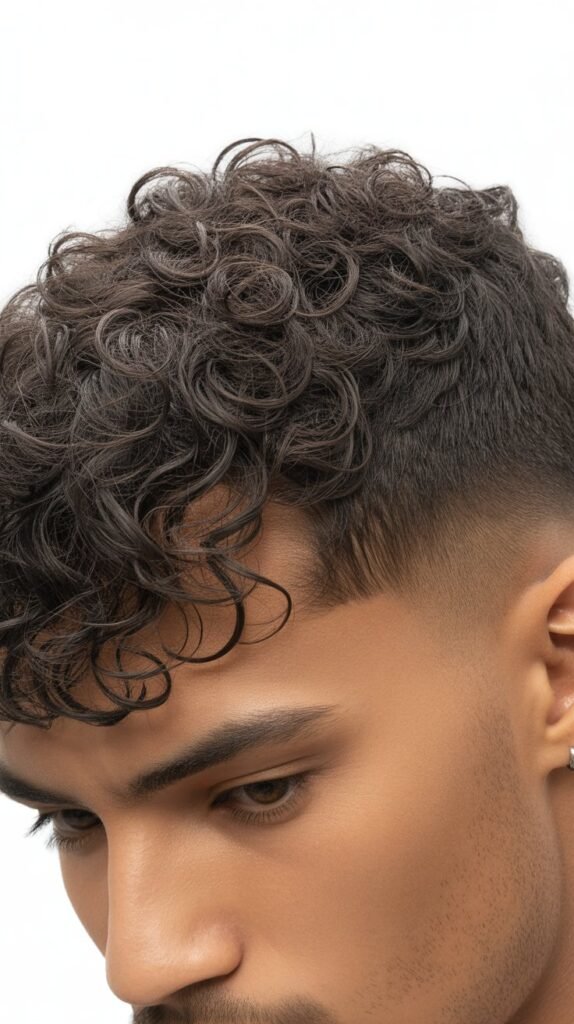
The curly textured crop with fringe combines short overall length with a defined forward-facing fringe, creating a youthful and modern style that emphasizes natural texture.
This European-inspired cut has gained popularity for its fashion-forward appeal.
Cut Architecture:
- Overall length is 1.5-3 inches with slight variation for dimension
- Fringe section extends forward to eyebrow level or slightly beyond
- Sides and back are cut short but maintain texture rather than being faded
- The cut emphasizes horizontal lines and forward movement
- Choppy, piece-y cutting techniques enhance the textured appearance
Fringe Variations:
- Blunt fringe: Cut straight across for bold statement
- Textured fringe: Point-cut for softer, more broken-up appearance
- Side-swept fringe: Angled to one side for asymmetric interest
- Choppy fringe: Varied lengths for enhanced texture
Product and Styling:
- Matte clay or paste creates the desired texture without shine
- Apply to dry or nearly dry hair for maximum control
- Use fingers to piece out and separate sections
- The fringe can be styled forward or slightly to the side
- Minimal effort required once technique is learned
23. Two-Block Curly Cut
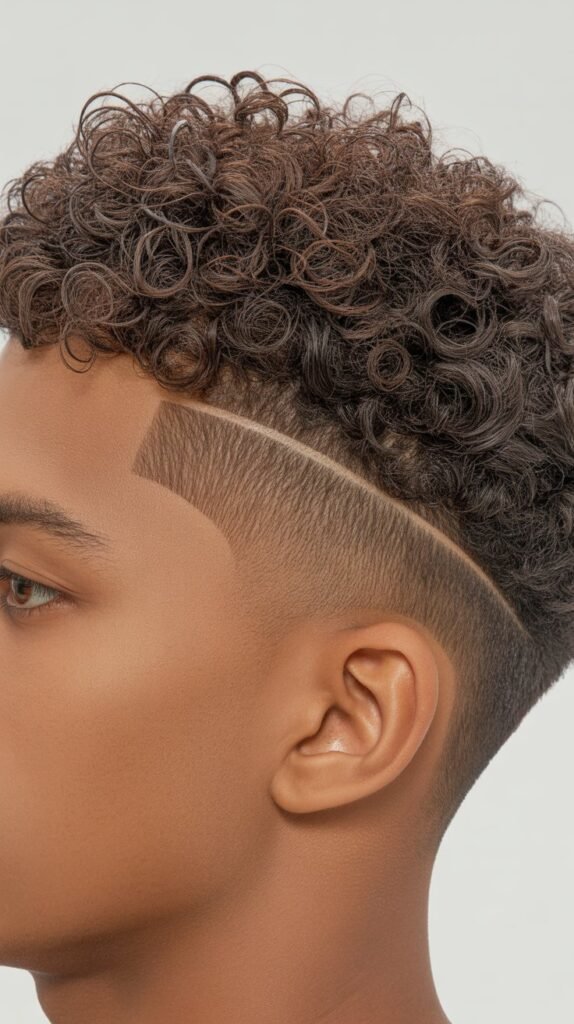
The two-block curly cut originates from Korean fashion and creates distinct separation between the long top section and dramatically shorter bottom section.
This architectural style has gained international popularity for its unique silhouette.
Structural Design:
- Top section is grown to significant length—3-6 inches
- Bottom section (sides, back, nape) is cut very short
- There is a clear horizontal line of separation between the two blocks
- The disconnect is intentional and visible
- Creates a bowl-like appearance when viewed from behind
Styling the Top:
- Can be parted in the middle, side, or left parted naturally
- Often styled to cover the ears and create overhang
- Curls can be left natural or enhanced with curl cream
- Some interpretations smooth the top section while others embrace texture
- The heavy top section contrasts dramatically with exposed short bottom
Cultural Context:
- Influenced by K-pop and Korean street fashion
- Popular among younger men and fashion enthusiasts
- Represents contemporary Asian beauty standards
- Often paired with bold fashion choices and accessories
24. Curly Mullet
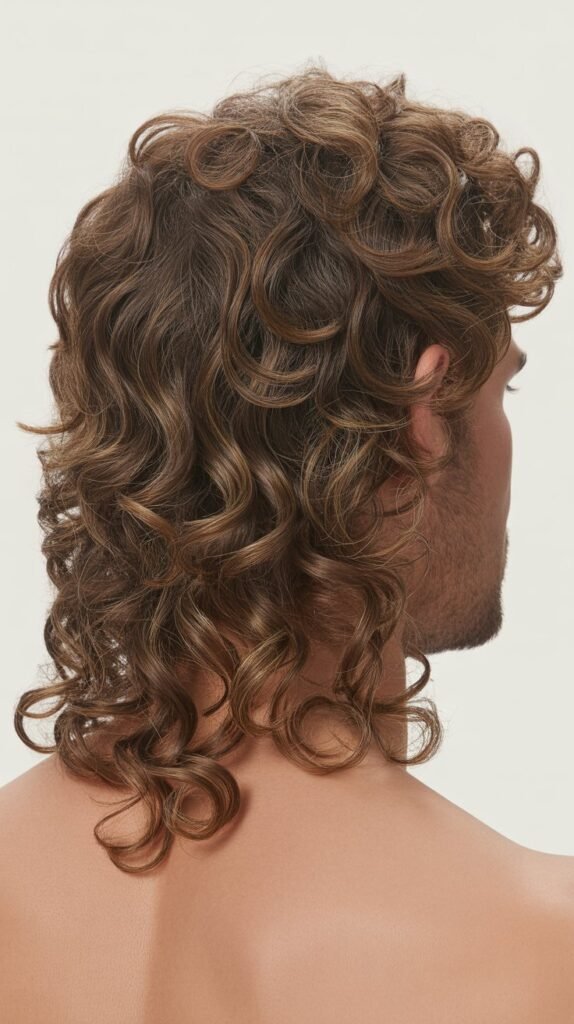
The curly mullet experiences a modern revival, offering “business in the front, party in the back” with natural texture adding unique character to this controversial but increasingly popular style.
Contemporary versions are more refined than their 1980s predecessors.
Modern Mullet Construction:
- Front and top sections are kept moderate length—2-4 inches
- Sides can be tapered, faded, or kept slightly longer than traditional mullets
- Back section extends beyond the collar, often to shoulder length or longer
- The transition from top to back can be gradual or more defined
- Layering throughout prevents excessive bulk and creates movement
Styling Variations:
- Sleek mullet: Top smoothed back, back section defined and neat
- Messy mullet: Embraces texture and intentional dishevelment throughout
- Curly shag mullet: Heavy layering creates a shaggy, rock-and-roll aesthetic
- Controlled front, wild back: Groomed front section with loose natural back
Cultural Renaissance:
- Embraced by musicians, artists, and creative professionals
- Represents rejection of conventional grooming norms
- Requires confidence and self-assuredness to wear effectively
- Works best for casual environments or creative industries
- The curls add softness and dimension that straight-hair mullets often lack
25. Curly Drop Fade
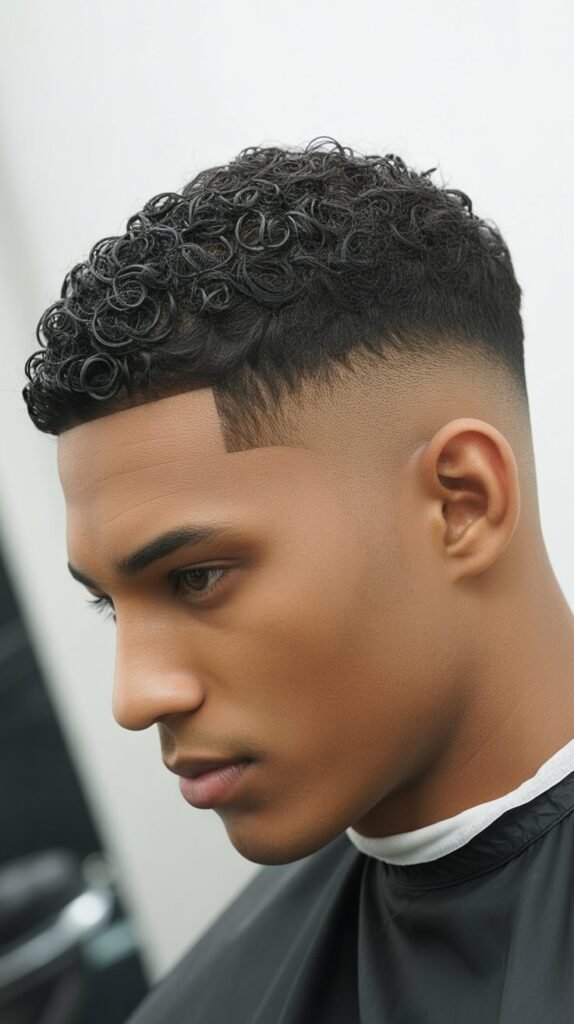
The curly drop fade creates a curved fade line that drops down behind the ears and follows the natural head shape, offering a unique alternative to standard fades.
This contemporary style adds visual interest through its distinctive fade pattern while celebrating curls on top.
Fade Pattern Details:
- The fade begins higher at the front and temples
- Curves downward as it moves toward the back of the head
- Creates an arc shape behind the ears
- The lowest point of the fade is at the nape
- Can be executed as a low, mid, or high drop depending on starting height
- Skin fade, shadow fade, or textured fade options available
Top Section Treatment:
- Maintains 3-5 inches of length to showcase curl pattern
- Can be styled in any direction—forward, back, or natural
- The volume on top contrasts dramatically with the clean fade
- Works with all curl types from loose waves to tight coils
- Layering in the top section prevents excessive weight
Technical Execution:
- Requires skilled barber familiar with drop fade techniques
- The curved fade line must be symmetrical on both sides
- Blending must be seamless throughout the arc
- Regular maintenance every 2-3 weeks keeps the drop fade defined
- Edge work and lineup complete the polished appearance
Visual Impact:
- Creates unique profile when viewed from the side
- The curved line follows natural head contours
- More visually interesting than standard straight-line fades
- Demonstrates attention to detail and grooming sophistication
26. Curly Burst Fade
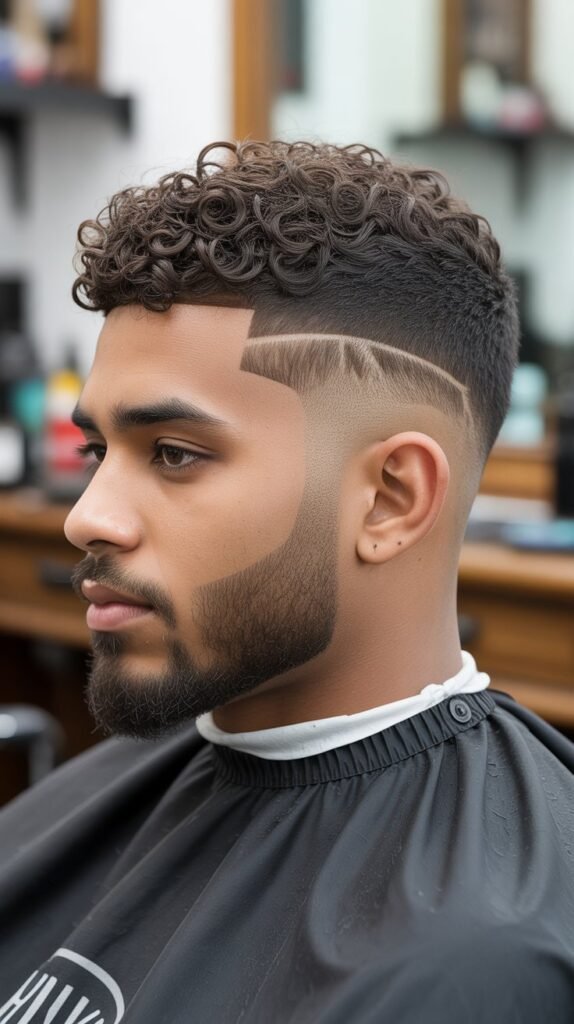
The curly burst fade radiates in a semi-circular pattern around the ears, creating a burst or sunburst effect that frames the face.
This distinctive fade style works exceptionally well with various top styles and curl patterns.
Burst Pattern Characteristics:
- The fade follows a circular or semi-circular arc around each ear
- Hair behind the ears can be left longer or faded as well
- The burst typically connects to a tapered or faded neckline
- Can be executed as a low, mid, or high burst based on where the arc begins
- The fade radiates outward from behind the ear in all directions
Versatile Top Styling:
- Works with mohawk-style center sections
- Complements curly faux hawks perfectly
- Pairs well with curly pompadours
- Suitable for natural, loose curl styling on top
- The burst adds interest regardless of top section style
Maintenance Requirements:
- Requires barber maintenance every 1-2 weeks for optimal appearance
- The circular fade pattern grows out less gracefully than straight fades
- Edge work around the ears is crucial for definition
- Home maintenance between visits is challenging due to complexity
Face Framing:
- The burst pattern emphasizes and frames the face
- Creates visual width which benefits narrow or long face shapes
- Draws attention to the jawline and facial structure
- Works well with facial hair that can connect to the fade pattern
27. Curly Shag
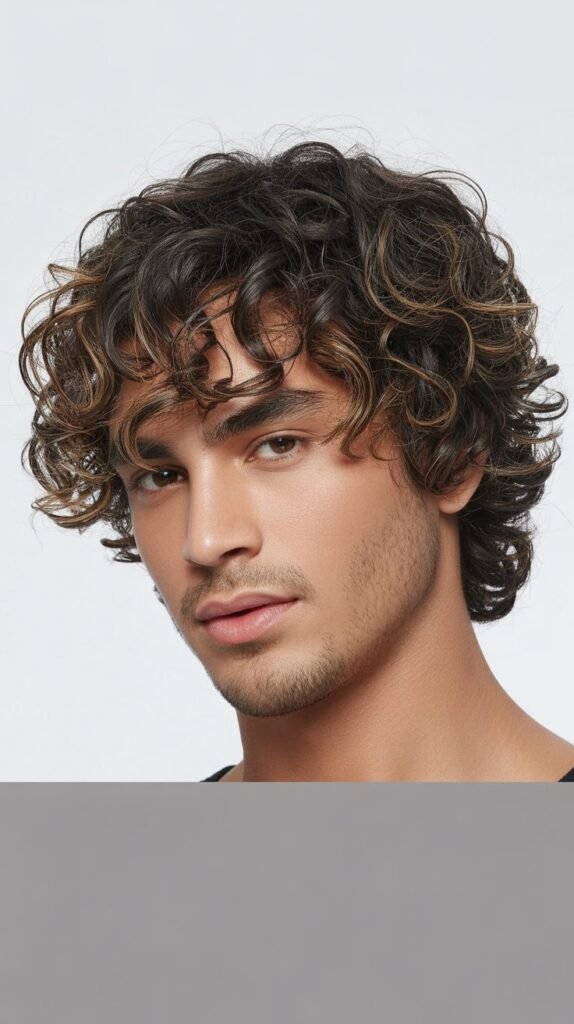
The curly shag is a heavily layered, deliberately messy style that embraces a carefree, rock-and-roll aesthetic.
This vintage-inspired cut has been modernized for contemporary tastes while maintaining its rebellious spirit.
Layering Structure:
- Multiple short to medium layers throughout create movement and texture
- Shortest layers at the crown add volume and lift
- Longer layers around the perimeter provide weight and shape
- Face-framing layers soften the appearance and add dimension
- The overall length typically ranges from 3-6 inches with significant variation
Texture and Movement:
- The heavy layering allows curls to move independently
- Creates a tousled, lived-in appearance even when freshly styled
- Prevents the solid, heavy look of one-length curly hair
- Each curl section has freedom to form and move naturally
- The style appears effortlessly cool rather than carefully constructed
Styling Philosophy:
- Minimal product application to maintain the undone aesthetic
- Air-drying is preferred over heat styling
- Light texturizing spray or sea salt spray enhances natural texture
- Scrunch and shake hair rather than combing or brushing
- The goal is deliberate messiness that appears unintentional
- Second and third-day hair often looks better than freshly washed
Ideal Candidates:
- Men with medium to thick curl density
- Those comfortable with a more relaxed, casual appearance
- Creative professionals or casual work environments
- Personality types that embrace individuality and non-conformity
- Works particularly well for wavy to loose curl patterns (2B-3B)
Length Considerations:
- Can be executed at various lengths from chin to shoulder
- Longer versions create more dramatic movement
- Shorter versions (3-4 inches) offer easier maintenance
- The shag grows out gracefully, requiring less frequent trims
- Regular dustings every 8-10 weeks maintain health without losing the style
Historical Context:
- Originated in the 1970s rock scene
- Popularized by musicians and counterculture figures
- Modern interpretations are more refined but retain the essential spirit
- Represents freedom from conventional grooming standards
Choosing the Right Curly Haircut for Your Face Shape
Understanding your face shape is essential for selecting a curly haircut that enhances your natural features and creates balanced proportions.
Oval Face Shape:
- Most versatile face shape that suits nearly all curly haircuts
- Can wear volume on top without elongating the face excessively
- Works well with both short and long styles
- Consider: Curly pompadour, textured fringe, natural afro, messy top with fade
- Avoid: No significant restrictions, though extremely long styles may over-elongate
Round Face Shape:
- Benefits from height on top and shorter sides to create length illusion
- Vertical emphasis helps elongate and slim the appearance
- Avoid excessive width at the sides that emphasizes roundness
- Consider: Curly quiff, pompadour, high-top fade, curly mohawk, faux hawk
- Avoid: Full afro at same length all around, wide curly bowl cuts
Square Face Shape:
- Soften angular jawline with textured, less structured styles
- Curls naturally provide the softness needed
- Can handle volume and width without issue
- Consider: Messy curly top, natural curly shag, textured fringe, long layered curls
- Avoid: Overly geometric cuts that emphasize angular features
Heart Face Shape:
- Balance wider forehead with volume at sides or length
- Curls at or below ear level create desired width at chin area
- Forward-facing styles can minimize forehead width
- Consider: Curly side part, textured fringe, long curly layered cut, curly man bun
- Avoid: High-top fades or styles that add excessive height without balancing width
Oblong/Rectangle Face Shape:
- Add width and minimize length perception
- Horizontal emphasis through styling and cut choices
- Curls naturally provide helpful width
- Consider: Curly fringe, burst fade, natural afro, curly bowl cut, side-swept styles
- Avoid: Pompadours, quiffs, or styles that add significant height
Diamond Face Shape:
- Narrow forehead and chin with wider cheekbones
- Balance proportions with fullness at forehead or chin level
- Consider: Textured fringe, curly side part, messy top with fade, curly shag
- Avoid: Styles that expose temples and emphasize narrow forehead
Essential Products for Curly Hair Maintenance
Understanding which products work best for curly hair ensures your haircut looks its best between barber visits and maintains health.
Cleansing Products:
- Sulfate-free shampoos prevent stripping natural oils that curls need
- Co-washing (conditioner-only washing) suitable for very dry or tight curls
- Clarifying shampoo used monthly removes product buildup
- Scalp scrubs promote healthy growth and remove dead skin cells
Conditioning Products:
- Leave-in conditioner provides daily moisture and detangling
- Deep conditioning masks used weekly for intensive moisture treatment
- Protein treatments strengthen curls and reduce breakage when used bi-weekly
- Regular rinse-out conditioner used with each wash for basic moisture
Styling Products:
- Curl-defining creams enhance natural curl pattern without crunchiness
- Gels provide hold and definition, especially for styles requiring structure
- Mousses offer lightweight volume and flexible hold
- Pomades work for slicked styles and structured looks requiring shine
- Matte pastes and clays create texture without shine for modern styles
- Sea salt sprays enhance natural texture and create beachy waves
Maintenance Tools:
- Wide-tooth comb for detangling when wet without breaking curls
- Denman brush for defining curl clumps and distributing product
- Afro pick for creating volume and lifting curls
- Diffuser attachment for blow dryer to dry curls without disrupting pattern
- Silk or satin pillowcase reduces friction during sleep
- Microfiber towel or t-shirt for drying without creating frizz
Common Curly Hair Challenges and Solutions
Challenge: Frizz and Flyaways
- Cause: Lack of moisture, humidity, friction from cotton fabrics
- Solution: Use leave-in conditioner daily, sleep on silk/satin, avoid touching hair throughout day
- Product recommendation: Anti-frizz serums with natural oils applied to damp hair
Challenge: Undefined Curl Pattern
- Cause: Buildup from products, lack of moisture, need for haircut
- Solution: Clarify hair, apply products to soaking wet hair, refresh cut with layering
- Technique: Squish to condish method, praying hands application, scrunch while drying
Challenge: Shrinkage
- Cause: Natural curl elasticity—tighter curls appear much shorter when dry
- Solution: Embrace it as part of curl beauty, or stretch curls with tension methods
- Options: Blow-drying with tension, banding method, threading, twist-outs
Challenge: Uneven Curl Pattern
- Cause: Different curl types in different areas, damage, or growth patterns
- Solution: Cut and style to work with variety rather than against it
- Approach: Strategic layering, varied product application by section
Challenge: Dry, Brittle Curls
- Cause: Insufficient moisture, protein-moisture imbalance, heat damage
- Solution: Deep condition weekly, balance protein and moisture, protect from heat
- Prevention: Limit heat styling, use heat protectant when necessary, regular trims
Challenge: Product Buildup
- Cause: Using too much product, products with heavy ingredients
- Solution: Monthly clarifying wash, lighter product amounts, water-soluble products
- Reset: Apple cider vinegar rinse helps remove stubborn buildup naturally
Styling Tips for Different Curl Types
Type 2 (Wavy Hair – 2A, 2B, 2C):
- Responds well to lightweight products that won’t weigh down waves
- Benefits from mousse for volume and definition
- Can achieve various styles from beachy to structured
- Sea salt spray enhances natural wave pattern
- Air-drying often sufficient for casual looks
- Works well with most of the haircuts featured, especially crops and fringes
Type 3 (Curly Hair – 3A, 3B, 3C):
- Classic curl pattern with defined spirals and loops
- Requires balance of moisture and protein
- Curl creams and gels work exceptionally well
- Benefits from diffusing to speed drying while maintaining definition
- Most versatile curl type for various haircut styles
- Regular deep conditioning prevents dryness
- Can achieve both defined and messy looks effectively
Type 4 (Coily Hair – 4A, 4B, 4C):
- Tighter curl pattern with Z-shaped or no visible curl definition
- Requires maximum moisture and gentle handling
- Heavy creams, butters, and oils work best
- Protective styling at night is essential
- Finger detangling preferred over combs for some textures
- Works beautifully with afros, high-tops, and natural styles
- Shrinkage is significant—embrace it as part of the beauty
- Regular moisturizing throughout the day may be necessary
Professional vs. Home Maintenance
What Requires Professional Attention:
- All fade variations—these require professional precision and blending
- Initial haircut establishment—setting the foundation for your style
- Major length changes or style transitions
- Fixing uneven growth or correcting mistakes
- Creating sharp lines, edge-ups, and detailed work
- Structural cuts like disconnected undercuts or geometric shapes
What You Can Maintain at Home:
- Daily styling and product application
- Refreshing curls between washes
- Light trimming of split ends with proper technique
- Moisturizing and deep conditioning treatments
- General curl health and maintenance routines
- Adjusting part placement and curl direction
Home Trimming Precautions:
- Only trim when curls are completely dry to see true length
- Cut less than you think necessary—you can always cut more
- Use professional hair scissors, not household scissors
- Work in small sections for control
- Follow your existing cut shape rather than creating new lines
- When in doubt, wait for professional help
Conclusion
The journey through these 27 Stylish Curly Haircuts for Men reveals that curly hair is far from the grooming challenge it was once perceived to be.
Each style showcased demonstrates that embracing natural texture creates distinctive, memorable looks that straight hair simply cannot replicate.
From the polished professionalism of the curly Ivy League to the bold statement of the high-top fade, from the casual ease of the messy curly top to the dramatic flair of the curly pompadour, there exists a perfect curly haircut for every man regardless of lifestyle, profession, or personal aesthetic.
The key to success lies in understanding your specific curl pattern, face shape, and maintenance commitment level, then working with a skilled barber who appreciates the unique properties of textured hair.
Modern grooming has evolved to celebrate rather than suppress natural curl, offering products, techniques, and cutting methods specifically designed to enhance your texture.
Whether you choose a low-maintenance buzz cut or commit to the styling requirements of a curly man bun, your curls are an asset that sets you apart.
Armed with the knowledge from this guide to 27 Stylish Curly Haircuts for Men, you can confidently step into the barber’s chair knowing exactly which style will help you look and feel your absolute best while celebrating the natural texture you were born with.