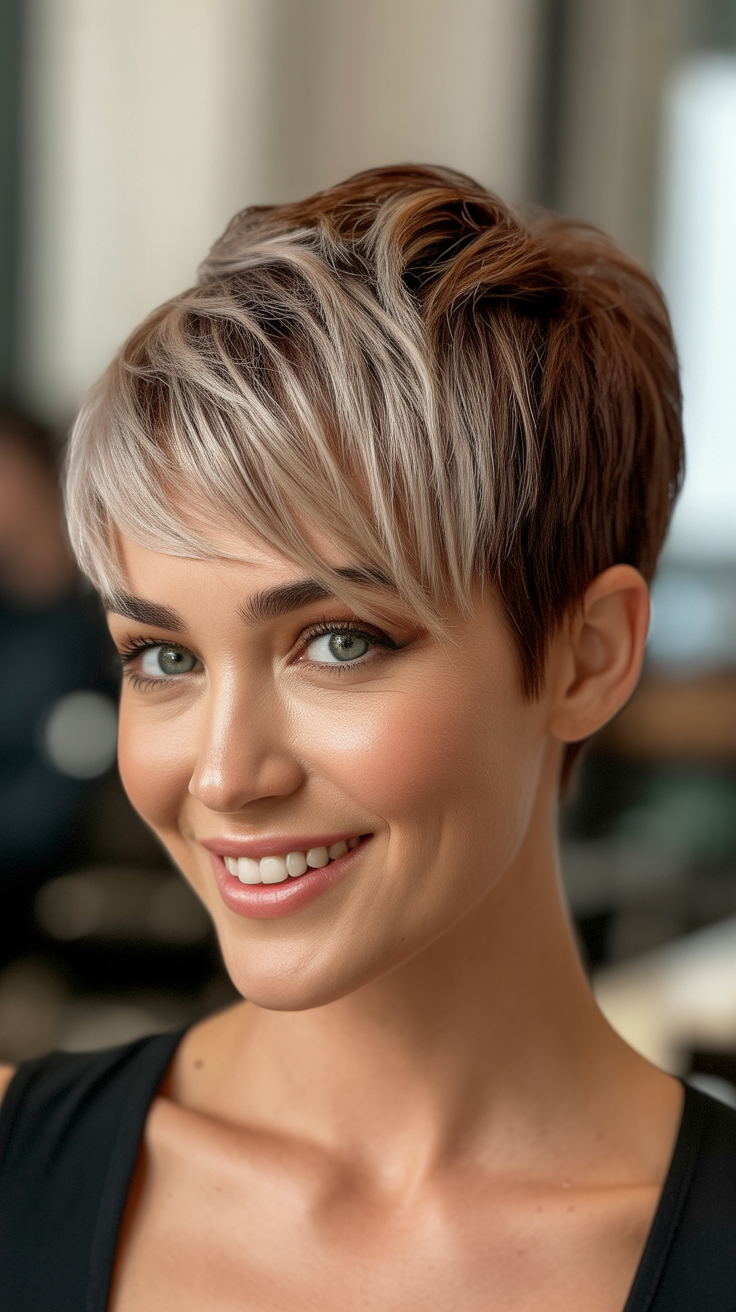
The pixie haircut has evolved from a simple short style into a powerful statement of confidence, individuality, and modern sophistication.
30 Edgy Short Pixie Haircuts for a Modern Look explores the transformation of this timeless cut into bold, contemporary variations that challenge conventional beauty standards while celebrating personal expression.
Whether you’re contemplating your first dramatic chop or seeking fresh inspiration to revitalize your current pixie, this comprehensive guide unveils thirty distinctive styles that range from subtly textured crops to dramatically asymmetrical designs.
Each haircut showcases how strategic layering, creative coloring, and thoughtful styling can transform a basic pixie into an artistic masterpiece that complements your facial features, lifestyle, and personality.
This article walks you through classic interpretations reimagined for today’s fashion-forward individual, provides practical maintenance tips, and offers styling techniques that ensure your pixie looks salon-fresh every day.
You’ll discover how different pixie variations flatter various face shapes, hair textures, and personal aesthetics, empowering you to make an informed decision about which edgy short cut aligns with your vision of modern beauty.
1. The Classic Pixie with a Twist
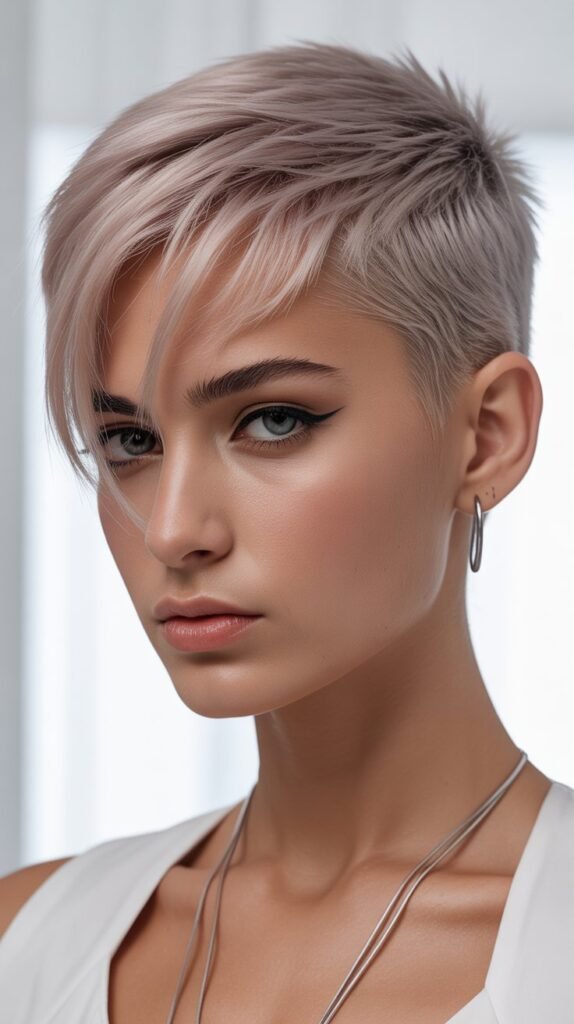
The traditional pixie haircut receives a contemporary upgrade through subtle modifications that maintain its timeless appeal while introducing modern edge.
This foundational style serves as the perfect starting point for those transitioning to short hair or seeking a versatile, low-maintenance option that never goes out of fashion.
Key characteristics that define this updated classic:
- The cut features slightly longer layers on top (approximately 2-3 inches) that create natural volume and movement without appearing overly structured
- Sides and back are tapered close to the head using clippers or scissors, creating a clean silhouette that emphasizes facial features
- Strategic point-cutting techniques at the crown add texture and prevent the flat, helmet-like appearance of older pixie iterations
- The style works exceptionally well with naturally straight to slightly wavy hair textures, though skilled stylists can adapt it for curlier patterns
- Minimal styling requirements make this cut ideal for busy professionals who need a polished look with five minutes of morning preparation
Modern styling variations:
- Forward-swept bangs create a youthful, playful appearance while balancing longer face shapes
- Side-parted versions offer sophisticated elegance suitable for professional environments
- Textured, piece-y styling with lightweight pomade delivers an effortlessly cool, lived-in aesthetic
- Adding subtle highlights or lowlights around the face creates dimension without dramatic color commitment
2. The Asymmetrical Edgy Pixie
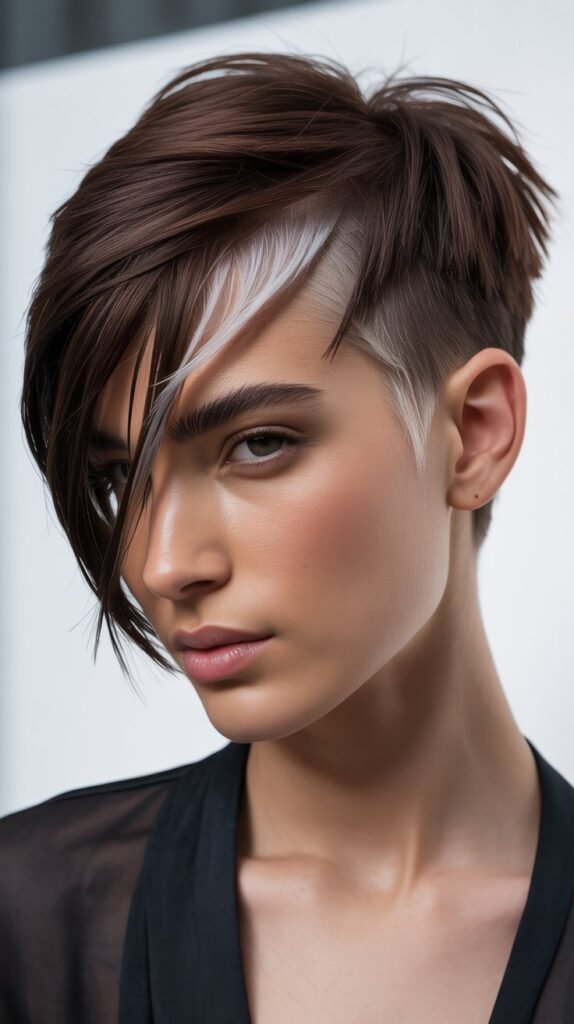
Asymmetry introduces dramatic visual interest and rebellious attitude to the pixie haircut through intentional imbalance that challenges traditional symmetrical beauty standards.
This bold interpretation transforms the pixie from pretty to provocative, making it ideal for creative individuals seeking to make a memorable impression.
Defining asymmetrical elements:
- One side is cut significantly shorter (often clippered to 1/4 inch or less) while the opposite side maintains 3-5 inches of length
- The dramatic length difference creates a striking diagonal line that draws attention to cheekbones and jawline
- Longer sections can be styled forward over the forehead, tucked behind the ear, or swept dramatically to one side
- This cut requires precise technical execution to ensure the transition between lengths appears intentional rather than accidental
- The stark contrast works particularly well for those with strong, angular facial features or who want to create the illusion of asymmetry in round face shapes
Styling and maintenance considerations:
- Daily styling takes 10-15 minutes using styling cream or light wax to emphasize the textured longer side
- Regular trims every 3-4 weeks maintain the sharp contrast between sides as hair grows
- The shorter side requires clipper maintenance to prevent an unkempt appearance as it grows out
- Color blocking techniques (contrasting colors on different sides) amplify the asymmetrical impact
- This style offers built-in versatility—slicking everything back creates a completely different aesthetic for formal occasions
3. The Textured Choppy Pixie
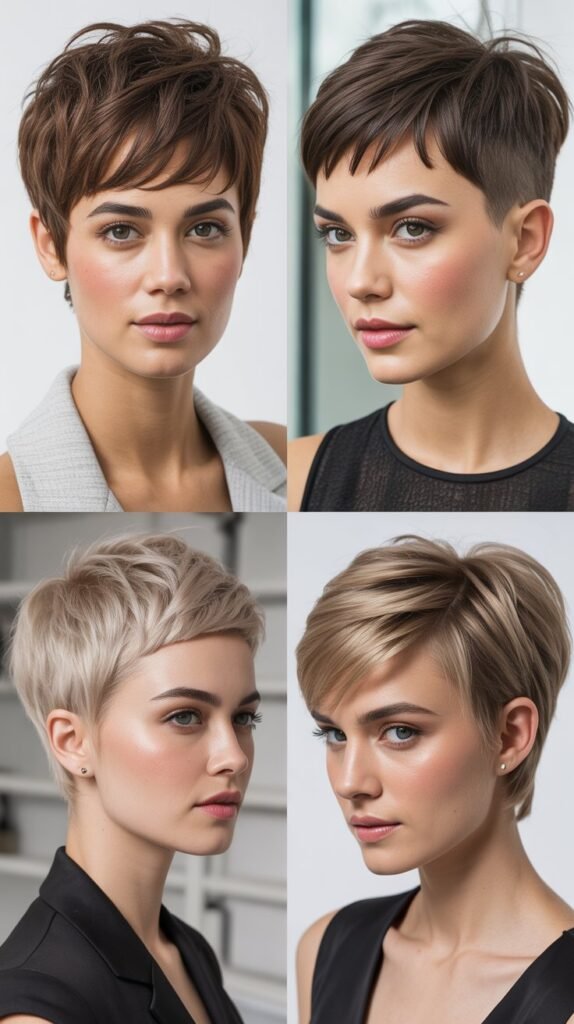
Choppy, heavily textured layers transform the pixie into a deliberately undone style that exudes effortless cool and modern nonchalance.
This variation embraces controlled chaos, with each strand appearing to have its own direction while contributing to an overall cohesive look.
Technical construction details:
- Stylists use razor cutting or aggressive point-cutting techniques to create irregular, jagged ends throughout the cut
- Multiple varied-length layers (ranging from 1/2 inch to 4 inches) are distributed throughout the head without following conventional layering patterns
- The crown area typically features the longest, most heavily textured pieces that can be styled upward or forward
- Shorter layers around the perimeter frame the face while maintaining the disheveled aesthetic
- This technique works exceptionally well with naturally thick or coarse hair that holds texture without excessive product
Achieving the perfect textured finish:
- Styling requires texturizing paste or clay worked through damp hair, then allowed to air-dry for maximum separation
- Using fingers rather than brushes or combs preserves the piece-y, separated appearance
- The style should look intentionally messy rather than neglected—this requires understanding the fine line between styled chaos and actual disorder
- Those with fine hair may need volumizing products at the roots to prevent the cut from appearing limp despite the texture
- Color techniques like babylights or subtle balayage enhance the multidimensional texture by creating depth between layers
4. The Undercut Pixie
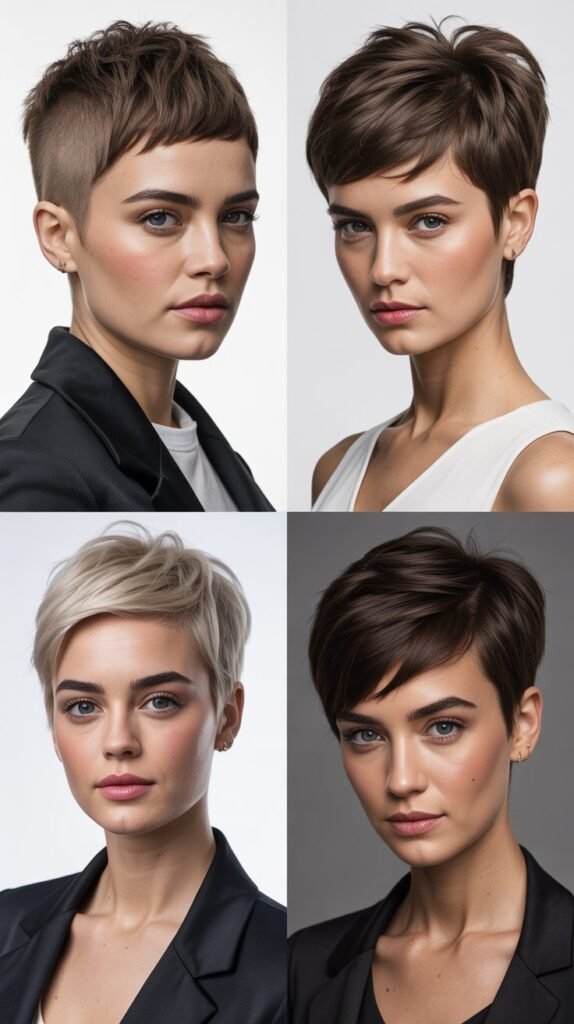
The undercut pixie combines feminine softness on top with masculine-inspired shaved or closely clippered sides and back, creating a striking contrast that pushes boundaries while remaining surprisingly versatile.
This hybrid style has gained significant popularity among fashion-forward individuals seeking maximum impact with minimal hair.
Structural components:
- The undercut section (sides and back) is typically clippered to 1/8 inch to 1/2 inch, creating dramatic contrast with the longer top section
- Top layers range from 3-6 inches, providing sufficient length for multiple styling options
- The transition line between undercut and longer sections can be gradual (faded) or sharply defined depending on desired edginess
- Many opt for designs or patterns shaved into the undercut section for additional personalization
- This cut significantly reduces hair volume, making it ideal for those with extremely thick or heavy hair
Practical benefits and styling flexibility:
- The undercut keeps the neck cool during summer months and reduces drying time by up to 50%
- Longer top sections can be styled forward for a softer look or slicked back to reveal the full undercut drama
- As the undercut grows out, it requires maintenance every 2-3 weeks to preserve the clean contrast
- This style offers the unique advantage of being concealable—the longer top can cover the undercut for conservative situations
- Bold color choices on the longer top section create striking contrast against the natural-colored or subtly toned undercut
5. The Long Pixie (Pixie Bob)
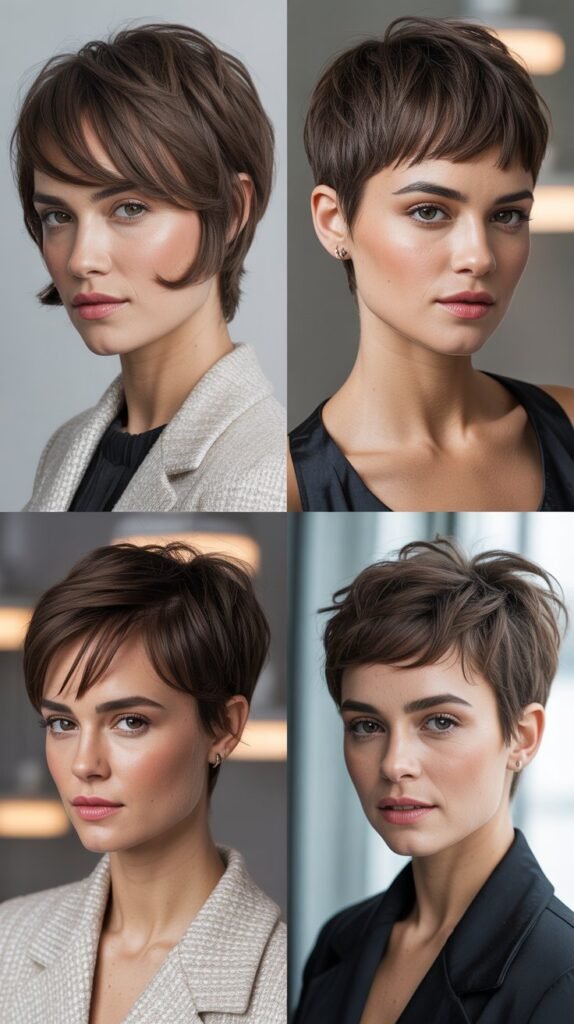
The long pixie, often called a pixie bob, bridges the gap between ultra-short pixies and traditional bob haircuts, offering the best of both worlds for those hesitant to commit to extremely short lengths.
This transitional style maintains pixie attitude while providing more styling versatility through slightly increased length.
Length and structure parameters:
- Hair length ranges from 4-6 inches throughout most of the head, with potential for slightly longer sections in specific areas
- The nape remains shorter (1-2 inches) to maintain the pixie’s signature clean neck exposure
- Layers are strategically distributed to create movement without appearing overly short or overly long
- This length allows for tucking behind ears, creating small ponytails, or using clips and accessories unavailable to shorter pixies
- Face-framing pieces can extend to chin length, providing softness and femininity that balance the short overall length
Ideal candidates and styling range:
- This cut suits individuals transitioning from long to short hair who want a less dramatic initial change
- It accommodates various face shapes more forgivingly than ultra-short pixies, particularly round or square faces
- Styling options include sleek and straight, wavy and textured, or curled under for a retro-inspired look
- The additional length provides more coverage for those with prominent ears or irregular head shapes
- Maintenance requirements fall between short pixies and bobs—typically requiring professional trims every 5-6 weeks
6. The Curly Pixie
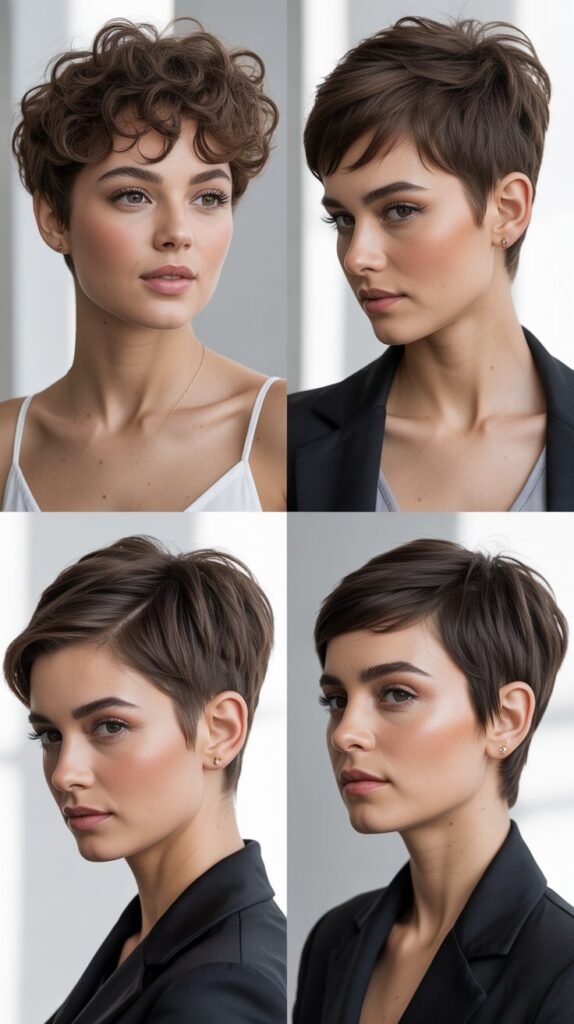
Curly hair in a pixie cut creates natural volume, texture, and personality that straight-haired individuals often attempt to recreate with styling products.
This variation celebrates natural curl patterns while strategically shaping them into a modern, manageable style that enhances rather than fights natural texture.
Cutting considerations for curly textures:
- Dry cutting techniques are essential for curly pixies, as cutting wet curls results in unpredictable length when hair dries and shrinks
- Stylists must understand curl patterns and cut with the natural fall of each curl section rather than against it
- The cut typically removes weight from the interior while maintaining length around the perimeter to prevent a triangular or mushroom-shaped silhouette
- Longer curls on top (3-4 inches when stretched) provide styling flexibility and prevent excessive volume
- Tapered sides keep proportions balanced and prevent the cut from appearing overwhelmingly wide
Styling and care for curly pixies:
- The curly girl method (sulfate-free shampoos, silicone-free conditioners, minimal heat styling) optimizes curl definition and health
- Diffusing hair upside down creates maximum root lift and enhances natural curl formation
- Curl-defining creams or gels applied to soaking wet hair provide hold without crunchiness
- Refreshing second-day curls requires only water in a spray bottle and scrunching to reactivate products
- Regular deep conditioning treatments maintain moisture levels that curly pixies need to avoid frizz and dryness
7. The Platinum Blonde Pixie
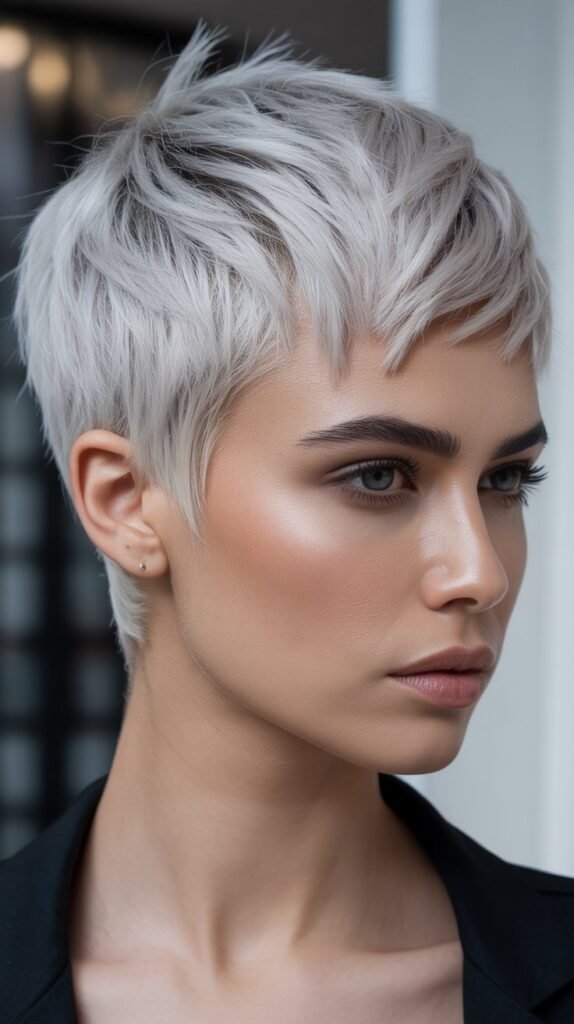
Platinum blonde coloring transforms any pixie haircut into a high-impact statement that commands attention and projects confidence.
This dramatic color choice requires commitment to maintenance but delivers unparalleled visual impact that elevates even the simplest pixie cuts to editorial-level sophistication.
Achieving and maintaining platinum color:
- The journey to platinum typically requires multiple bleaching sessions (especially for naturally dark hair) spaced weeks apart to minimize damage
- Professional colorists use toners (purple or silver-based) to neutralize unwanted yellow or brassy tones
- Hair health must be prioritized throughout the process using bond-building treatments and intensive conditioning masks
- Platinum blonde requires touch-ups every 4-6 weeks as roots become visible against the light color
- Purple shampoo and conditioner used 2-3 times weekly maintain the cool, icy tone between salon visits
Styling platinum pixies for maximum impact:
- The light color creates incredible contrast against darker clothing, making fashion choices appear more intentional and striking
- Platinum works especially well with cool-toned skin undertones (pink or blue-based) and blue or green eyes
- The reflective quality of platinum hair catches light beautifully, creating dimension even in simply cut styles
- Those with warm undertones can opt for warmer platinum shades (champagne or buttery blonde) for more flattering results
- Platinum’s bold nature pairs perfectly with dramatic makeup looks or provides striking contrast when wearing minimal makeup
8. The Shaggy Pixie
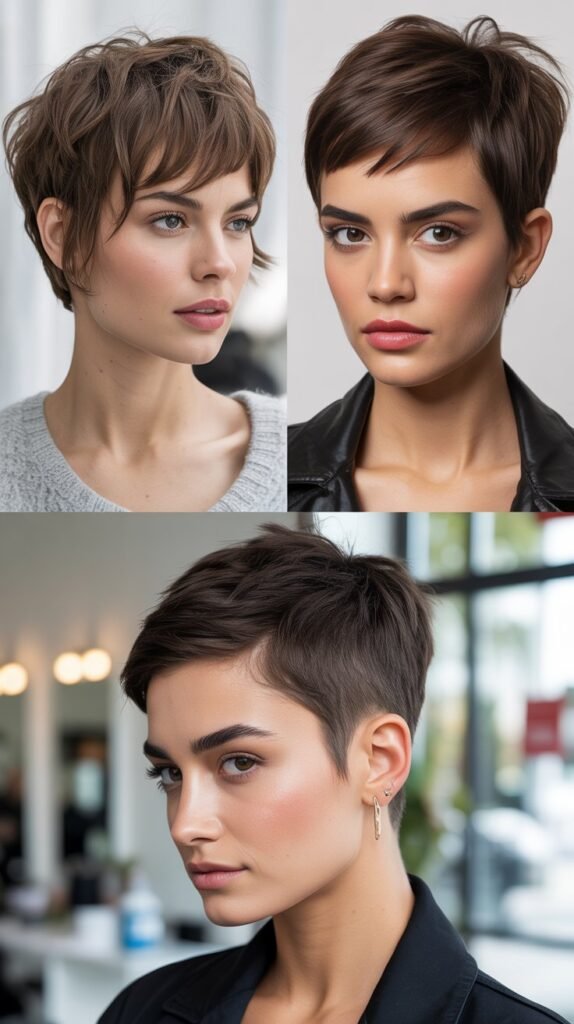
The shaggy pixie resurrects 1970s rock-and-roll attitude through deliberately unkempt layers, feathered ends, and purposeful messiness that reads as effortlessly cool rather than disheveled.
This style rejects precision in favor of organic, lived-in texture that appears to require minimal effort despite thoughtful construction.
Construction techniques for authentic shagginess:
- Stylists employ slide cutting (scissors gliding down hair shafts) to create soft, feathered ends rather than blunt lines
- Layers of varying lengths are irregularly distributed without following traditional layering formulas
- Longer pieces around the face and crown (3-5 inches) contrast with shorter sections at the nape and sides
- The cut intentionally lacks symmetry, with pieces falling at different lengths on either side of the head
- This approach works beautifully with naturally wavy or slightly coarse hair that holds texture without appearing frizzy
Achieving the shaggy aesthetic through styling:
- Rough-drying hair with hands (scrunching and tousling) rather than precise brush work creates the desired undone effect
- Sea salt spray or texturizing spray applied to damp hair enhances natural wave and separation
- The goal is appearing as though you’ve just removed a helmet or run fingers through hair after a convertible ride
- Over-styling defeats the purpose—this cut should look like it requires no effort even though achieving perfect shagginess requires understanding your hair’s natural tendencies
- Second and third-day hair often looks better than freshly washed and styled, making this an ideal cut for low-maintenance lifestyles
9. The Pixie with Bangs
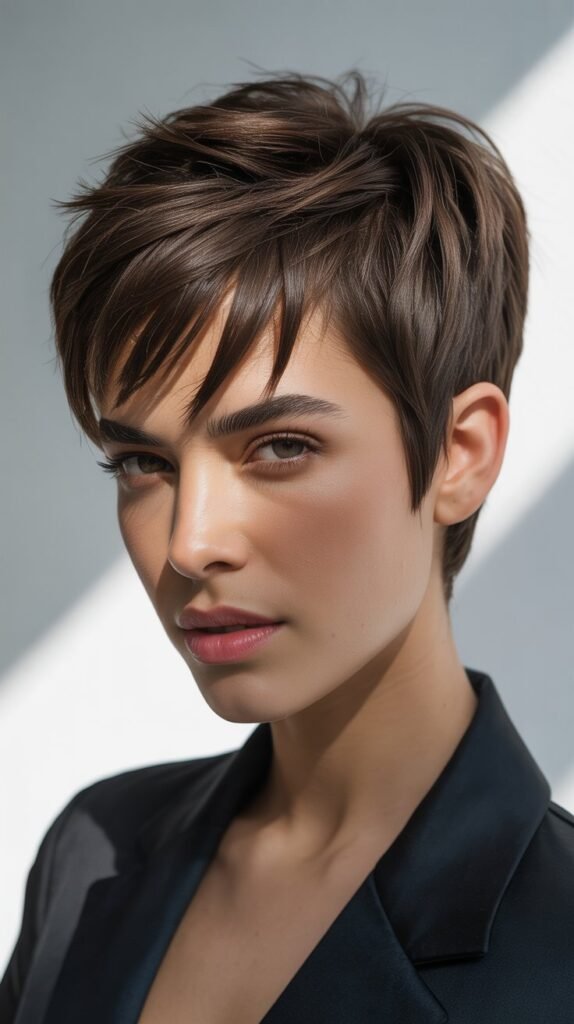
Incorporating bangs into a pixie cut adds facial framing that softens features, draws attention to eyes, and provides styling versatility that basic pixies sometimes lack.
Different bang styles create dramatically different overall aesthetics while maintaining the pixie’s signature short-all-over construction.
Bang variations for pixie cuts:
- Blunt, straight-across bangs create a mod, fashion-forward look reminiscent of 1960s style icons while providing maximum eye emphasis
- Side-swept bangs offer sophistication and versatility, easily styled differently for various occasions
- Choppy, piece-y bangs align with textured pixie styles, maintaining consistency in the deliberately undone aesthetic
- Micro bangs (cut significantly above eyebrows) create editorial edginess perfect for those seeking avant-garde style
- Longer, eyebrow-grazing bangs provide the most wearability and flatter the widest range of face shapes
Practical bang considerations:
- All bang styles require more frequent trims (every 2-3 weeks) than the rest of the pixie to prevent them from obscuring vision
- Those with naturally curly or wavy hair may need to straighten bangs for intended effects, adding daily styling time
- Oily skin types may experience more frequent breakouts along the forehead due to bang contact with skin
- Bangs add dimension and interest to photos, breaking up the face in flattering ways that bare foreheads sometimes lack
- Growing out pixie bangs requires patience and strategic styling with clips, headbands, or products to manage awkward lengths
10. The Mohawk-Inspired Pixie
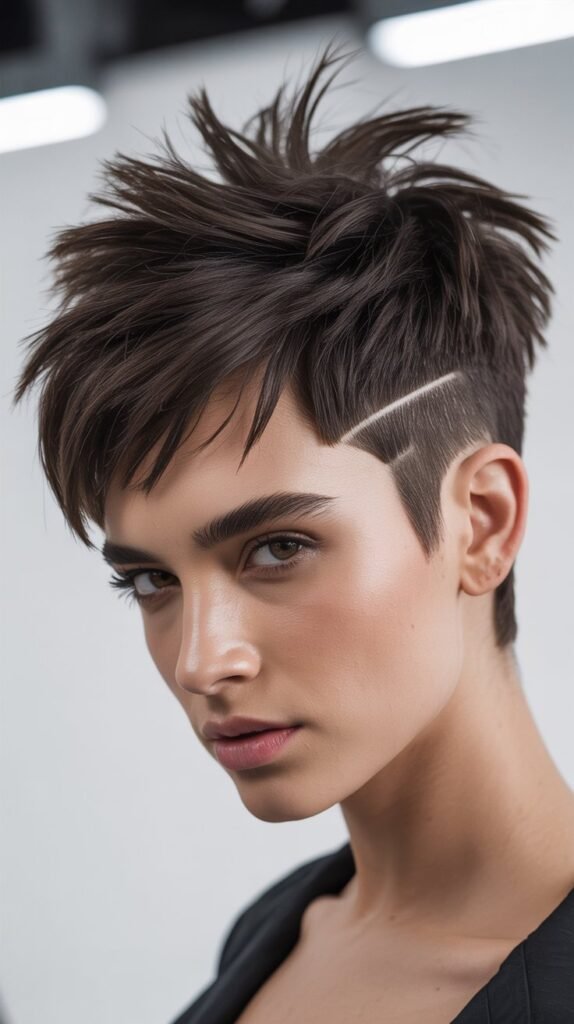
The mohawk pixie channels punk rock rebellion into a wearable everyday style by maintaining significantly longer hair along the crown while keeping sides very short or shaved.
This dramatic interpretation walks the line between professional acceptability and countercultural edge depending on how extremely the contrast is executed.
Structural elements:
- A strip of longer hair (typically 3-6 inches) runs from the forehead to the crown, sometimes extending down the back of the head
- Sides are clippered short (1/4 inch or less) or completely shaved, creating stark contrast with the central mohawk strip
- The width of the longer section varies based on head shape and desired intensity—narrower strips read more punk while wider strips appear more mainstream
- The longer section can be styled upward (traditional mohawk), forward, to the side, or slicked back depending on the occasion
- Gradual fading from shaved sides into the longer center section softens the look for those wanting mohawk inspiration without full commitment
Styling versatility and occasions:
- Professional settings allow for styling the longer section flat or to the side, concealing the dramatic nature of the underlying cut
- Evening or casual situations invite spiking the longer hair upward using strong-hold gel or pomade for maximum impact
- The cut works equally well on fine hair (which naturally stands up more easily) and thick hair (which creates bolder volume when spiked)
- Adding bright or unusual colors to the longer mohawk section amplifies the punk aesthetic
- As this style grows out, it transitions naturally into a textured pixie with undercut rather than creating awkward in-between stages
11. The Tapered Pixie
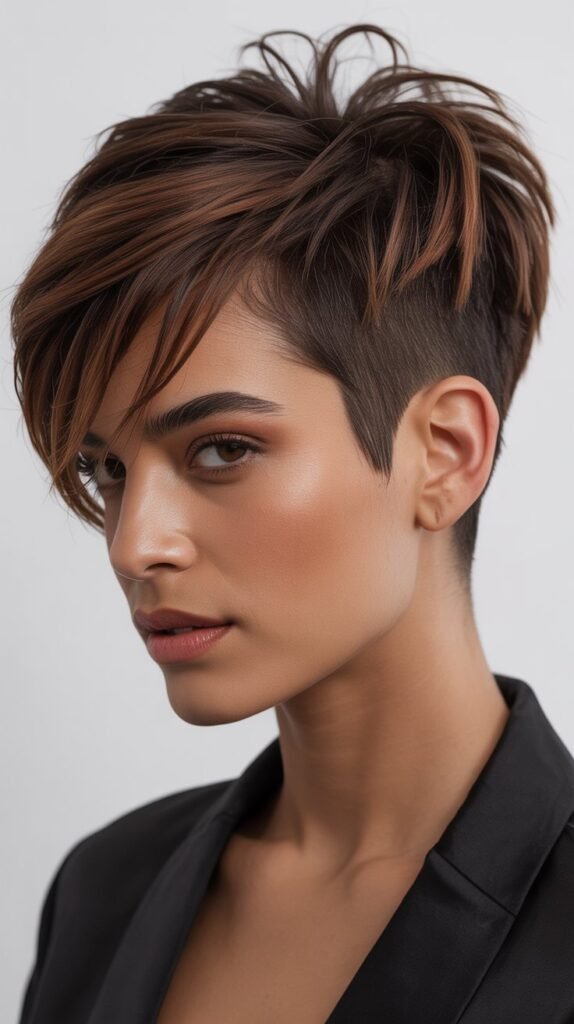
The tapered pixie prioritizes sleek, architectural lines that gradually decrease in length from top to bottom and front to back, creating a refined, polished appearance suited to professional environments.
This precision-cut style emphasizes clean geometry over textured messiness, delivering sophisticated elegance.
Precision cutting requirements:
- The longest point (typically 2-3 inches) sits at the front crown area, with hair systematically decreasing in length toward all perimeter areas
- Sides taper smoothly from longer top sections down to the ear area using scissors or clipper-over-comb techniques
- The back follows similar gradual reduction, creating an elongated, feminine neckline rather than a blunt horizontal line
- This cut requires exceptional technical skill to maintain smooth transitions without visible lines or demarcations between lengths
- Regular maintenance every 3-4 weeks preserves the clean, manicured appearance as growth disrupts the carefully calibrated proportions
Ideal characteristics and styling:
- The tapered pixie particularly flatters oval and heart-shaped faces by emphasizing facial symmetry and bone structure
- This style reads as professional, polished, and intentional—ideal for corporate environments or conservative industries
- Styling requires minimal product—usually just a small amount of smoothing cream or light pomade to enhance sleekness
- The precision-cut nature means even small amounts of growth become noticeable, requiring commitment to regular salon visits
- This cut serves as an excellent foundation for color experimentation, as the clean lines showcase highlights, lowlights, or vibrant colors beautifully
12. The Pixie with Shaved Designs
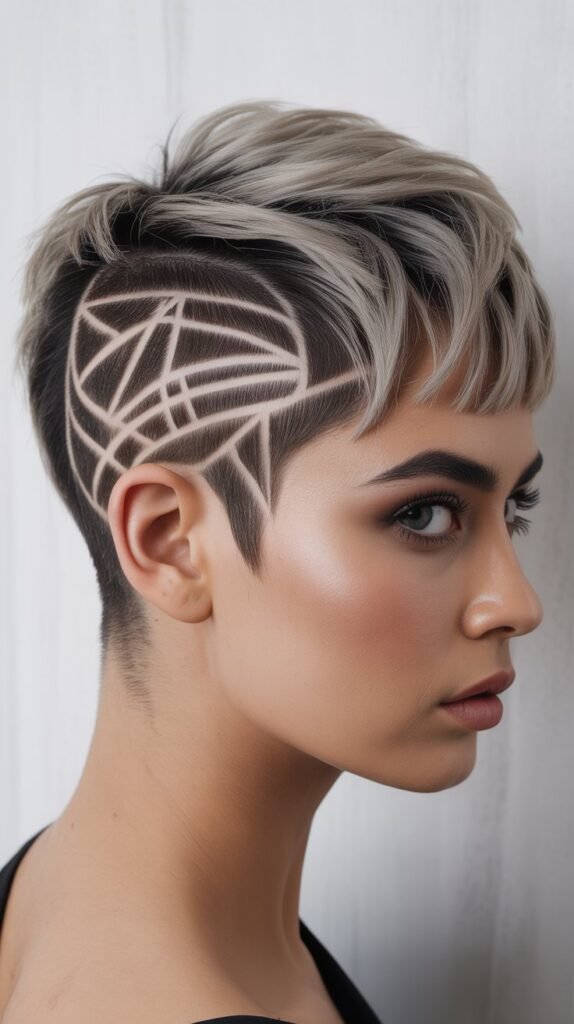
Incorporating shaved patterns, designs, or geometric shapes into pixie cuts elevates them from simple short haircuts to personalized artistic statements.
These intricate designs transform the practical aspects of maintaining short hair into opportunities for creative self-expression that can be modified seasonally or as moods change.
Popular design options:
- Geometric patterns (lines, triangles, chevrons) create modern, architectural interest that complements the pixie’s inherent structure
- Nature-inspired designs (leaves, flowers, stars) add whimsical personality while maintaining sophistication
- Abstract artistic elements or tribal-inspired patterns appeal to those seeking unique, culturally-influenced aesthetics
- Subtle line work appears understated and professional while still providing detail for those who look closely
- Complex, elaborate designs covering larger sections make bold statements ideal for creative industries or personal expression
Practical considerations:
- Designs must be refreshed every 7-14 days as hair growth blurs formerly crisp lines and shapes
- Those with faster-growing hair or darker hair colors will need more frequent touch-ups to maintain design visibility
- Designs work best on the undercut or very short sections of pixie cuts where contrast between shaved and unshaved areas remains visible
- At-home maintenance requires quality clippers with guards and a steady hand, though professional touch-ups ensure best results
- As interest wanes or for conservative situations, growing out designs takes 3-4 weeks until they become invisible
13. The Side-Swept Pixie
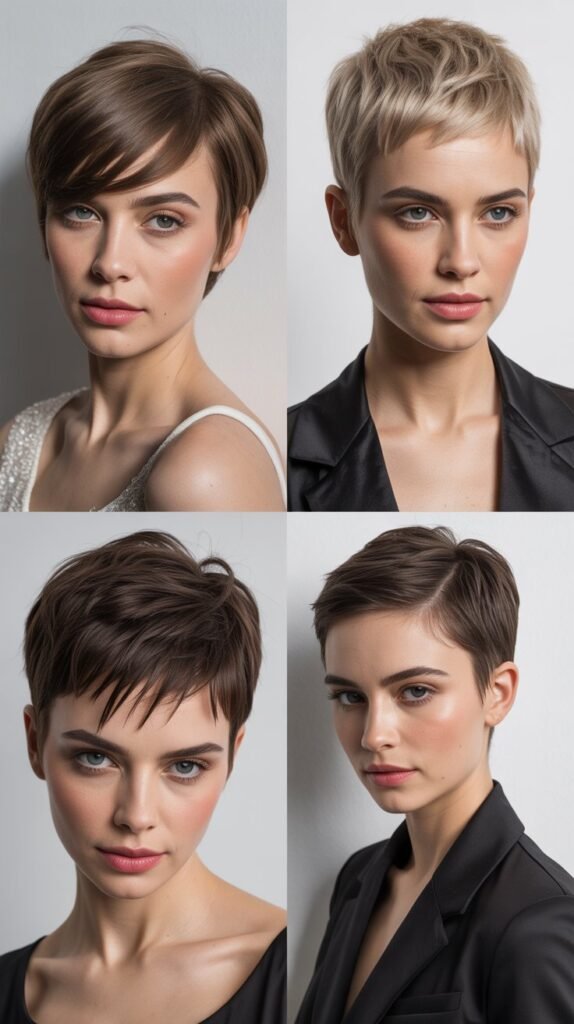
The side-swept pixie creates asymmetrical elegance through dramatic side parting and directional styling that sweeps the majority of hair to one side.
This variation offers glamorous sophistication while maintaining the pixie’s low-maintenance core, making it popular for special occasions and everyday elegance alike.
Creating the side-swept effect:
- Hair is cut longer on top (3-5 inches) to provide sufficient length for dramatic sweeping across the head
- A deep side part (positioned 2-3 inches from the center) creates the foundation for the asymmetrical sweep
- One side remains shorter (1-2 inches) to emphasize the contrast with the longer swept section
- The longer side is styled forward and across, often covering part of the forehead or sweeping over one eye
- The shorter side typically tucks behind the ear or lies flat against the head, creating clean contrast
Styling and securing the sweep:
- Light to medium hold pomade or cream applied to damp hair provides flexible hold without stiffness
- Blow-drying hair in the desired direction while pulling it across with a brush sets the sweep’s foundation
- Bobby pins discreetly positioned under the longer section can secure the style for special events requiring all-day hold
- The swept side can be curled under slightly at the ends for vintage-inspired elegance or left straight for modern sleekness
- This style works particularly well for formal events, providing red-carpet glamour from inherently casual short hair
14. The Pixie Mullet
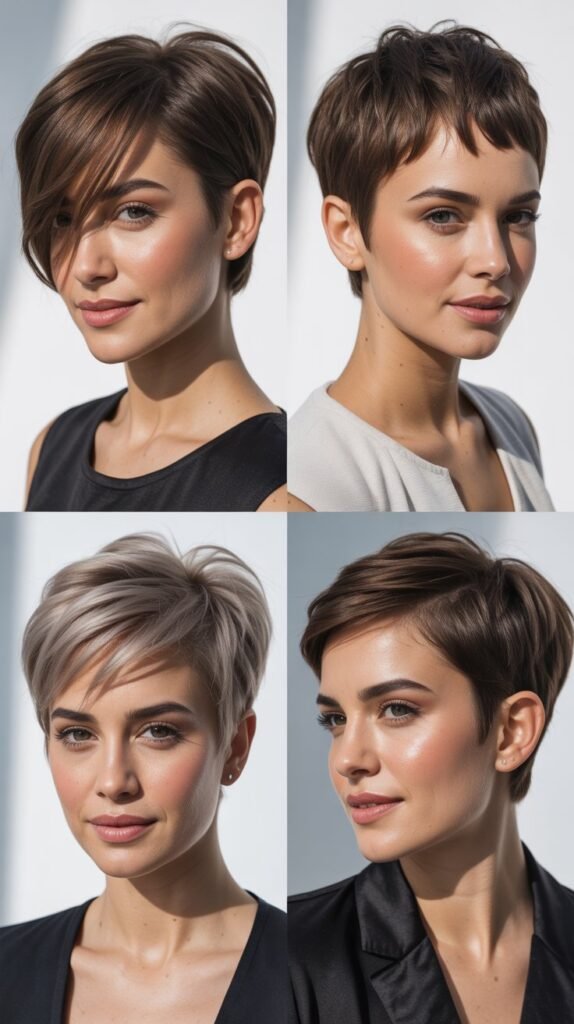
The pixie mullet boldly combines business-in-the-front with party-in-the-back, creating an intentionally contradictory style that challenges conventional beauty norms.
This modern reinterpretation of the historically maligned mullet transforms it into fashion-forward irony that has gained significant traction in contemporary alternative fashion circles.
Structural composition:
- Front and top sections remain short (1-3 inches), maintaining pixie characteristics that keep the face open and features visible
- Hair at the crown gradually increases in length toward the nape, where it extends 3-6 inches beyond the collar
- The sides are typically kept short (clippered or scissor-cut close) to emphasize the dramatic front-to-back length progression
- Modern iterations often incorporate texture, choppy layers, or shaggy elements in the longer back section rather than the sleek, solid mullets of previous decades
- The dramatic contrast works best when executed intentionally and confidently rather than apologetically
Embracing the controversial aesthetic:
- This cut requires exceptional confidence and willingness to field questions, compliments, and criticism about the unconventional choice
- The pixie mullet particularly resonates within LGBTQ+ communities and artistic circles where gender-nonconforming aesthetics are celebrated
- Styling options range from slicking everything back for cohesive flow to emphasizing the textural contrast between sections
- The longer back section can be braided, colored differently from the front, or accessorized with clips and small elastics
- As fashion cycles continue accelerating, the pixie mullet represents participation in current trends while nodding to retro influences
15. The Disheveled Bedhead Pixie
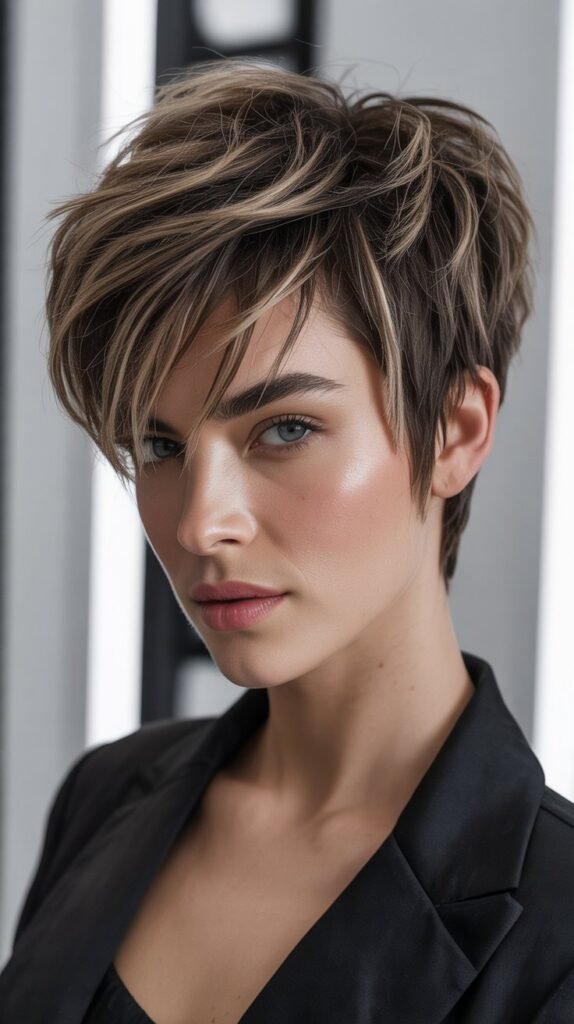
The bedhead pixie celebrates intentional messiness that mimics the appealing tousled texture of recently-awakened hair.
This style rejects perfectionism in favor of effortless, lived-in appeal that paradoxically requires significant styling skill to achieve convincingly while avoiding looking genuinely unkempt.
Achieving authentic bedhead texture:
- The cut incorporates multiple short layers (1-3 inches) throughout the head without following predictable patterns
- Stylists use point-cutting and texturizing techniques extensively to create separation and prevent pieces from lying flat together
- The goal is creating hair that naturally wants to stick up, stick out, and move in different directions simultaneously
- This style works exceptionally well with naturally thick or coarse hair that holds texture without excessive product
- Those with fine or straight hair require more aggressive cutting techniques and stronger styling products to maintain the deliberately disheveled effect
Styling for controlled chaos:
- Products with matte finish (clay, paste, or fiber) preserve the natural, unstyled appearance while providing necessary hold
- Rough-drying hair by scrunching, twisting, and directing it randomly rather than combing creates authentic texture
- Applying product to completely dry hair and working it through with fingers provides maximum separation and piece-y definition
- The style should appear as though you simply woke up with perfect hair—never overly stiff, crunchy, or obviously product-heavy
- Embracing second-day texture often yields better results than freshly washed and styled hair for this particular aesthetic
16. The Bowl-Cut Inspired Pixie
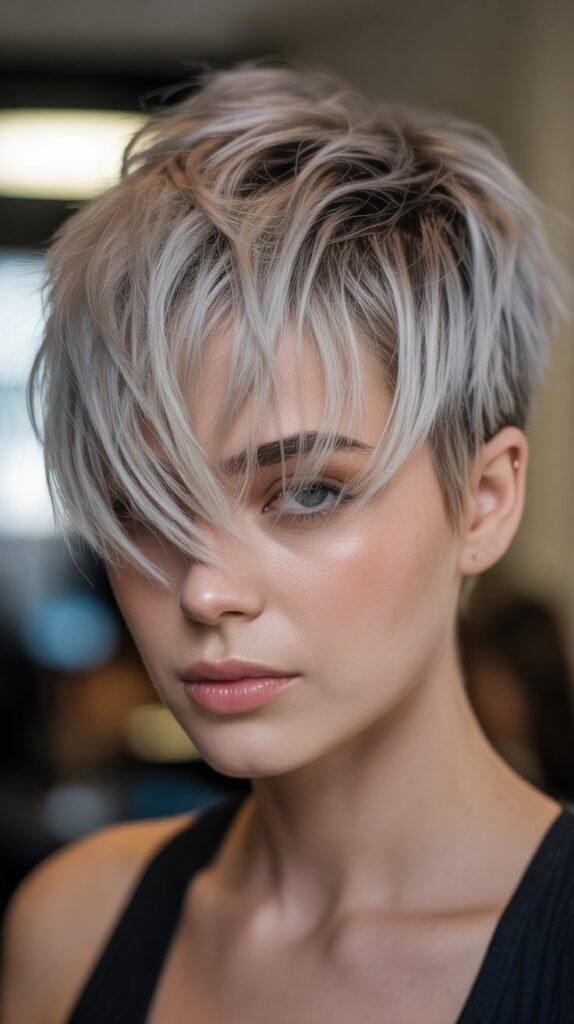
The bowl-cut pixie reimagines the childhood haircut into a fashion-forward statement through precision cutting, perfect proportions, and confident styling.
This geometric interpretation creates a smooth, rounded silhouette that reads as intentionally editorial rather than accidentally juvenile when executed with sophistication.
Precision requirements:
- Hair is cut to uniform length (typically 2-3 inches) around the entire perimeter of the head, creating a smooth, circular outline
- The line around the head should follow the natural curve of the skull, appearing deliberately geometric but not artificially rigid
- Unlike traditional bowl cuts that sit horizontally, modern interpretations may angle slightly downward in the back for contemporary sophistication
- The interior is strategically layered to create volume and movement while the perimeter maintains its distinctive clean line
- This cut requires exceptional technical skill to execute properly—even slight unevenness becomes glaringly obvious in such a geometric style
Making the bowl-cut pixie modern:
- Sleek, straight styling emphasizes the architectural nature and creates maximum visual impact
- Subtle highlights or tonal variation prevent the solid shape from appearing too flat or one-dimensional
- Pairing the precise cut with edgy styling (leather jackets, bold makeup, statement accessories) balances its inherent sweetness
- The bowl-cut pixie particularly suits those with strong, defined features that can hold their own against the bold hairstyle
- Confidence in wearing this polarizing style transforms it from outdated reference into fashion-forward statement
17. The Feathered Pixie
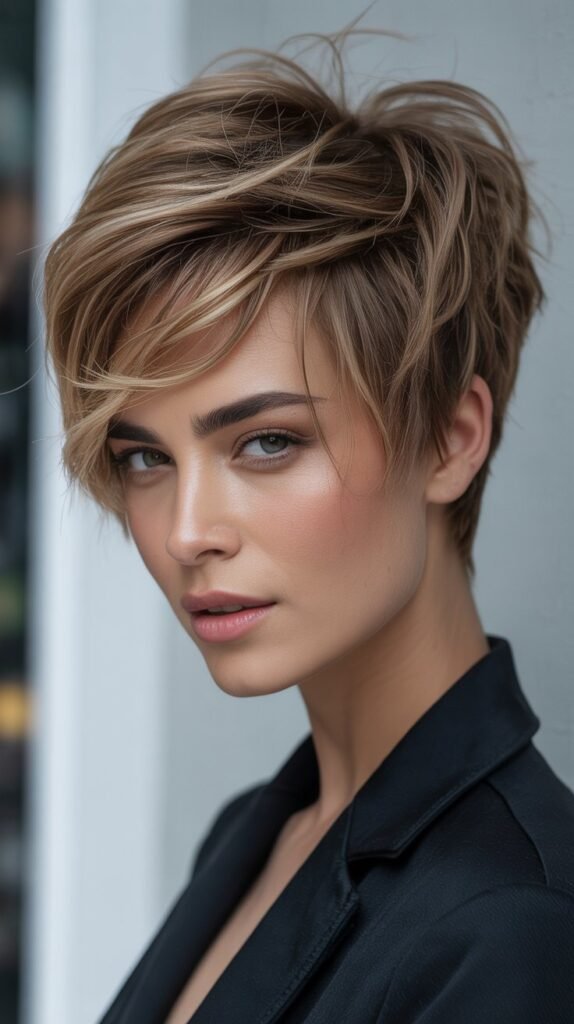
The feathered pixie channels 1970s Farrah Fawcett-inspired glamour into short hair through layered pieces that flip, curve, and frame the face with soft, feminine movement.
This variation prioritizes romantic softness over edgy sharpness, creating an approachable, flattering style that enhances rather than dominates facial features.
Cutting for feathered movement:
- Layers throughout the cut are angle-cut to naturally curve away from the head rather than lying flat against it
- Stylists use thinning shears or razor techniques on the ends to create soft, wispy tips that catch air and movement
- Face-framing pieces are left longer (2-4 inches) and specifically shaped to curve toward or away from the face depending on desired effect
- The perimeter features heavy texturizing to prevent blunt edges that would contradict the soft, feathered aesthetic
- This cut works beautifully with naturally wavy hair that enhances the feathering, though straight hair can achieve similar effects with styling
Styling for maximum feathering:
- Round brush blow-drying while pulling sections away from the head creates the characteristic outward-flipping movement
- Light mousse or volumizing spray applied to damp roots provides lift without weighing down the feathered ends
- The goal is bouncy, touchable softness rather than rigid, over-sprayed hold
- Straight or flat irons can flip ends outward for those with naturally straight hair that won’t hold curl from blow-drying alone
- This style benefits from regular trims every 4-5 weeks to maintain the delicate feathered ends and prevent them from appearing ragged
18. The Pixie with Pop of Color
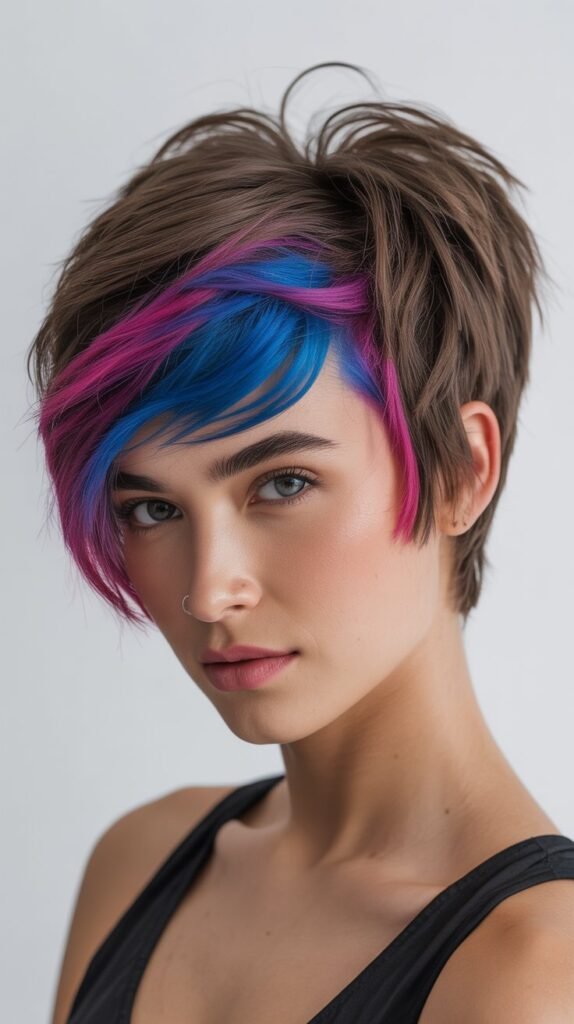
Strategic color placement transforms ordinary pixie cuts into personalized art pieces through vibrant highlights, bold all-over color, or creative placement of unexpected hues.
Color experimentation carries less risk with short hair due to faster growth cycles and less damage potential compared to maintaining color on long locks.
Color placement strategies:
- Peek-a-boo highlights hidden underneath top layers reveal color only with specific styling or movement
- Bold, all-over fashion colors (pink, purple, blue, green) make maximum impact and showcase confidence
- Ombre or gradual color transitions from natural roots to vibrant ends create dimension even in short lengths
- Face-framing highlights in complementary or contrasting colors draw attention to features and add brightness around the complexion
- Multi-tonal color (combining several shades of the same color family) creates depth that prevents flat, one-dimensional appearance
Maintenance and care considerations:
- Fashion colors fade significantly faster than traditional highlights, requiring refresh appointments every 3-4 weeks for maximum vibrancy
- Color-safe, sulfate-free shampoos extend color life between appointments by minimizing fade from washing
- Short hair requires less product and fewer washes overall, helping maintain color vibrancy longer than long hair
- The accelerated growth of pixie cuts means colored hair grows out quickly—roots become visible within 2-3 weeks
- Bleached sections require protein treatments and intensive conditioning to maintain hair health despite short length
Popular color combinations:
- Platinum blonde with pastel pink or lavender tips creates soft, romantic appeal
- Natural brown base with cobalt blue or emerald green panels delivers bold contrast
- Silver or gray color (intentionally achieved, not natural gray) paired with pixie cuts reads as fashion-forward rather than aging
- Rainbow placement (multiple colors throughout the cut) works surprisingly well on pixies where each color claims specific sections
19. The Pompadour Pixie
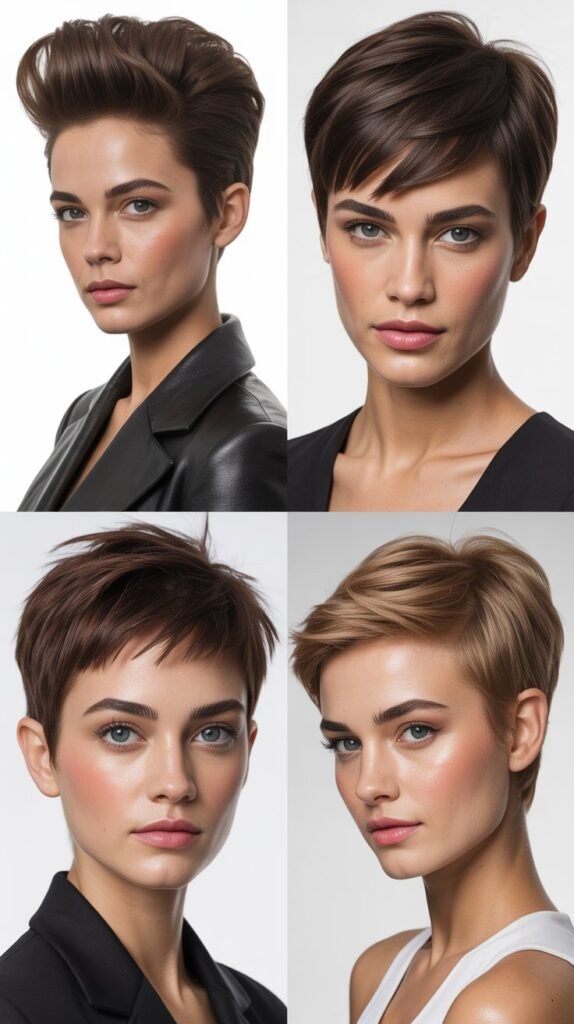
The pompadour pixie combines vintage 1950s masculine styling with contemporary short cuts, creating dramatic height and volume at the front that gradually tapers toward the back.
This sophisticated variation elevates literal and figurative height, adding drama and elegance to the practical pixie foundation.
Creating pompadour structure:
- Front sections must be significantly longer (4-6 inches) than surrounding areas to achieve characteristic pompadour volume
- Hair is styled upward and slightly backward from the forehead, creating height that can range from subtle to exaggerated
- Sides are kept short (1-2 inches or clippered) to emphasize the height contrast at the front
- The back tapers down smoothly, maintaining pixie characteristics while supporting the dramatic front elevation
- Strong hold products are essential to maintain the pompadour throughout the day without drooping or collapsing
Styling the pompadour effect:
- Blow-drying front sections upward while using a round brush creates initial volume and backward curve
- Strong hold pomade, gel, or spray applied to damp hair provides necessary structure for all-day hold
- Some prefer to slightly tease or backcomb the pompadour section for additional height before smoothing the surface
- The style can range from sleek and shiny (using gel) to matte and textured (using clay or fiber) depending on personal preference
- The pompadour reads as sophisticated and intentional rather than dated when paired with contemporary clothing and makeup
20. The Wavy Pixie
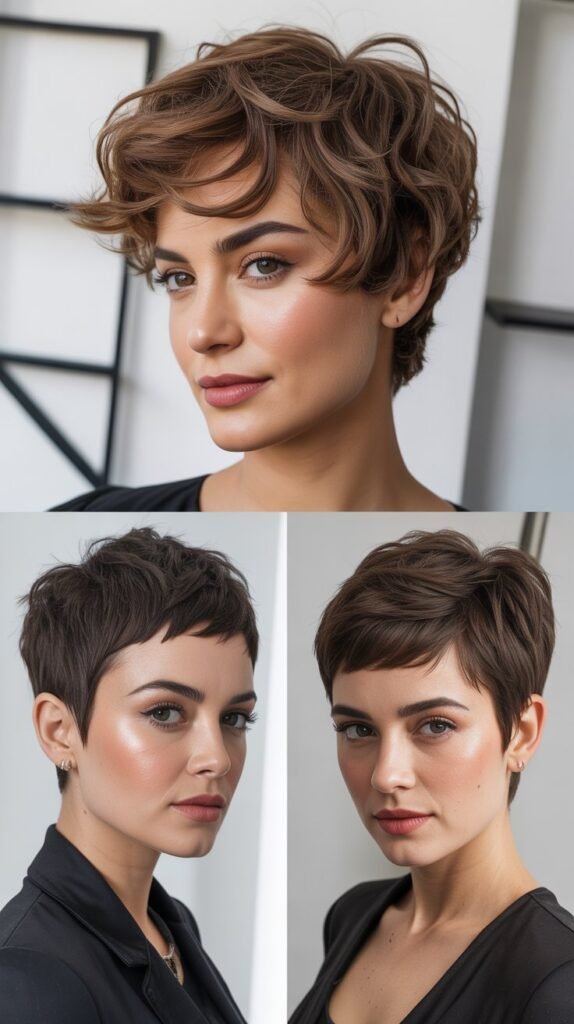
Natural or styled waves in pixie cuts create romantic softness, dimensional movement, and interesting texture that straight pixies sometimes lack.
This variation proves that short hair can maintain feminine, flowing qualities typically associated with longer styles while retaining the practical benefits of pixie length.
Optimizing cuts for wavy texture:
- Layers are distributed to enhance natural wave patterns rather than fighting against them with heavy cutting
- The cut should prevent triangular or pyramid shapes that wavy short hair naturally creates when improperly layered
- Longer pieces at the crown and front (3-5 inches) provide sufficient length for waves to form visible S-patterns
- Strategic thinning at the perimeter prevents wavy ends from appearing too bulky or heavy
- Stylists must account for shrinkage as wavy hair dries shorter than it appears when wet
Enhancing and defining waves:
- Curl-enhancing creams or mousses applied to damp hair encourage wave formation without creating crunch or stiffness
- Scrunching hair while air-drying or diffusing activates natural wave patterns and prevents frizz
- Some individuals with naturally straight hair can create waves using small-barrel curling irons or flat irons with twisting techniques
- The goal is soft, touchable waves rather than rigid, over-styled curls that appear forced
- Second-day waves often look better than freshly styled hair as the waves relax into natural, lived-in texture
21. The Androgynous Pixie
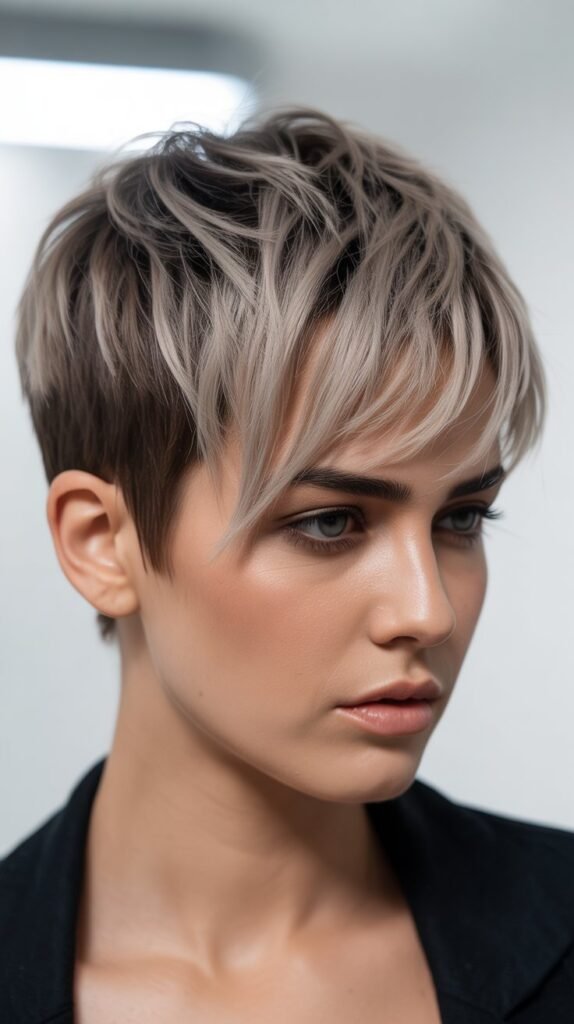
The androgynous pixie intentionally blurs traditional gender lines in hairstyling, creating looks that don’t conform to conventionally masculine or feminine aesthetics.
This variation celebrates gender-neutral beauty through cuts that work equally well regardless of the wearer’s gender identity or expression.
Characteristics of androgynous styling:
- The cut avoids overtly feminine elements like excessive layering, feathering, or overly styled waves
- Similarly, it eschews traditionally masculine elements like severe fades or extremely short military-inspired cuts
- Length typically remains moderate (2-4 inches throughout) without dramatic variations that read as gendered
- The style emphasizes clean, simple lines and natural texture over elaborate styling
- Face-framing elements remain minimal and functional rather than decorative
Cultural significance and styling:
- Androgynous pixies have become particularly popular within LGBTQ+ communities as expressions of gender nonconformity
- The style works across all gender presentations, worn by feminine, masculine, and non-binary individuals alike
- Minimal styling products and natural texture contribute to the unfussy, authentic aesthetic
- The cut serves as a foundation that individuals can dress up or down depending on clothing, makeup, and accessory choices
- Professional environments increasingly accept androgynous styling as workplaces become more inclusive of diverse gender expressions
22. The Slicked-Back Pixie
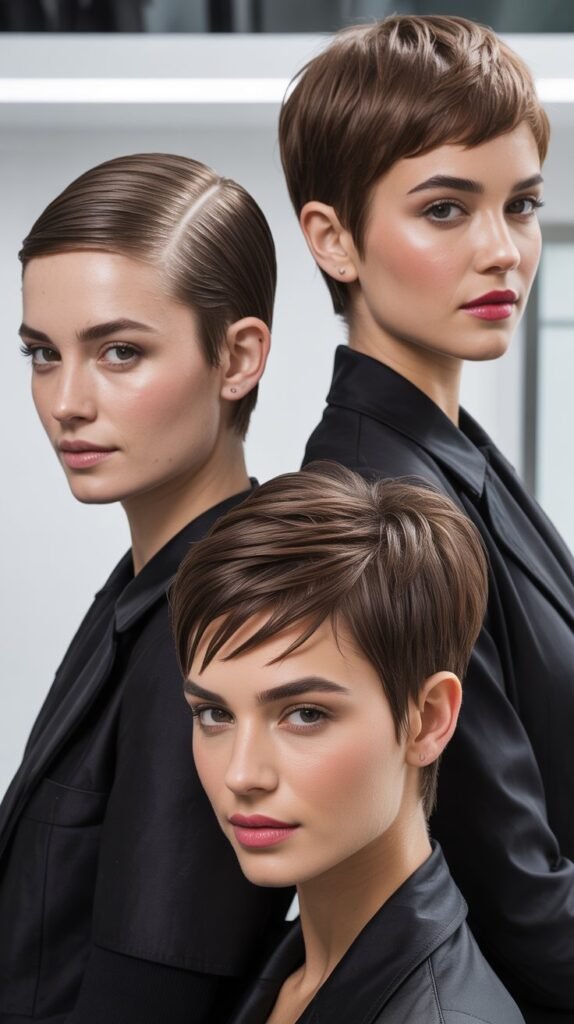
The slicked-back pixie transforms short hair into sleek, sophisticated elegance through wet-look styling that pulls all hair away from the face.
This dramatic styling choice exudes confidence and works beautifully for formal occasions while maintaining an edgy, modern sensibility that prevents it from appearing overly conservative.
Achieving the slicked effect:
- Hair must be at least 2-3 inches long throughout most of the head to create sufficient length for sleek backward styling
- Gel with high shine and strong hold provides both the wet appearance and structure to keep hair in place
- Product should be applied to soaking wet hair and combed straight back from the forehead in smooth, continuous strokes
- Some individuals prefer adding a deep side part before slicking, creating subtle asymmetry within the otherwise uniform slicked appearance
- The nape and sideburns must be trimmed cleanly as the slicked-back style puts these areas on full display
Occasions and variations:
- This styling works exceptionally well for black-tie events, formal dinners, or any occasion requiring polished sophistication
- The slicked-back pixie emphasizes facial features dramatically, particularly bone structure, eyes, and lips
- Those with prominent ears may feel exposed in this style, though it can be modified by leaving small face-framing pieces unstyled
- Adding hair accessories (jeweled clips, decorative combs) transforms the simple slicked style into formal elegance
- The style transitions easily from formal to edgy by changing makeup intensity and clothing choices while maintaining the same hair
23. The Layered Crown Pixie
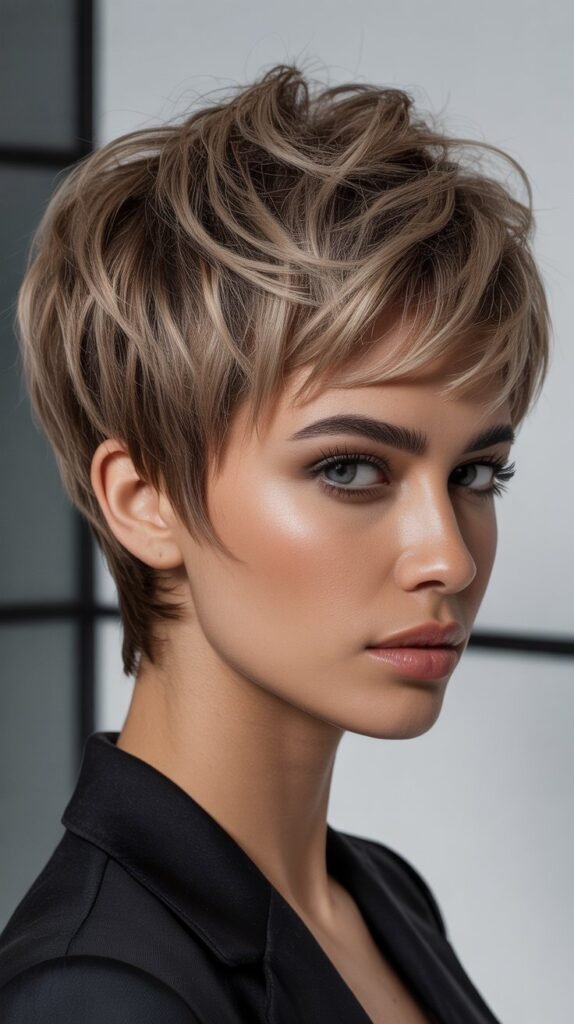
The layered crown pixie concentrates length and volume at the top of the head while keeping sides and back short, creating a dimensional silhouette that adds perceived height and draws attention upward.
This variation flatters round faces by creating vertical lines that elongate facial proportions.
Strategic layering placement:
- The crown area features the longest layers (3-5 inches), cut with significant texturizing for maximum volume potential
- Layers graduate progressively shorter as they move toward the sides and back of the head
- The concentrated top volume creates a subtle mohawk-like effect without the extreme contrast of true mohawk styling
- Face-framing pieces around the hairline may be left slightly longer to soften the overall appearance
- This cut requires hair with enough natural body or thickness to hold volume without lying flat
Styling for maximum crown volume:
- Blow-drying crown sections upward while directing airflow against the growth pattern creates lift at the roots
- Volumizing products (mousse, root-lift spray, or thickening cream) applied at the scalp enhance natural volume
- Teasing or backcombing the crown area before smoothing the surface creates additional height for special occasions
- The style can be worn with volume or styled flat depending on the occasion, offering versatility
- Regular trims every 4-5 weeks maintain the clean perimeter while allowing crown length to develop
24. The Textured Fringe Pixie
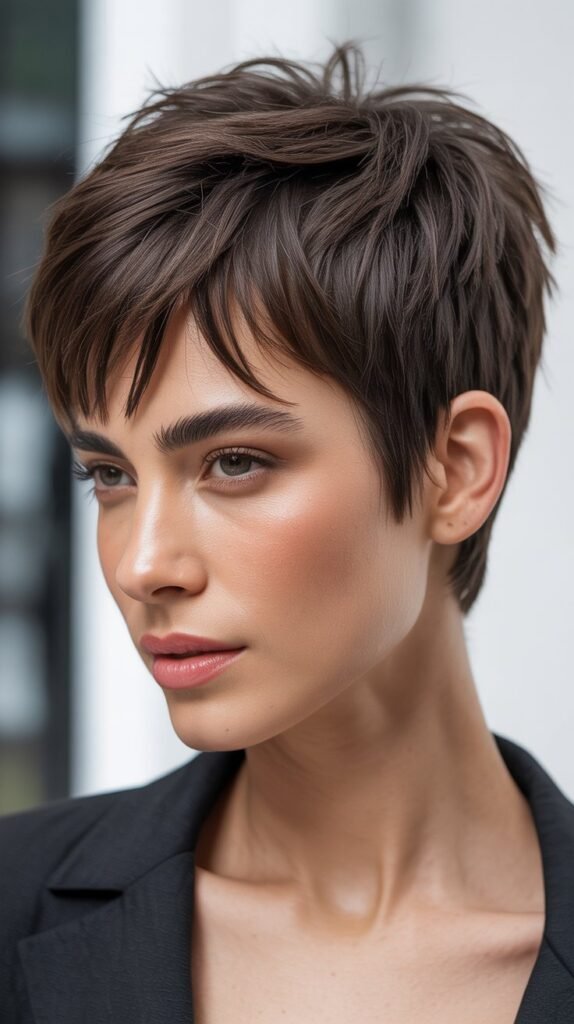
The textured fringe pixie features longer, deliberately messy bangs that create a focal point above the eyes while the rest of the cut remains short and clean.
This variation combines the eye-catching interest of substantial fringe with the practical benefits of short hair elsewhere.
Fringe construction details:
- The fringe section (front 2-3 inches of hairline) is left significantly longer than surrounding areas, typically 3-5 inches
- Heavy texturizing throughout the fringe creates separation and prevents it from forming a solid, heavy curtain
- The fringe can be styled forward over the forehead, swept to one side, or pushed upward depending on mood and occasion
- Surrounding areas are cut short (1-2 inches) to emphasize the fringe as the style’s focal point
- The contrast between substantial fringe and short surrounding hair creates inherent visual interest
Versatile fringe styling:
- Forward-styled fringe partially or fully covers the forehead, creating mystery and drawing attention to eyes
- Side-swept fringe offers romantic softness and works well for professional settings
- Upward-styled fringe (using product to create height) delivers edgy, alternative aesthetics
- The substantial fringe length allows for creative styling with clips, braiding, or twisting that shorter fringes cannot accommodate
- Different styling options transform the overall look dramatically, providing multiple styles from a single cut
25. The Vintage-Inspired Pixie
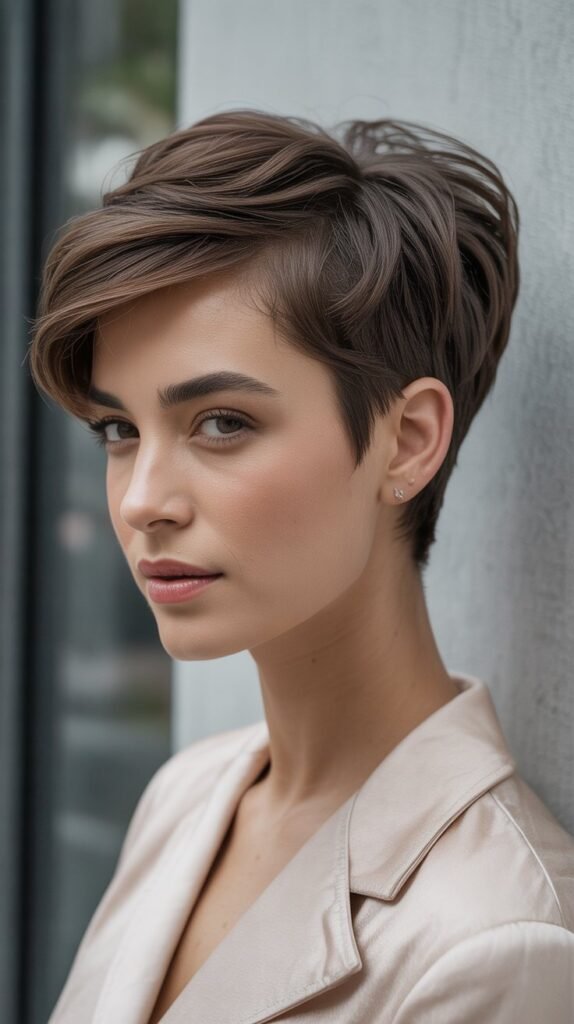
The vintage-inspired pixie draws aesthetic elements from past decades—particularly the 1920s, 1950s, and 1960s—and adapts them for contemporary wearability.
These retro references create nostalgic appeal while remaining firmly planted in modern styling sensibilities through updated techniques and products.
Era-specific characteristics:
- 1920s-inspired pixies feature smooth, close-to-the-head styling with subtle finger waves near the face
- 1950s interpretations incorporate volume at the crown and soft, feminine curving away from the face
- 1960s mod pixies emphasize geometric precision, blunt lines, and architectural structure
- Vintage elements are combined with modern cutting techniques that improve wearability and maintenance
- The styles reference historical periods without becoming costume-like through careful balance of retro and contemporary elements
Modernizing vintage styling:
- Current products provide better hold with less stiffness than historical equivalents, improving comfort and natural movement
- Vintage styles are adapted to suit contemporary face-framing preferences and lifestyle requirements
- Color choices can either enhance the vintage aesthetic (platinum blonde, jet black) or create contrast with modern hues
- Pairing vintage hair with contemporary clothing prevents the overall look from appearing dated or costume-like
- Social media has sparked renewed interest in vintage styling, making these interpretations increasingly relevant and fashionable
26. The Disconnected Pixie
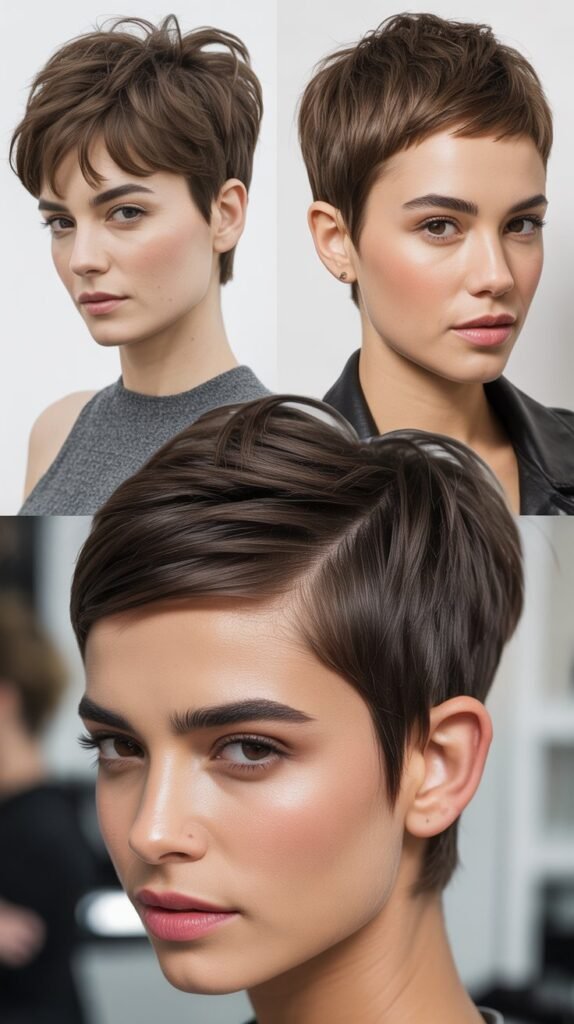
The disconnected pixie features dramatic, intentional separation between different sections—long pieces abruptly transition to short sections without gradual blending.
This avant-garde approach creates striking visual contrast that challenges conventional cutting rules while delivering undeniably modern edge.
Structural disconnection:
- Certain sections (typically top or crown) are left long (4-6 inches) while adjacent areas are cut extremely short (1/2 inch or clippered)
- No gradual transition or fading connects these contrasting lengths—the change is abrupt and obvious
- This intentional violation of traditional blending rules creates the style’s signature shocking contrast
- The disconnect can occur horizontally (long top, short sides) or vertically (long front, short back)
- Executing this cut requires confidence and technical skill as the stylist must resist conventional blending instincts
Styling the disconnection:
- The contrast becomes most apparent when longer sections are styled away from shorter sections (upward, forward, or to the side)
- Product choice affects how dramatically the disconnection reads—high-hold products emphasize contrast while lighter products allow some blending
- This cut works particularly well for those with naturally thick hair that maintains volume in the longer sections
- The avant-garde nature suits creative industries and fashion-forward individuals comfortable with attention-getting style
- Despite the dramatic appearance, maintenance requirements mirror traditional pixies with 3-4 week trim intervals
27. The Natural Texture Pixie
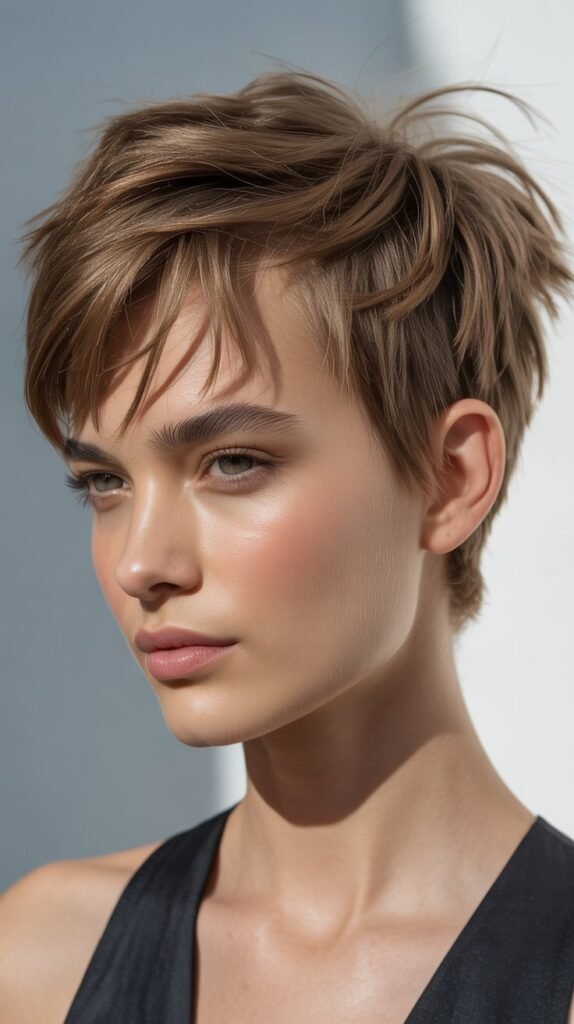
The natural texture pixie celebrates and enhances whatever texture naturally grows from the scalp—whether pin-straight, wavy, curly, or coily—rather than fighting against it with extensive heat styling.
This approach prioritizes hair health, embraces authenticity, and reduces daily styling time while still creating polished, intentional appearance.
Cutting for natural texture:
- Stylists must cut hair dry in its natural state to accurately predict how the finished cut will look daily
- Layer placement enhances natural texture rather than creating styles that require straightening or curling to achieve
- The cut removes bulk and weight that can pull natural texture flat without removing so much hair that texture becomes frizzy
- Natural texture requires less frequent professional cutting since growth integrates seamlessly rather than destroying a precise geometric shape
- This approach works across all hair types from 1A (straight) through 4C (coily), each requiring texture-specific techniques
Embracing natural texture daily:
- Styling routines minimize heat tools, instead using air-drying, diffusing, or finger-coiling techniques that work with texture
- Product choices vary by texture—straight hair needs volume, wavy hair needs definition, curly hair needs moisture, coily hair needs hydration
- The natural texture movement has gained significant traction as people prioritize hair health over damaging styling practices
- Transitioning to natural texture styling may involve an adjustment period as hair recovers from previous heat damage
- The natural texture pixie connects to broader movements toward authenticity, sustainability, and self-acceptance in beauty standards
28. The Pixie with Tapered Nape
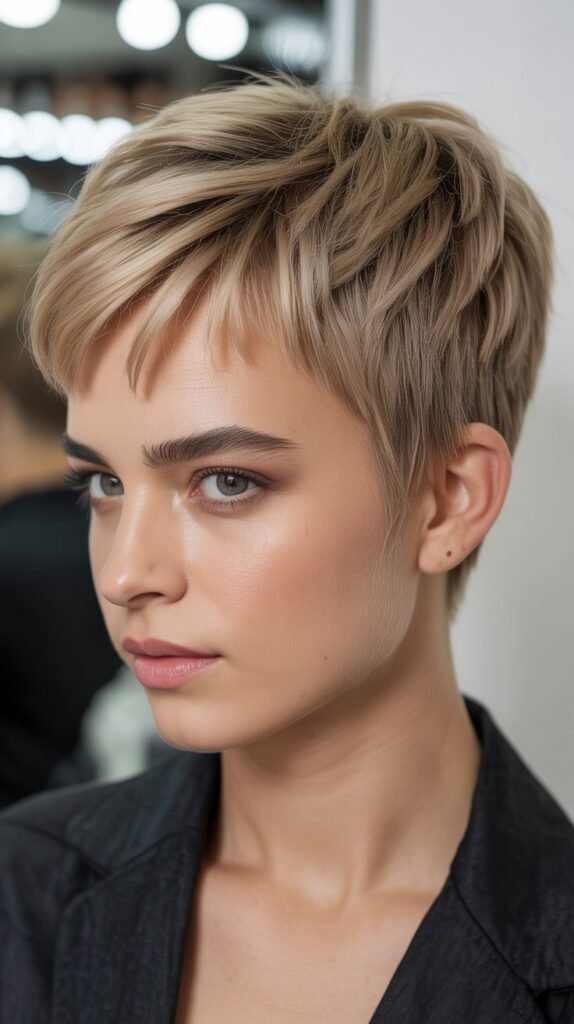
The tapered nape pixie features gradual length reduction at the back of the neck, creating an elegant, feminine neckline that extends the visual length of the neck.
This refined detail elevates standard pixie cuts through deliberate attention to the often-overlooked back view.
Nape tapering techniques:
- Hair gradually decreases from approximately 2 inches at the occipital bone down to skin-tight at the nape’s lowest point
- The taper can follow straight lines, curve inward toward the center, or create soft V-shapes depending on desired effect
- Precise clipper work or scissor-over-comb techniques create smooth transitions without visible lines or steps
- The tapered nape elongates the neck’s appearance, particularly flattering for those with shorter necks or fuller faces
- Regular maintenance every 3-4 weeks prevents the nape from losing its clean definition as hair grows
29. The Pixie with Ear Accents
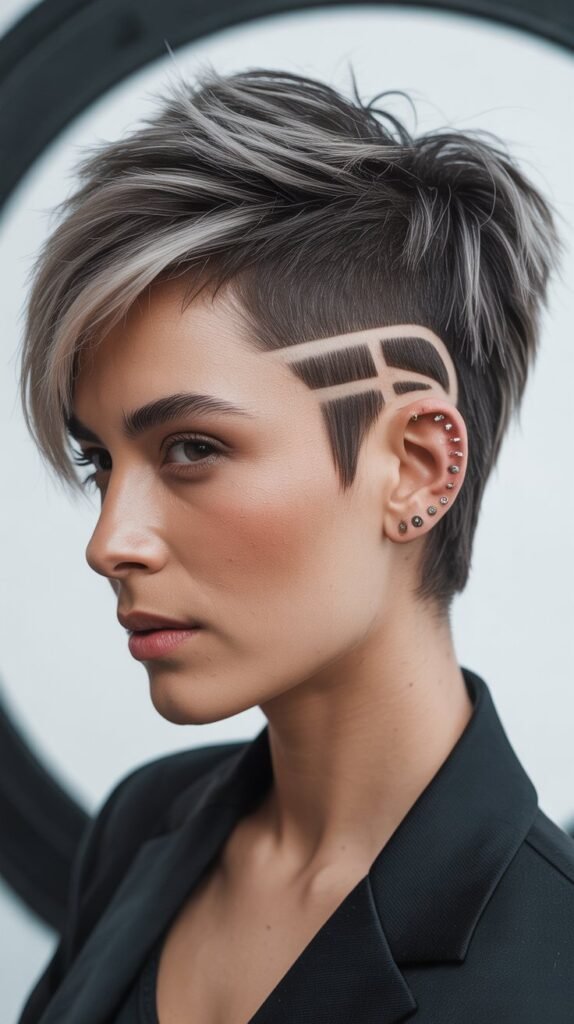
The pixie with ear accents intentionally frames and draws attention to the ears through strategic cutting that treats them as features to showcase rather than hide.
This approach works beautifully for those with interesting earrings, attractive ear shape, or who simply wish to challenge conventions about concealing ears.
Cutting around ears:
- Hair is cut shorter around and behind ears (1/2 to 1 inch), creating negative space that frames ear structure
- The cut can angle toward ears from longer sections above, creating directional lines that point toward them
- Some styles completely expose ears while others leave small face-framing pieces in front of ears while cutting behind them short
- This approach requires consideration of ear size, shape, and position—prominent ears become focal points while proportionate ears gain emphasis
- The ear-exposing cut feels liberating for those accustomed to hiding ears behind longer hair
Accessorizing ear-focused cuts:
- Statement earrings become essential accessories, filling the visual space around newly-prominent ears
- Multiple ear piercings create additional visual interest now that ears are fully visible
- The clean area around ears becomes canvas for showcasing jewelry from subtle studs to dramatic chandelier styles
- Those without pierced ears can use ear cuffs or clip-on accessories to decorate the exposed area
- Hair color choices (especially bold colors or highlights) can complement or contrast with earrings for cohesive styling
30. The Grown-Out Pixie
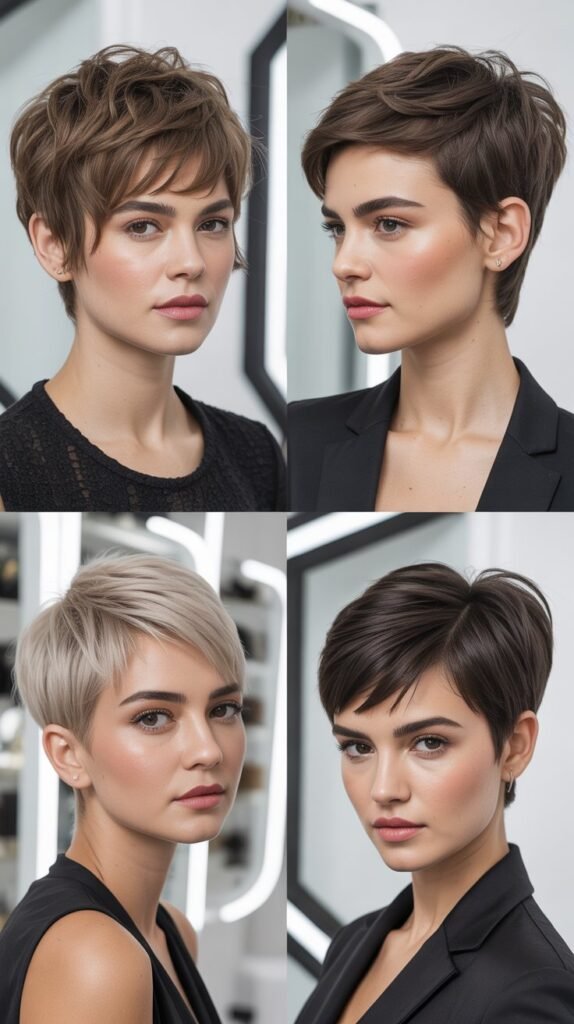
The grown-out pixie exists in the transitional stage between freshly-cut pixie and longer styles, creating its own distinct aesthetic that many choose to maintain intentionally.
This variation embraces the natural growing-out process, transforming what some consider “awkward length” into deliberate style.
Managing growth stages:
- Hair typically reaches 3-6 inches throughout most of the head during the grown-out phase, creating shaggy, relaxed appearance
- The nape and sides grow more quickly than top sections, creating natural layering and dimension without additional cutting
- Strategic trimming of specific sections (like overgrown napes or sideburns) maintains intentional appearance versus genuine neglect
- This length offers increased styling versatility—ponytails, clips, braiding, and accessories become possible
- The grown-out stage can last several months for those transitioning to longer hair or serve as destination style for those who prefer this specific length
Styling grown-out texture:
- The increased length creates natural wave and movement that ultra-short pixies cannot achieve
- Styling products add definition and prevent the style from appearing unkempt despite its deliberately casual nature
- The grown-out pixie suits effortless, bohemian, or casual aesthetics rather than polished or formal presentations
- This phase connects to broader acceptance of imperfection and natural beauty in contemporary culture
- For those growing out pixies, embracing this stage rather than hiding through it improves the experience significantly
Transitioning strategies:
- Regular trims (every 6-8 weeks) of specific sections keep proportions intentional without stopping overall growth
- Accessories (headbands, clips, scarves) manage awkward lengths while adding personal style
- Changing part placement creates different looks from the same growing length
- Color services (highlights, lowlights) add dimension that helps grown-out cuts appear more intentional
Maintenance and Styling Tips for Pixie Haircuts
Maintaining pixie cuts requires different approaches than longer styles, with more frequent professional appointments balanced against significantly reduced daily styling time.
Understanding proper care ensures your pixie remains salon-fresh between cuts while staying healthy despite regular trimming.
Professional maintenance schedule:
- Most pixie cuts require professional trims every 3-5 weeks to maintain shape and prevent overgrown, unkempt appearance
- Those with very short or precision cuts (undercuts, tapered styles, specific geometric shapes) need appointments every 2-3 weeks
- Longer pixies or grown-out styles extend time between cuts to 5-7 weeks depending on desired length
- Regular appointments prevent the “grow-out mullet” effect where nape hair becomes disproportionately long
- Establishing relationship with a skilled stylist who understands your specific pixie ensures consistency across appointments
Daily styling essentials:
- Quality texturizing paste, pomade, or wax provides versatile styling options from sleek to piece-y
- Lightweight products prevent the “helmet head” effect while still providing hold
- Most pixies require only pea-sized amounts of product, making bottles last months
- Styling typically takes 5-10 minutes maximum, significantly less than longer styles
- Air-drying works well for many pixie styles, further reducing morning routine time
Choosing the Right Pixie for Your Face Shape
Face shape plays a crucial role in determining which pixie variation will most flatter your features.
Understanding your facial proportions helps identify styles that create balance and harmony while avoiding cuts that emphasize features you prefer to minimize.
Face shape identification:
- Oval faces have balanced proportions with gently curved jawline and slightly wider cheekbones than forehead
- Round faces have similar width and length with full cheeks and softer angles
- Square faces feature strong jawline, broad forehead, and similar width throughout
- Heart faces show wider forehead, prominent cheekbones, and narrow, pointed chin
- Long/oblong faces have significantly greater length than width with elongated proportions
Pixie recommendations by face shape:
Oval Faces:
- Nearly all pixie styles flatter oval faces due to balanced proportions
- Experiment confidently with asymmetry, extreme lengths, or avant-garde variations
- Both short and longer pixies work equally well
Round Faces:
- Choose pixies with height at the crown to create vertical lines that elongate
- Asymmetrical styles break up roundness and create angular interest
- Avoid styles that add width at cheekbones or hide the jawline entirely
Square Faces:
- Soft, textured pixies with piece-y layers soften strong jawlines
- Side-swept styles and soft fringe balance angular features
- Avoid blunt, geometric cuts that emphasize squareness
Heart Faces:
- Pixies with volume at the nape balance narrow chins
- Side-swept bangs or longer face-framing pieces widen the chin area visually
- Avoid excessive volume at the crown that emphasizes the already-wide forehead
Long Faces:
- Pixies with width and volume at the sides create balance for elongated proportions
- Bangs shorten the forehead and reduce overall face length
- Avoid tall, voluminous styles that add height
Pixie Haircuts for Different Hair Textures
Hair texture significantly impacts how pixie cuts behave, require styling, and ultimately appear.
Understanding texture-specific considerations ensures realistic expectations and appropriate cut selection that works with rather than against natural hair characteristics.
Fine/Thin Hair Considerations:
- Pixie cuts actually benefit fine hair by removing weight that pulls hair flat when long
- Textured, choppy layers create the illusion of fuller, thicker hair through strategic cutting
- Blunt cuts at the perimeter add visual weight and density
- Shorter lengths (1-3 inches) tend to hold volume better than longer pixies on fine hair
- Volumizing products at roots and texturizing products throughout create fuller appearance
Thick/Coarse Hair Advantages:
- Pixies dramatically reduce styling time and product needs for thick-haired individuals
- The cut removes bulk while showcasing texture that long, heavy hair conceals
- Thinning and texturizing techniques prevent pixies from appearing boxy or triangular
- Thick hair holds styles longer and requires less product to maintain shape
- Those with thick hair can wear both sleek and textured pixie variations successfully
Straight Hair Styling:
- Straight pixies showcase clean lines and precise cutting beautifully
- These textures require more frequent trims to maintain shape as growth is immediately visible
- Styling products add necessary texture and prevent flat, lifeless appearance
- Straight hair works perfectly for sleek, slicked, or geometric pixie variations
- Adding waves or curls with heat tools transforms the look for different occasions
Curly/Coily Hair Opportunities:
- Pixie cuts liberate natural curl patterns by removing weight that pulls curls downward
- Curly pixies create natural volume and texture that straight-haired individuals attempt to recreate artificially
- Moisture-rich products and curl-specific cutting techniques optimize natural pattern
- Curls provide built-in texture and interest without additional styling effort
- The shorter length reduces detangling time and product usage significantly
Conclusion
The journey through 30 Edgy Short Pixie Haircuts for a Modern Look reveals the remarkable versatility, artistry, and personal expression possible within this seemingly simple category of short haircuts.
From classic interpretations that honor the pixie’s timeless appeal to avant-garde variations that push boundaries and challenge conventions, these thirty styles demonstrate that pixie cuts offer far more than basic short hair.
Each variation presents unique opportunities for self-expression while delivering the practical benefits that make pixies perennially popular—minimal styling time, reduced product needs, and liberating freedom from hair management burdens.
Whether you’re drawn to the romantic softness of feathered layers, the bold statement of dramatic asymmetry, the sophisticated polish of tapered precision, or the rebellious attitude of undercut designs, there exists a pixie variation perfectly suited to your features, lifestyle, and aesthetic vision.
The modern pixie transcends age, gender, and conventional beauty standards, instead celebrating individuality, confidence, and the courage to make bold choices.
As you consider which of these thirty edgy short pixie haircuts aligns with your personal style, remember that the most important element isn’t the specific cut you choose but the confidence with which you wear it—that transforms any haircut from merely stylish to truly unforgettable.