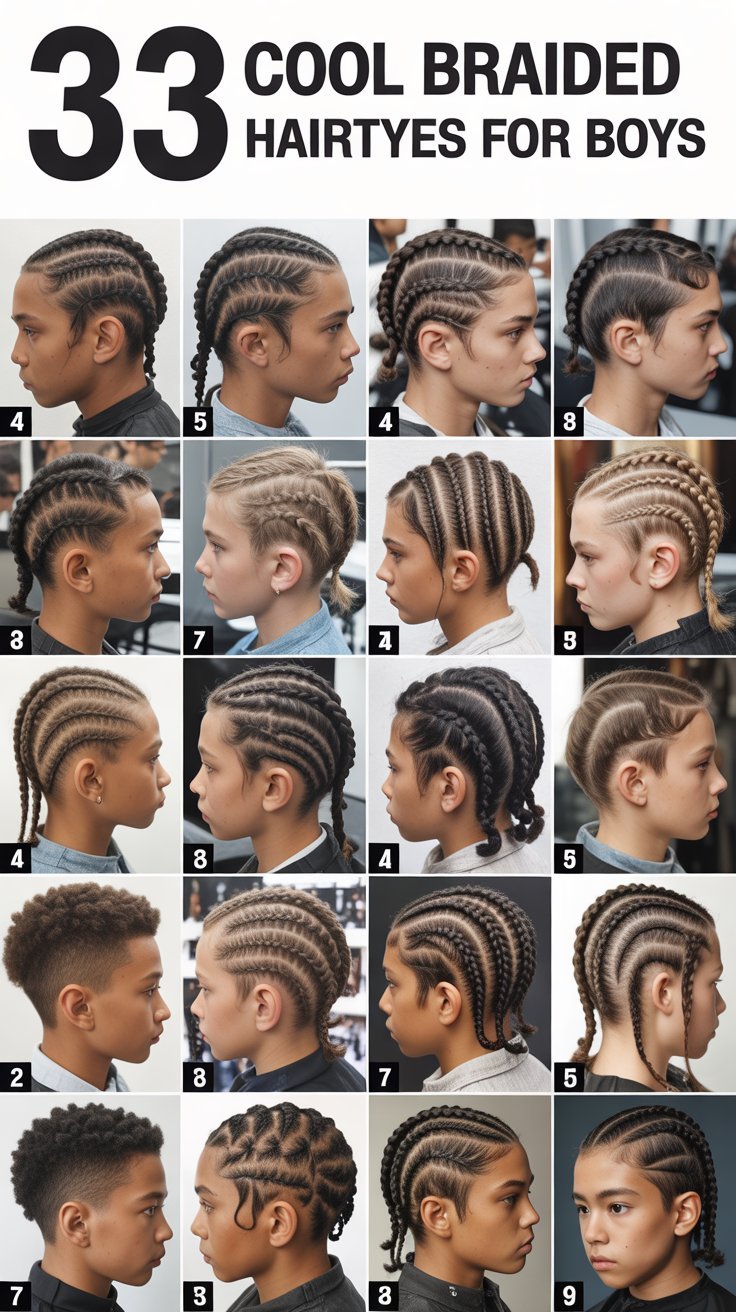
Braided hairstyles for boys have evolved from traditional styles into a dynamic form of self-expression that combines cultural heritage with modern fashion trends.
Whether your son is heading to school, attending a special event, or simply wants to stand out from the crowd, braids offer endless possibilities for creativity and style.
This comprehensive guide explores 33 cool braided hairstyles for boys that range from simple and understated to bold and intricate, ensuring you’ll find the perfect look for any occasion, hair type, and personal preference.
From classic cornrows to trendy man braids, each style in this article comes with detailed descriptions, styling tips, and maintenance advice to help you achieve professional-looking results at home.
1. Classic Cornrows
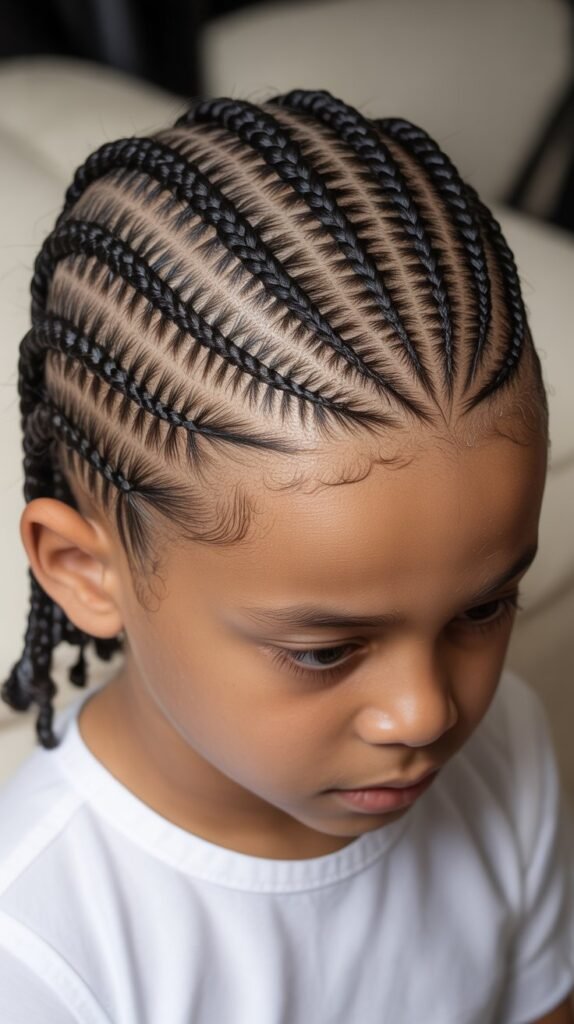
Cornrows are the foundation of braided hairstyles, featuring tight, close-to-the-scalp braids that have been a staple in African and African-American culture for generations.
This timeless style works exceptionally well for boys with medium to long hair and can last several weeks with proper care.
Key Features:
- The braids are created by braiding hair tightly against the scalp in straight, parallel rows.
- This style can be customized with different patterns, thicknesses, and directions.
- Cornrows work best on hair that’s at least 2-3 inches long.
- The style typically lasts 2-4 weeks depending on hair texture and maintenance.
Styling Tips:
- Start with freshly washed and conditioned hair for the smoothest results.
- Apply a light moisturizing cream or oil to prevent dryness and breakage.
- Use a rat-tail comb to create precise, straight parts.
- Maintain consistent tension throughout each braid for a uniform appearance.
- Wrap hair with a silk or satin scarf at night to preserve the style.
2. Box Braids

Box braids are individual plaits that are divided into square-shaped sections, offering a protective style that’s both fashionable and practical for active boys.
These versatile braids can be worn at various lengths and thicknesses, making them suitable for different face shapes and personal styles.
Key Features:
- Each braid is created from a square or box-shaped section of hair.
- Can be done with natural hair alone or with added extensions for length and volume.
- The style offers excellent protection for natural hair underneath.
- Box braids can last 4-8 weeks with proper maintenance.
Styling Benefits:
- Highly versatile and can be styled in ponytails, buns, or left loose.
- Requires minimal daily maintenance once installed.
- Protects natural hair from environmental damage and over-manipulation.
- Works well for boys involved in sports or other physical activities.
- Can be customized with beads, cuffs, or colored extensions.
3. Two-Strand Twists
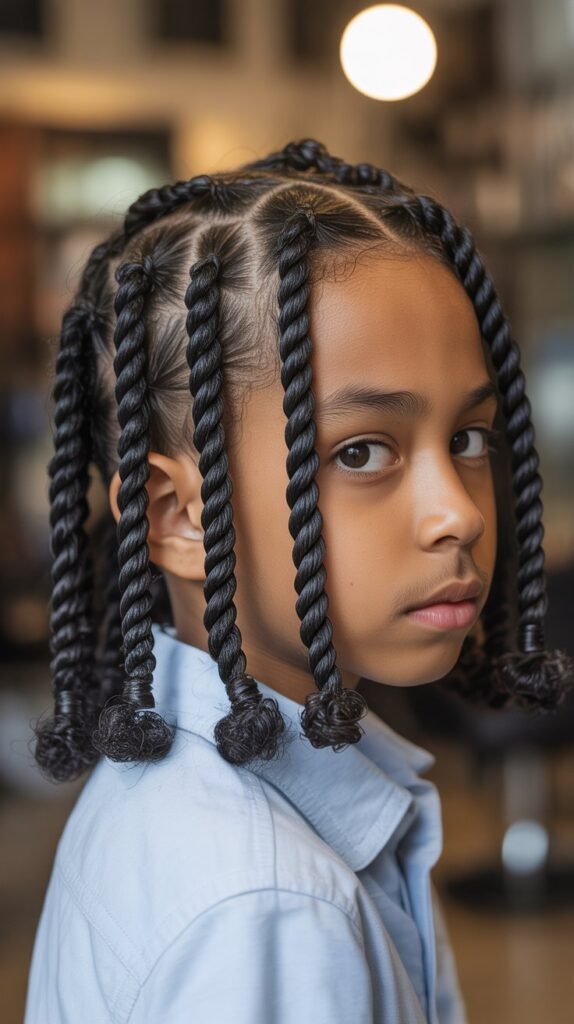
Two-strand twists offer a simpler alternative to traditional braids while still providing texture, definition, and a polished appearance.
This style involves twisting two sections of hair around each other, creating a rope-like effect that’s easier to install and remove than braids.
Key Features:
- Created by dividing hair into sections and twisting two strands together.
- Generally faster to install than traditional three-strand braids.
- Works exceptionally well on natural, textured hair types.
- Can be worn as a standalone style or unraveled for a twist-out look.
Installation Process:
- Section hair into desired sizes (smaller sections create tighter twists).
- Apply a twisting cream or butter to each section for hold and shine.
- Split each section into two equal parts.
- Twist the two strands around each other from root to tip.
- Seal the ends by palm-rolling or using a small amount of gel.
4. Cornrow Mohawk

The cornrow mohawk combines the edginess of a mohawk with the intricate detail of cornrows, creating a bold statement style perfect for boys who want to stand out.
This style features braids along the sides that meet at a raised center section.
Key Features:
- Cornrows are braided diagonally from the sides toward the center of the head.
- The center section is left raised or can be styled in various ways.
- Often paired with a fade or undercut on the sides for added contrast.
- Creates a striking visual effect that’s perfect for confident personalities.
Styling Variations:
- The center mohawk section can be left loose, braided, twisted, or styled upward.
- Add color to the center section for extra impact.
- Vary the thickness of the cornrows for different effects.
- The height and width of the mohawk can be adjusted to suit preferences.
- Works well with temporary designs shaved into the faded sides.
5. Zigzag Cornrows
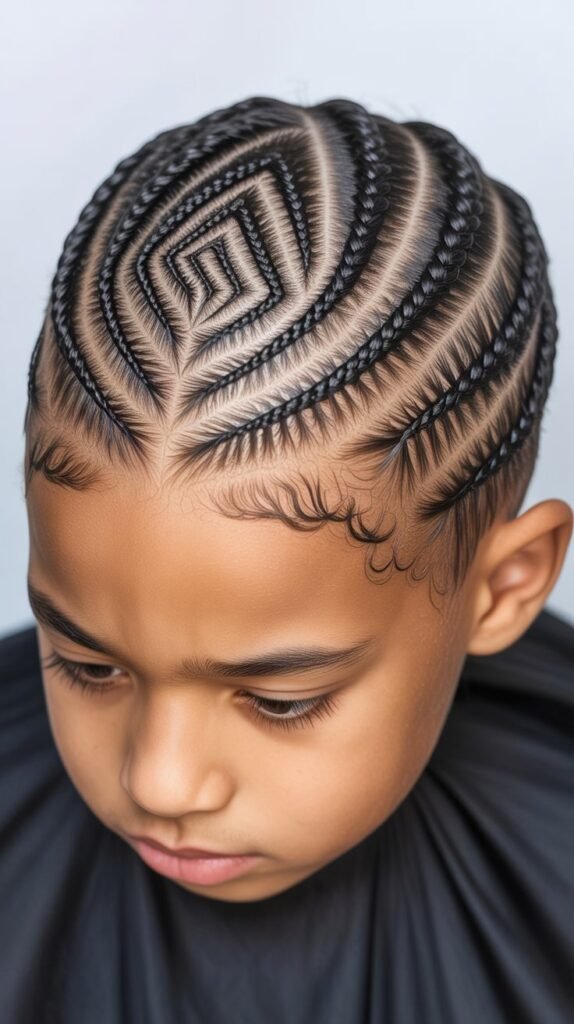
Zigzag cornrows add a creative twist to traditional straight-back cornrows by incorporating geometric patterns that showcase artistic flair.
This eye-catching style demonstrates advanced braiding techniques while maintaining the practical benefits of cornrows.
Key Features:
- Cornrows are braided in zigzag or wave patterns rather than straight lines.
- Requires more time and skill to achieve than traditional cornrows.
- The pattern can be customized with various geometric designs.
- Offers a unique, artistic appearance that’s sure to attract attention.
Design Considerations:
- Plan the pattern before starting to ensure symmetry and balance.
- Use a white eyeliner pencil to sketch the design on the scalp as a guide.
- Maintain consistent braid thickness throughout for a professional look.
- The complexity of the pattern can be adjusted based on skill level.
- This style typically lasts 2-3 weeks with proper care.
6. Man Bun with Braided Sides
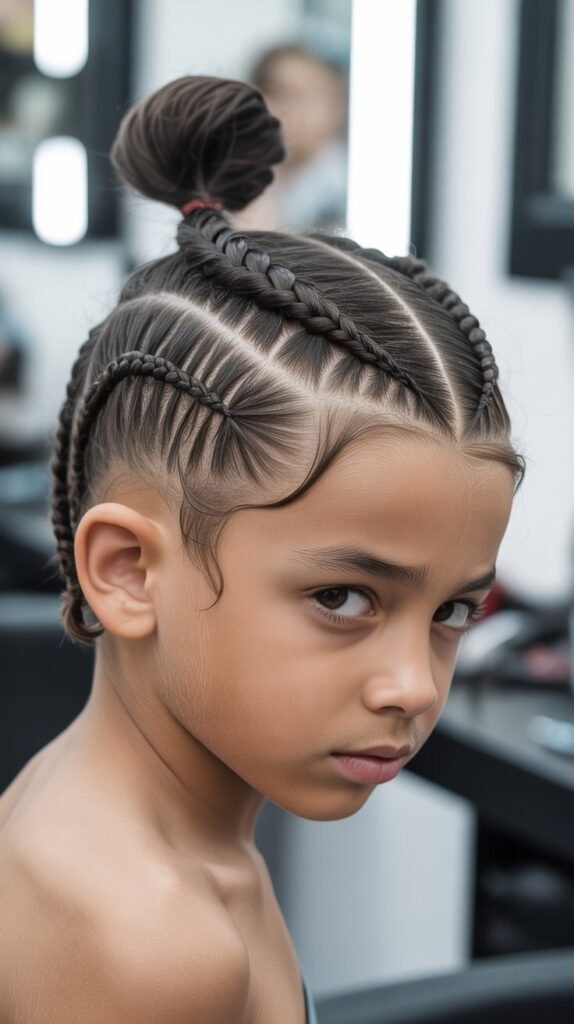
The man bun with braided sides combines contemporary styling with traditional braiding techniques, perfect for boys with longer hair who want a sophisticated yet trendy look.
This versatile style keeps hair secure and manageable while showcasing braiding detail.
Key Features:
- Hair on top is grown long enough to gather into a bun or ponytail.
- Sides and back feature cornrows, flat twists, or other braided styles.
- The contrast between the loose bun and structured braids creates visual interest.
- Works best with medium to long hair length on top.
Styling Instructions:
- Braid the sides and back in the desired pattern first.
- Gather the top section and secure with a hair tie.
- Twist or wrap the hair around the base to form the bun.
- Secure with additional elastics or bobby pins as needed.
- Apply edge control or gel to smooth any flyaways around the bun.
7. Feed-In Braids

Feed-in braids, also known as Ghana braids or invisible cornrows, start small at the hairline and gradually become thicker as hair extensions are fed into the braid.
This technique creates a more natural appearance and reduces tension on the hairline.
Key Features:
- Braids start thin at the hairline to reduce stress and prevent breakage.
- Extension hair is gradually added to increase braid thickness.
- Creates a more natural look compared to traditional cornrows with extensions.
- Gentler on the scalp and hairline, making it ideal for younger boys.
Health Benefits:
- Reduces traction alopecia risk by minimizing tension at the roots.
- Allows the scalp to breathe better than heavy, thick braids.
- Easier to remove and causes less damage to natural hair.
- The gradual thickness change looks more natural and seamless.
- Can last 3-6 weeks depending on maintenance and hair growth.
8. Braided Ponytail

A braided ponytail elevates a simple ponytail by incorporating braids into the style, offering a clean, athletic look that’s perfect for active boys.
This style combines functionality with visual appeal.
Key Features:
- Hair is gathered into a ponytail and then braided.
- Can feature cornrows leading into the ponytail for added style.
- The ponytail itself can be one thick braid or multiple smaller braids.
- Keeps hair completely off the face and neck.
Style Variations:
- Single thick braid for a bold, simple look.
- Multiple small braids gathered into a ponytail holder.
- Cornrows on the sides leading to a braided ponytail at the back.
- French braid or Dutch braid technique for the ponytail section.
- Add decorative elastics or bands along the length of the braid.
9. Tribal Braids

Tribal braids draw inspiration from traditional African braiding patterns, featuring intricate designs that tell stories and represent cultural heritage.
These bold, statement-making braids can be adapted to modern preferences while honoring their cultural roots.
Key Features:
- Incorporate various braid sizes, directions, and patterns in one style.
- Often include geometric shapes, curves, and intersecting lines.
- Can combine cornrows, box braids, and other techniques.
- Celebrate cultural heritage while allowing for personal expression.
Cultural Significance:
- Many patterns have historical significance in African cultures.
- Different designs traditionally represented tribe, status, or life events.
- Modern interpretations blend traditional elements with contemporary aesthetics.
- Teaches boys about their cultural heritage through hairstyling.
- Encourages appreciation for the artistry and skill involved in braiding.
10. Braided Top with Fade

This hybrid style features braids on the top portion of the head while the sides and back are faded short, creating a clean contrast that’s both modern and manageable.
It’s an excellent choice for boys who want braids without committing to a full head.
Key Features:
- Top hair is long enough for braiding while sides are cut short.
- The fade can be low, mid, or high depending on preference.
- Braids on top can be styled in various patterns and directions.
- Combines the best of both braided and cut styles.
Maintenance Requirements:
- The fade needs regular touch-ups every 1-2 weeks to stay sharp.
- Braids on top can last 2-4 weeks before needing redoing.
- Less overall maintenance than a full head of braids.
- Easier to wash and care for than all-over braided styles.
- Offers flexibility to change the braided pattern frequently.
11. French Braids

French braids, while traditionally seen on girls, have become increasingly popular for boys with longer hair, offering a sleek, controlled style that’s perfect for formal occasions or everyday wear.
These braids start at the hairline and incorporate hair as they progress down.
Key Features:
- Hair is braided from the hairline backward, incorporating more hair with each stitch.
- Can be done as one center braid or two braids (one on each side).
- Creates a raised, three-dimensional effect on the scalp.
- Works well for medium to long hair lengths.
Braiding Technique:
- Start with a small section of hair at the front hairline.
- Divide into three strands and begin a regular three-strand braid.
- With each crossing motion, add a small section of new hair to the outer strands.
- Continue adding hair and braiding until all hair is incorporated.
- Finish with a regular three-strand braid to the ends.
12. Micro Braids
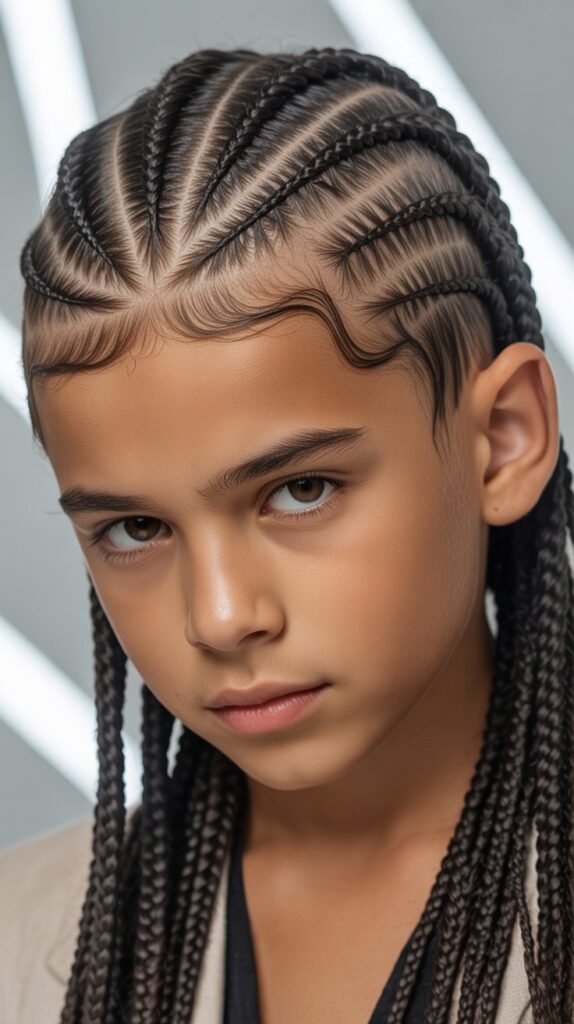
Micro braids are very thin, delicate braids that create a unique, detailed look requiring patience and skill to install.
These tiny braids offer incredible versatility and can be styled in countless ways once completed.
Key Features:
- Each braid is extremely thin, typically the width of a pencil or smaller.
- Installation can take 6-12 hours or more depending on hair length and density.
- Offers maximum styling versatility once installed.
- Can last 2-3 months with proper care and maintenance.
Considerations:
- Requires significant time investment for installation.
- Best done by an experienced braider to ensure proper tension.
- Can be heavy if too much extension hair is added.
- Removing micro braids also requires patience and care.
- The thin size means more braids overall, creating a fuller appearance.
13. Ladder Braids
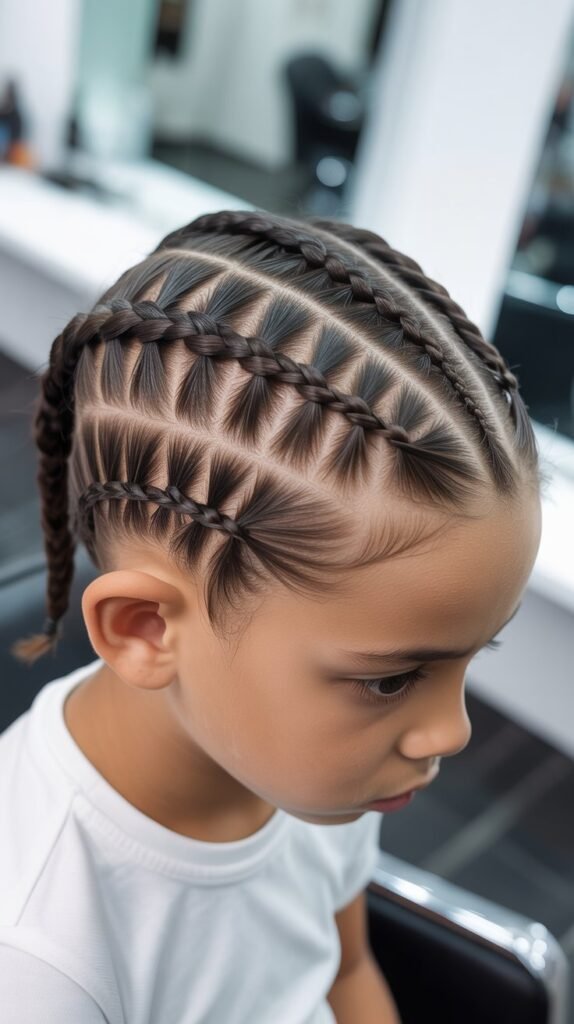
Ladder braids create a horizontal rungs-like effect with connected cornrows that resemble a ladder pattern.
This creative style showcases advanced braiding skills and geometric precision.
Key Features:
- Vertical cornrows are connected with horizontal braided sections.
- Creates a ladder or geometric grid pattern on the scalp.
- Requires advanced braiding skills and precise planning.
- Offers a unique, artistic appearance that stands out.
Installation Details:
- Vertical cornrows are braided first in parallel rows.
- Small sections are left unbraided at regular intervals.
- Horizontal sections are then braided to connect the vertical rows.
- The pattern requires careful planning to ensure symmetry.
- This style typically lasts 1-2 weeks as it can loosen quickly.
14. Stitch Braids

Stitch braids feature a distinctive raised, textured appearance created by adding hair extensions in a specific technique that creates a “stitched” effect.
These braids are thicker and more defined than traditional cornrows.
Key Features:
- Extensions are added using a specific stitch-like technique.
- Creates thicker, more pronounced braids than regular cornrows.
- The textured, raised appearance is visually striking.
- Typically installed in straight-back or simple patterns.
Styling Advantages:
- The thickness makes them more visible and impactful.
- Less likely to look messy as they grow out.
- The technique creates a unique texture that photographs well.
- Works well for boys who want bold, statement braids.
- Can be combined with fades or undercuts for added contrast.
15. Braided Faux Hawk
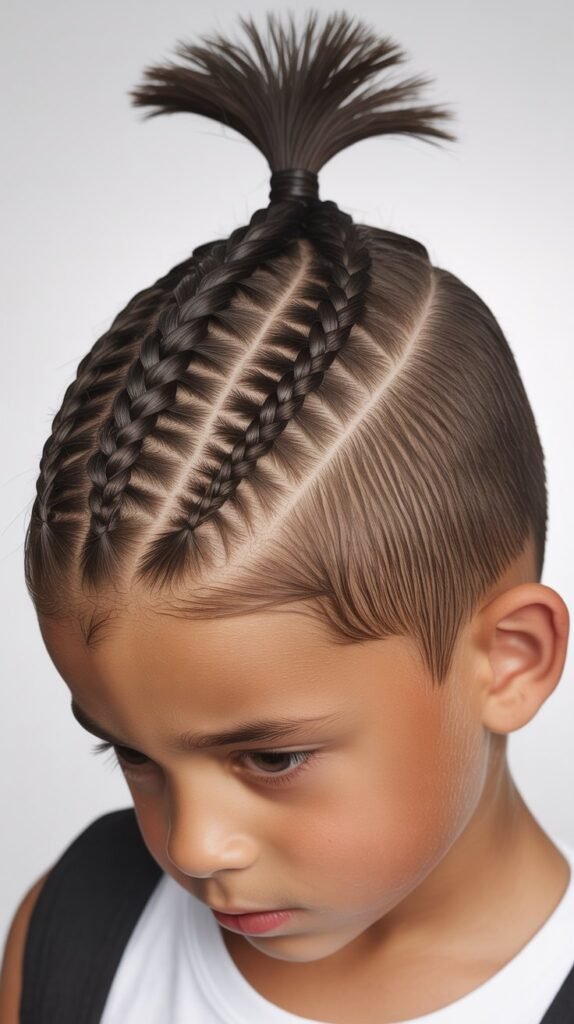
The braided faux hawk creates the illusion of a mohawk using braiding techniques without actually shaving the sides.
This style offers the edgy appearance of a mohawk with the flexibility to change back to other styles easily.
Key Features:
- Cornrows on the sides are braided flat and angled toward the center.
- The center section can be left unbraided, braided upward, or styled in various ways.
- Creates a mohawk appearance without cutting hair short on the sides.
- Offers more versatility than a true shaved mohawk.
Styling Options:
- Center section can be twisted, braided upward, or left in an afro.
- Side braids can vary in thickness and angle for different effects.
- The height and definition of the faux hawk can be adjusted with styling products.
- Color can be added to the center section for extra impact.
- The style can be easily changed by unbraiding without affecting hair length.
16. Braids with Designs

Braids with designs incorporate shaved patterns, parts, or artistic elements into the braided hairstyle, combining barbering skills with braiding techniques.
This creative approach allows for ultimate personalization and self-expression.
Key Features:
- Combines cornrows or other braids with shaved designs.
- Designs can include lines, geometric shapes, symbols, or artistic patterns.
- Requires both braiding expertise and barbering precision.
- The designs typically need touch-ups every 1-2 weeks.
Popular Design Elements:
- Straight or curved lines shaved into faded sections.
- Geometric patterns like triangles, diamonds, or zigzags.
- Symbols, initials, or numbers with personal significance.
- Lightning bolts, waves, or other stylized shapes.
- Asymmetrical designs for a more artistic, edgy look.
17. Braided Undercut
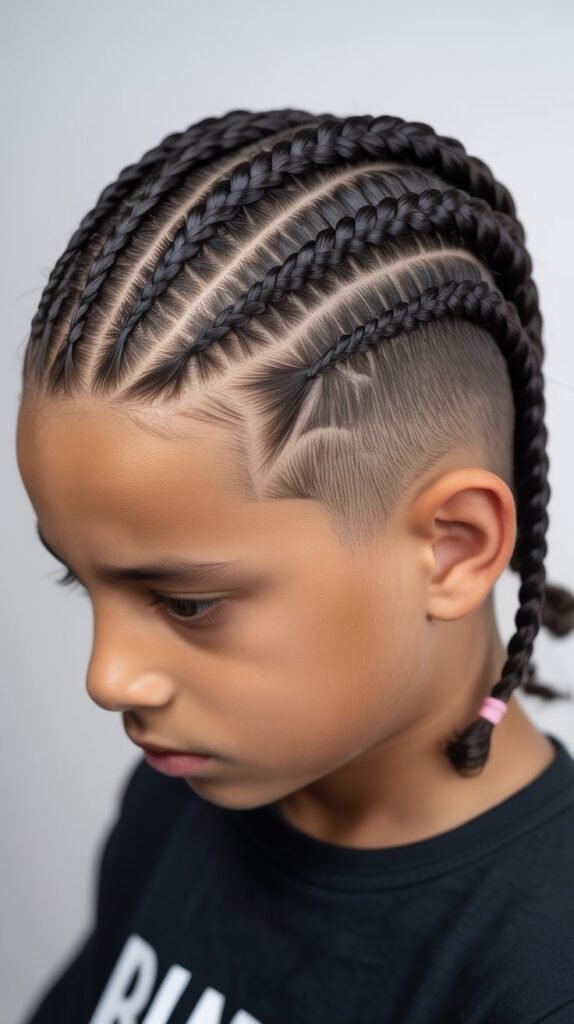
The braided undercut features longer braided hair on top with very short or shaved sides and back, creating maximum contrast and a bold, modern aesthetic.
This style is perfect for boys who want a dramatic, high-fashion look.
Key Features:
- Sides and back are shaved very short or completely bald.
- Top section is significantly longer and braided.
- Creates striking contrast between the lengths.
- The braided top can be styled in multiple ways.
Styling Versatility:
- Top braids can be pulled back into a ponytail or bun.
- Braids can be worn forward over the forehead for different looks.
- The undercut allows the scalp to breathe and stay cool.
- Maintenance is easier with less hair overall.
- The shaved portion can incorporate designs or patterns.
18. Senegalese Twists
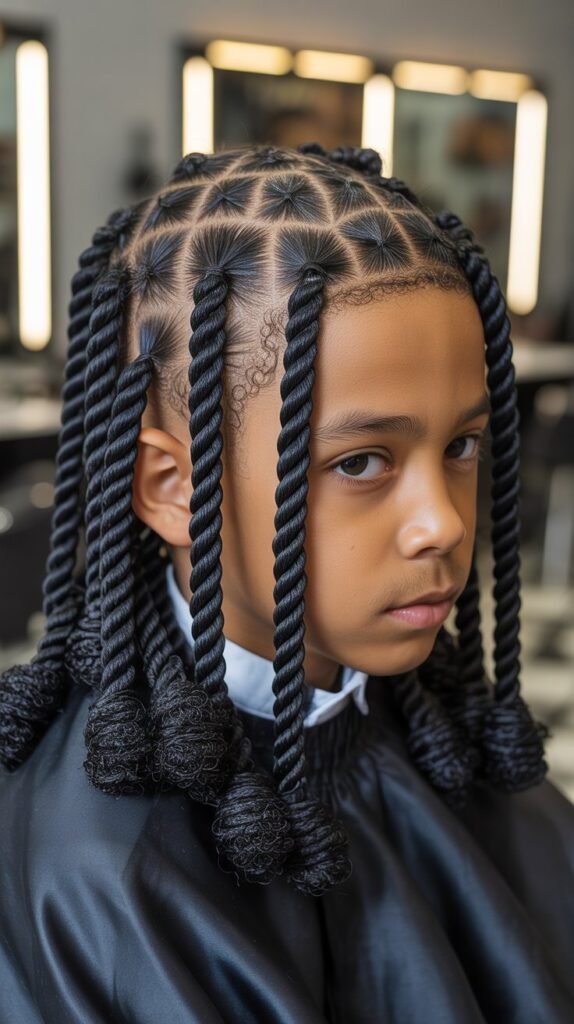
Senegalese twists, also called rope twists, use a two-strand twisting technique with added hair for length and fullness.
These sleek, rope-like twists offer a polished alternative to traditional braids.
Key Features:
- Created using two strands twisted together rather than braided.
- Extension hair is wrapped around natural hair for the rope effect.
- Results in sleek, cylindrical twists that are less bulky than box braids.
- Typically lasts 4-8 weeks with proper maintenance.
Installation Process:
- Hair is sectioned similar to box braids.
- Extension hair is added to natural hair at the root.
- Two sections are twisted around each other in the same direction.
- The ends are sealed with hot water or by knotting.
- The twisting creates a smooth, rope-like appearance.
19. Viking Braids

Viking braids draw inspiration from Norse warriors, featuring long braids often combined with shaved or short sides.
These masculine, warrior-inspired styles can include multiple braids, top knots, or undercuts.
Key Features:
- Often combines long braids with shaved or very short sides.
- Can include one thick braid down the center or multiple braids.
- Sometimes incorporates a top knot or ponytail with braided elements.
- Inspired by historical Norse and Germanic hairstyles.
Style Characteristics:
- Emphasizes length and thickness of braids.
- May include decorative elements like leather wraps or beads.
- Works best with hair that’s at least shoulder-length.
- The contrast between long braids and short sides is key.
- Can be combined with facial hair for older teens.
20. Braided Bun

The braided bun combines braiding techniques with the classic man bun, creating a neat, sophisticated style that keeps longer hair completely secured.
This elegant style works for both casual and formal occasions.
Key Features:
- Hair is braided before being wrapped into a bun shape.
- Can be done with one large braid or multiple smaller braids.
- The bun can be positioned high, mid, or low on the head.
- Keeps hair completely secure and off the neck.
Styling Methods:
- Braid hair into one or more braids, then wrap into a bun.
- Create cornrows that feed into a braided bun at the crown.
- French braid or Dutch braid hair directly into the bun formation.
- Combine braided sections on the sides with a braided bun on top.
- Add hair accessories or wraps for extra flair.
21. Crochet Braids
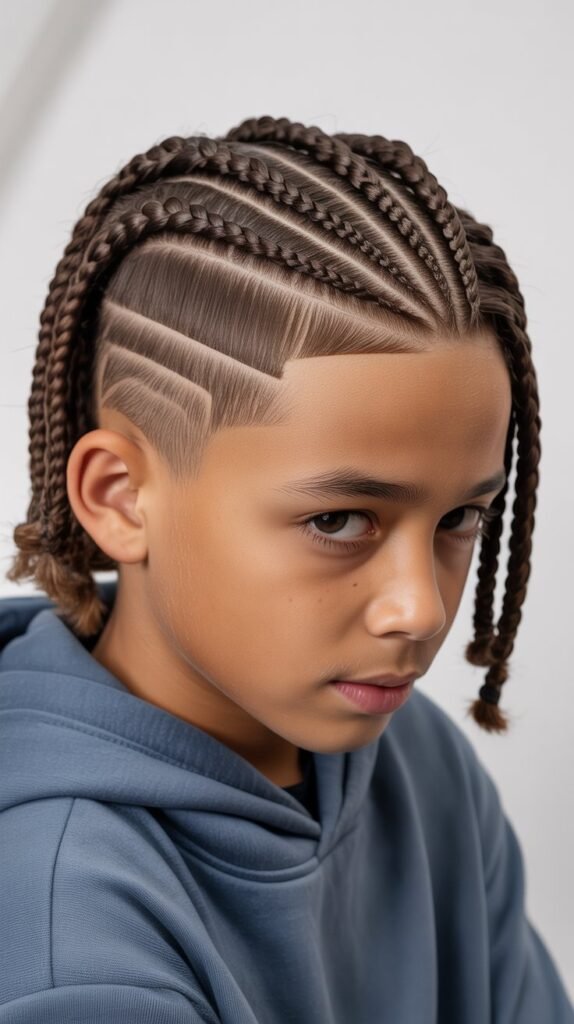
Crochet braids involve braiding the natural hair in cornrows and then using a crochet hook to loop pre-braided or twisted hair extensions through the cornrows.
This protective style offers endless variety with minimal installation time.
Key Features:
- Natural hair is cornrowed flat against the scalp.
- Extensions are attached using a crochet hook looped through the cornrows.
- Installation is faster than individual braids or twists.
- Offers great versatility in texture, length, and style.
Benefits:
- Protective style that tucks away natural hair completely.
- Less tension on the scalp compared to individual braids.
- Easier and quicker to install than many other protective styles.
- Can be removed easily without cutting or excessive manipulation.
- Wide variety of extension textures and styles available.
22. Braided Side Part

The braided side part features braids styled to one side with a distinct parting line, creating an asymmetrical, fashion-forward look.
This style adds sophistication and can make facial features appear more defined.
Key Features:
- A deep side part divides the hair into unequal sections.
- Braids are directed toward one side of the head.
- Creates an asymmetrical, modern appearance.
- The part can be straight or curved for different effects.
Styling Benefits:
- Elongates the face and adds dimension.
- More interesting visually than straight-back braids.
- Can be combined with fades or undercuts.
- The sweep direction can highlight best facial features.
- Easier to maintain than complex geometric patterns.
23. Jumbo Braids

Jumbo braids are thick, large braids that make a bold statement and require less installation time than smaller braids.
These oversized plaits are perfect for boys who want a dramatic look with lower maintenance.
Key Features:
- Each braid is significantly thicker than standard box braids.
- Requires less time to install due to fewer, larger sections.
- Creates a bold, eye-catching appearance.
- Typically lasts 2-4 weeks before needing maintenance.
Practical Advantages:
- Faster installation time (3-5 hours versus 6-10 for smaller braids).
- Easier to maintain and refresh than many smaller braids.
- Less weight on the scalp than numerous small braids.
- Easier to wash and dry thoroughly.
- Good option for boys new to braided styles.
24. Heart-Shaped Braided Design
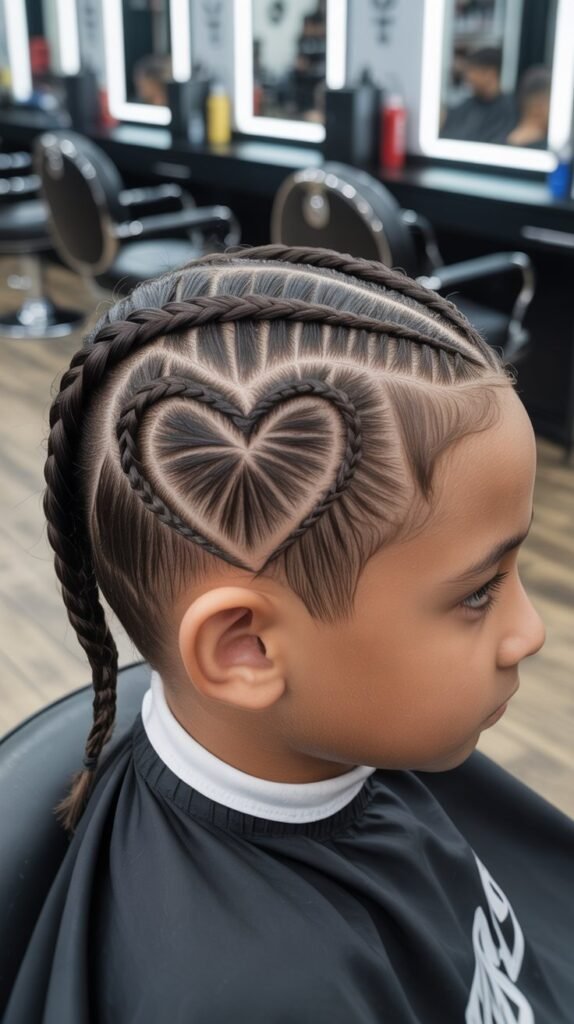
A heart-shaped braided design incorporates cornrows or parts arranged to form a heart shape, typically on the back or side of the head.
This creative, playful style is perfect for boys who want to showcase personality through their hair.
Key Features:
- Braids or parts are arranged to create a heart outline.
- Usually placed on the back or side of the head where visible.
- Can be subtle or bold depending on size and contrast.
- Requires precise planning and skilled braiding.
Design Execution:
- The heart shape is mapped out before braiding begins.
- Braids can form the outline of the heart or fill it in.
- Can be combined with other braiding patterns around it.
- Works well with contrasting braid directions for definition.
- Best suited for special occasions or when making a statement.
25. Tree Braids

Tree braids are a protective style where extensions are cornrowed into the natural hair, with the extension ends left loose to flow freely, resembling branches.
This technique protects the natural hair while giving the appearance of a fuller, longer hairstyle.
Key Features:
- Natural hair is cornrowed with extensions.
- The ends of the extensions are left loose and unbraided.
- Creates volume and the appearance of longer, fuller hair.
- Protects natural hair while allowing styling versatility.
Style Advantages:
- Natural hair is completely protected within the cornrows.
- The loose ends can be curled, straightened, or styled differently.
- Less manipulation means less breakage of natural hair.
- Can be maintained for 4-8 weeks.
- Offers the look of loose hair with protective benefits.
26. Lemonade Braids
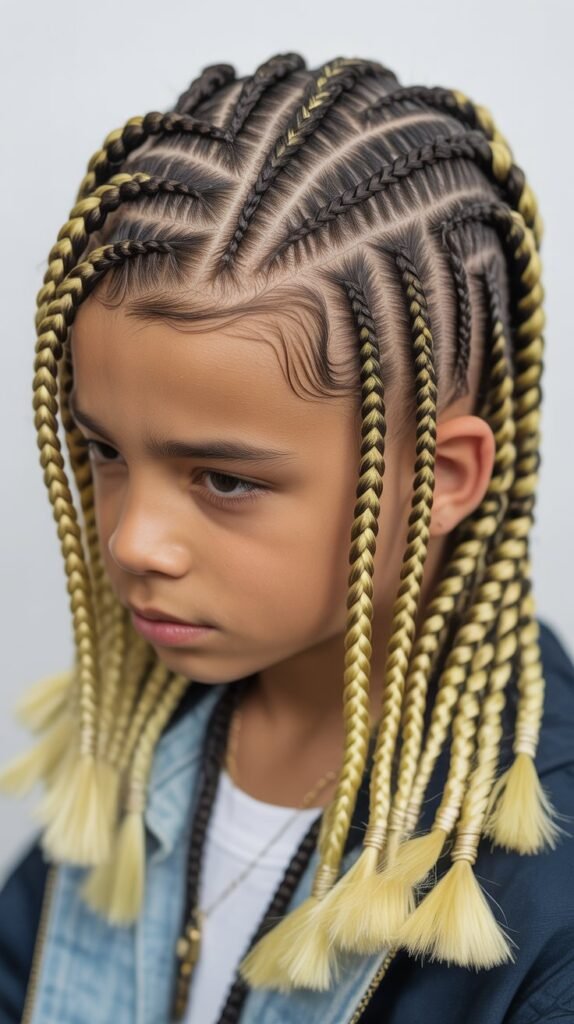
Lemonade braids, popularized by Beyoncé, are side-swept cornrows that curve gracefully to one side of the head.
This feminine-inspired style has been adapted for boys, creating a sleek, stylish appearance with visual flow.
Key Features:
- Cornrows are braided diagonally, sweeping toward one side.
- Braids typically curve rather than going straight back.
- Creates an elegant, flowing appearance.
- The curved pattern adds visual interest and movement.
Styling Characteristics:
- Braids can vary in thickness throughout the style.
- The curve and angle can be adjusted to suit face shape.
- Often longer on one side, creating asymmetry.
- Works particularly well with longer hair lengths.
- Can incorporate multiple braid sizes for added texture.
27. Infinity Braids
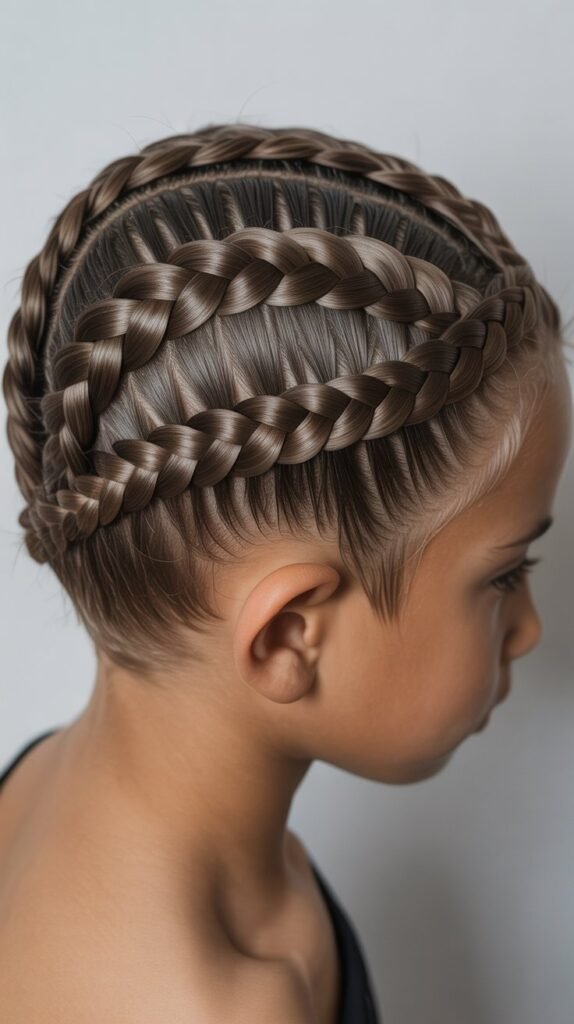
Infinity braids incorporate the infinity symbol (∞) into the braiding pattern, creating a mathematically inspired design that’s both unique and meaningful.
This creative style demonstrates advanced braiding artistry.
Key Features:
- Braids are arranged to form the infinity symbol.
- Requires precise planning and expert braiding skills.
- The symbol can be placed anywhere on the head.
- Represents concepts like limitless potential or eternal connection.
Design Considerations:
- The size of the infinity symbol can be adjusted.
- Works best when there’s contrast between the symbol and surrounding hair.
- Can be incorporated into larger braiding patterns.
- May require more frequent touch-ups to maintain clarity.
- Best suited for boys who appreciate mathematical or symbolic elements.
28. Goddess Braids

Goddess braids are thick, raised cornrows that are larger and more prominent than regular cornrows.
Originally a women’s style, these bold braids have crossed over into boys’ fashion, offering a regal, statement-making appearance.
Key Features:
- Significantly thicker than standard cornrows.
- Raised high off the scalp for a three-dimensional effect.
- Typically consists of 3-8 large braids.
- Extensions are often added for extra thickness and length.
Style Benefits:
- Creates instant impact with bold, visible braids.
- Faster to install than many small braids.
- Easier to maintain than intricate patterns.
- The thickness makes them suitable for various hair textures.
- Can last 1-3 weeks depending on activity level.
29. Braids with Beads

Adding beads to braids is a traditional practice that adds personality, cultural connection, and visual interest to any braided style.
Beads can be wooden, plastic, metal, or glass, in various colors and sizes.
Key Features:
- Beads are threaded onto individual braids or twist ends.
- Can be placed at the ends, throughout the length, or clustered at specific points.
- Available in countless colors, materials, and sizes.
- Adds cultural significance and personal expression.
Bead Application:
- Beads with large holes can be threaded directly onto braids.
- Smaller beads may require threading techniques or special tools.
- Secure beads with additional small elastics if needed.
- Metal cuffs can be crimped onto braids for secure attachment.
- Consider the weight of beads, especially for younger boys.
30. Braided Crown

The braided crown features cornrows or braids arranged in a circular pattern around the head, resembling a crown or halo.
This regal style works well for special occasions and boys with medium to long hair.
Key Features:
- Braids circle around the head in a crown-like formation.
- Can be one continuous braid or multiple braids arranged in a circle.
- The center can be left loose, tied up, or braided differently.
- Creates an elegant, sophisticated appearance.
Styling Variations:
- Dutch braid or French braid technique for the crown.
- Multiple smaller braids arranged in a circular pattern.
- Cornrows that curve around to form the crown shape.
- Combination of braided crown with loose or styled center hair.
- Can incorporate twists instead of braids for different texture.
31. Zig-Zag Parts with Straight Braids

This creative style combines geometric zig-zag parting patterns with straight cornrows, creating visual interest through the contrast between the angular parts and linear braids.
The parts become a design element themselves.
Key Features:
- Parts between braids follow zig-zag or geometric patterns.
- The braids themselves remain straight for contrast.
- Creates a unique visual effect that’s noticeable even from a distance.
- Requires precision in creating the parting pattern.
Design Elements:
- Parts can be sharp and angular or gently curved.
- The size of the zig-zag can vary for different effects.
- Works well with various braid thicknesses.
- Can be combined with fades or designs on the sides.
- The pattern should be symmetrical for a polished look.
32. Half-Up Half-Down Braids

The half-up half-down style features braids or cornrows on the top half of the head while leaving the bottom half loose or in a different style.
This versatile look offers the best of both worlds – structured and free-flowing.
Key Features:
- Top section is braided, twisted, or pulled up and secured.
- Bottom section remains loose, in different braids, or styled differently.
- Creates dimension and visual separation.
- Offers styling versatility and easy modification.
Styling Options:
- Top can be cornrowed back while bottom is left in an afro or loose curls.
- Top can be in box braids pulled into a ponytail with bottom braids hanging free.
- Top can feature intricate patterns while bottom is simple.
- The division line can be straight, curved, or diagonal.
- Works well for boys transitioning between styles.
33. Spiral Braids

Spiral braids feature cornrows that curve in spiral or circular patterns around the head, creating mesmerizing geometric designs.
This advanced style requires significant skill and planning but results in stunning visual impact.
Key Features:
- Braids curve and spiral rather than going in straight lines.
- Can form complete circles, spirals, or curved geometric shapes.
- Requires advanced braiding skills and precise planning.
- Creates a unique, artistic appearance that’s highly individual.
Design Complexity:
- Patterns can range from simple curves to complex multi-directional spirals.
- Often starts from a central point and spirals outward.
- Requires careful sectioning to ensure smooth curves.
- May incorporate multiple spiral patterns in one style.
- Best executed by experienced braiders with pattern design skills.
Maintenance Tips for All Braided Hairstyles
Protection | Wrap hair with silk/satin scarf or use satin pillowcase | Nightly | | Edge Control | Apply edge control gel to hairline | As needed (2-3 times/week) | | Touch-ups | Re-braid loose sections or edges | Every 2-3 weeks | | Deep Conditioning | Apply leave-in conditioner to braids and scalp | Weekly |
General Care Guidelines:
- Always sleep with a silk or satin scarf, bonnet, or pillowcase to reduce friction and frizz.
- Keep the scalp clean and moisturized to prevent dryness, itching, and flaking.
- Avoid over-tightening braids, as this can cause traction alopecia and hairline damage.
- Don’t leave braids in for more than 8 weeks to prevent matting and breakage.
- When washing, focus on the scalp rather than roughly scrubbing the braids themselves.
- Use a spray bottle with diluted shampoo to cleanse without causing excessive frizz.
- Apply lightweight oils like jojoba, coconut, or argan oil to maintain moisture.
- Avoid heavy products that cause buildup and make braids look dull or greasy.
Signs It’s Time to Remove Braids:
- Significant new growth at the roots making braids loose.
- Excessive itching that doesn’t resolve with proper cleansing.
- Braids looking frizzy, fuzzy, or losing their defined shape.
- Matting or tangling beginning to occur near the roots.
- The style has been in for 6-8 weeks (maximum recommended time).
Choosing the Right Braided Style
Selecting the perfect braided hairstyle depends on several factors that should be carefully considered before installation.
Hair Length Requirements:
- Short hair (1-3 inches): Cornrows, two-strand twists, simple patterns with or without extensions.
- Medium hair (4-6 inches): Most braiding styles work well, including box braids, cornrows, and twists.
- Long hair (7+ inches): All styles possible, including man buns, ponytails, and elaborate patterns.
Face Shape Considerations:
- Round faces benefit from styles with height on top and slimmer sides.
- Oval faces can wear virtually any braided style successfully.
- Square faces look good with softer, curved braiding patterns.
- Long faces benefit from horizontal elements and width rather than height.
Lifestyle Factors:
- Active boys/athletes should choose secure styles like tight cornrows or protective braids.
- School requirements may limit certain bold or colorful styles.
- Time availability affects whether complex or simple styles are practical.
- Maintenance commitment determines how long braids should stay in.
Hair Texture Considerations:
- Type 3 (curly) hair holds braids well and can work with most styles.
- Type 4 (coily/kinky) hair is ideal for all protective braiding styles.
- Type 2 (wavy) hair may need more product for hold and definition.
- Type 1 (straight) hair might require extensions or special techniques for some styles.
Professional vs. DIY Braiding
When to See a Professional:
- Complex geometric patterns or designs requiring precision.
- First time getting a particular style to learn proper technique.
- Styles requiring extensions or specific installation methods.
- When you want the style to last as long as possible.
- Intricate patterns like tribal braids, spirals, or custom designs.
DIY-Friendly Styles:
- Simple two-strand twists that don’t require extreme precision.
- Basic straight-back cornrows once technique is learned.
- French braids or single braids for longer hair.
- Braided ponytails and buns with practice.
Finding a Skilled Braider:
- Look for braiders with experience working on boys’ hair specifically.
- Check portfolios and before/after photos of their work.
- Read reviews focusing on comments about technique and hair health.
- Ask about their experience with your child’s specific hair type.
- Ensure they understand proper tension to avoid damage.
- Visit naturalhaircare.com for tips on finding qualified stylists in your area.
Products Essential for Braided Hairstyles
Pre-Braiding Products:
- Clarifying shampoo to remove buildup before installation.
- Deep conditioning treatment to strengthen hair.
- Detangling spray or leave-in conditioner for easier sectioning.
- Lightweight moisturizing cream for smoother braiding.
During Styling:
- Edge control gel for smooth, sleek hairlines.
- Braiding gel or pomade for hold without flaking.
- Rat-tail comb for precise parting.
- Hair clips to section and hold hair during braiding.
- Extension hair if adding length or fullness.
Daily Maintenance Products:
- Light oil spray (jojoba, argan, or grapeseed oil).
- Dry shampoo or scalp-cleansing spray.
- Leave-in conditioner spray for moisture.
- Anti-itch scalp treatment if needed.
- Edge control for touch-ups.
For Removal:
- Detangling spray or conditioner.
- Wide-tooth comb for gentle removal.
- Deep conditioning treatment for post-braid care.
- Moisturizing hair mask to restore hydration.
Cultural Significance and Respect
Braided hairstyles carry deep cultural significance, particularly within African and African-American communities where these styles originated and have been passed down through generations.
Understanding the History:
- Braiding techniques in Africa date back thousands of years with specific meanings.
- Different patterns traditionally indicated tribe, age, marital status, wealth, and social position.
- During slavery, braids were used to create maps and convey messages.
- Braiding has been a communal activity that strengthens bonds between generations.
Cultural Appreciation vs. Appropriation:
- Boys of all backgrounds can wear braids when done with respect and understanding.
- Learn about the cultural significance of the styles you choose.
- Support Black-owned braiding salons and hair care businesses.
- Acknowledge the cultural origins when discussing your child’s braided style.
- Teach children about the rich history behind their hairstyle.
Respecting the Craft:
- Recognize that braiding is a skilled art form requiring years of practice.
- Compensate braiders fairly for their time and expertise.
- Be patient during installation as quality work takes time.
- Follow care instructions to honor the braider’s work.
- Share positive experiences and refer others to skilled braiders.
Health Considerations for Braided Hairstyles
Scalp Health:
- Braids should never cause pain during or after installation.
- Excessive tension can lead to traction alopecia (hair loss from pulling).
- Redness, bumps, or persistent tenderness indicates braids are too tight.
- The scalp should be able to breathe and should not feel restricted.
- Regular moisturizing prevents dryness, flaking, and itching.
Signs of Potential Problems:
- Headaches or tenderness lasting more than 24 hours after braiding.
- Visible thinning or recession of the hairline.
- Small bumps or inflammation along the braided sections.
- Excessive hair shedding when braids are removed.
- Difficulty sleeping due to scalp discomfort.
Protective Benefits:
- When done correctly, braids protect hair from environmental damage.
- Reduced daily manipulation means less breakage and split ends.
- Tucked ends are protected from rubbing on clothing and pillows.
- Natural hair can retain more moisture when properly braided.
- Length retention is improved with protective styling.
When to Take a Break:
- After 8 weeks in braids, give hair a 2-4 week rest period.
- If any scalp irritation or thinning occurs, remove braids immediately.
- Allow hair to recover with deep conditioning treatments.
- Trim any split or damaged ends before re-braiding.
- Consider looser styles or different braiding techniques if issues arise.
Conclusion
The world of braided hairstyles offers boys incredible opportunities for self-expression, cultural connection, and practical hair management.
From traditional cornrows to contemporary man buns with braided sides, these 33 cool braided hairstyles for boys provide options for every personality, hair type, and lifestyle.
Whether your son prefers simple, athletic styles or wants to make a bold statement with intricate patterns, braided hairstyles combine artistry with functionality in ways that celebrate both individuality and heritage.
By understanding proper installation techniques, maintenance requirements, and the cultural significance behind these styles, parents and boys can confidently embrace braided hairstyles that not only look amazing but also keep hair healthy and protected.
Remember that the best braided hairstyle is one that makes your son feel confident, comfortable, and authentically himself while honoring the rich traditions from which these beautiful styles originated.
