
Straight-back braided hairstyles have remained a timeless classic in the world of hair styling, offering a perfect blend of elegance, practicality, and cultural significance.
Whether you’re preparing for a casual day out, a professional meeting, or a special occasion, these versatile hairstyles provide endless possibilities for self-expression while keeping your hair neatly secured and protected.
This comprehensive guide explores 30 stunning straight-back braided hairstyles that cater to different hair types, lengths, and personal preferences.
From traditional cornrows to modern feed-in braids, chunky designs to intricate patterns, you’ll discover detailed styling techniques, maintenance tips, and creative variations that will transform your look.
Each style has been carefully selected to showcase the beauty and versatility of straight-back braids, making it easier for you to choose the perfect option that complements your face shape, lifestyle, and fashion sense.
1. Classic Cornrows Straight Back
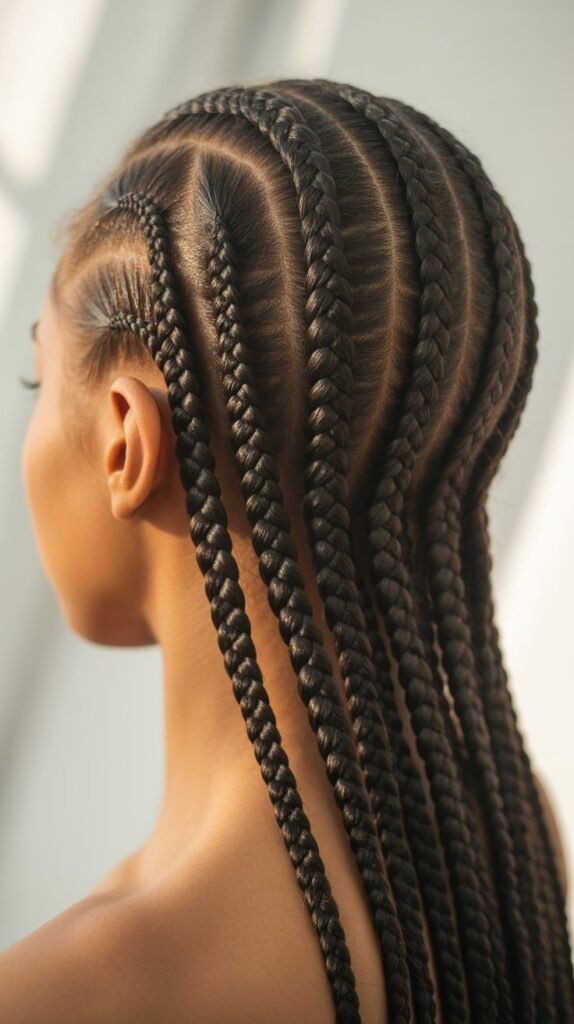
Classic cornrows straight back represent the foundation of all braided hairstyles, offering a clean and sophisticated appearance that never goes out of style.
- Cornrows are created by braiding the hair very close to the scalp in continuous, raised rows that run from the hairline to the nape of the neck.
- This style typically features multiple parallel braids ranging from 4 to 10 rows, depending on your desired thickness and overall aesthetic.
- The braiding technique involves a three-strand underhand method where sections are consistently added from the sides as you progress backward.
- Classic cornrows can last between 2 to 6 weeks with proper maintenance, making them an excellent protective style for natural hair.
- This hairstyle works exceptionally well for all hair textures and provides a streamlined look that complements both casual and formal attire.
- To achieve the best results, start with freshly washed and conditioned hair, then apply a light moisturizing cream before sectioning.
- The scalp should be clearly visible between each row, creating clean parts that demonstrate precision and skill in the braiding process.
2. Jumbo Straight-Back Braids

Jumbo straight-back braids offer a bold and dramatic statement while requiring less time to install compared to thinner braiding styles.
- These oversized braids typically consist of 4 to 8 large sections that create a striking visual impact and showcase confident personal style.
- The installation process is significantly faster than smaller braids, usually taking between 1 to 2 hours depending on hair length and texture.
- Jumbo braids work particularly well for those with thicker hair density, as they can accommodate more volume within each braid section.
- This style provides excellent scalp access for moisturizing and maintenance, making it easier to care for your natural hair underneath.
- The larger size means these braids may not last as long as smaller versions, typically staying neat for 2 to 4 weeks.
- Jumbo straight-back braids create a youthful and energetic appearance that pairs perfectly with athletic wear and casual fashion styles.
- Using high-quality braiding hair in colors that complement your natural shade will enhance the overall cohesiveness of the look.
3. Feed-In Braids Straight Back

Feed-in braids straight back provide a more natural-looking hairline and reduce tension on the scalp compared to traditional cornrow techniques.
- The feed-in method involves starting with your natural hair at the roots and gradually adding synthetic hair as you braid backward.
- This technique creates a tapered effect where braids begin smaller at the hairline and gradually increase in thickness toward the back.
- Feed-in braids significantly reduce the risk of traction alopecia and hairline damage because they distribute tension more evenly across the scalp.
- The installation process requires more skill and time, typically taking 3 to 5 hours depending on the number of braids and desired size.
- These braids offer a seamless, natural appearance that makes it difficult to distinguish where your natural hair ends and extensions begin.
- Feed-in straight-back braids can last 4 to 8 weeks with proper care, making them an excellent long-term protective styling option.
- This method works beautifully for those with fine or fragile hairlines who want to achieve fuller-looking braids without excessive pulling.
4. Micro Straight-Back Braids

Micro straight-back braids deliver intricate detail and maximum styling longevity through numerous thin, precisely crafted braids.
- Micro braids consist of 20 or more extremely thin braids that create an incredibly detailed and textured appearance across the scalp.
- The installation process is time-intensive, often requiring 6 to 10 hours or multiple sessions to complete the entire head.
- These delicate braids can last significantly longer than larger styles, maintaining their neat appearance for 6 to 12 weeks with proper maintenance.
- Micro braids provide exceptional versatility, as they can be styled into various updos, ponytails, and other configurations despite their small size.
- The lightweight nature of individual micro braids reduces overall tension on the scalp when properly installed without excessive pulling.
- This style requires meticulous sectioning and consistent braid sizing to achieve a uniform and professional-looking result.
- Micro straight-back braids work best for those with patience for both installation and maintenance, as they require careful attention during washing and moisturizing.
5. Straight-Back Braids with Beads

Straight-back braids with beads combine traditional braiding techniques with decorative accessories that add personality and cultural significance to your hairstyle.
- Beads can be added at the ends of braids, spaced throughout the length, or concentrated at specific sections to create rhythmic patterns.
- Traditional African beads made from wood, metal, or plastic carry cultural significance and connect modern wearers to ancestral styling practices.
- The addition of beads provides auditory interest, creating gentle clicking sounds with head movement that many find aesthetically pleasing.
- Bead placement should be secure but not too tight to avoid creating tension points that could damage the braids or natural hair underneath.
- Color coordination between beads and braiding hair can create cohesive looks, while contrasting colors make bold fashion statements.
- This embellishment works particularly well for children and young adults, adding a playful element to protective styling routines.
- Beads should be removed before sleeping or secured with rubber bands to prevent tangling and maintain the integrity of the braids.
6. Straight-Back Tribal Braids
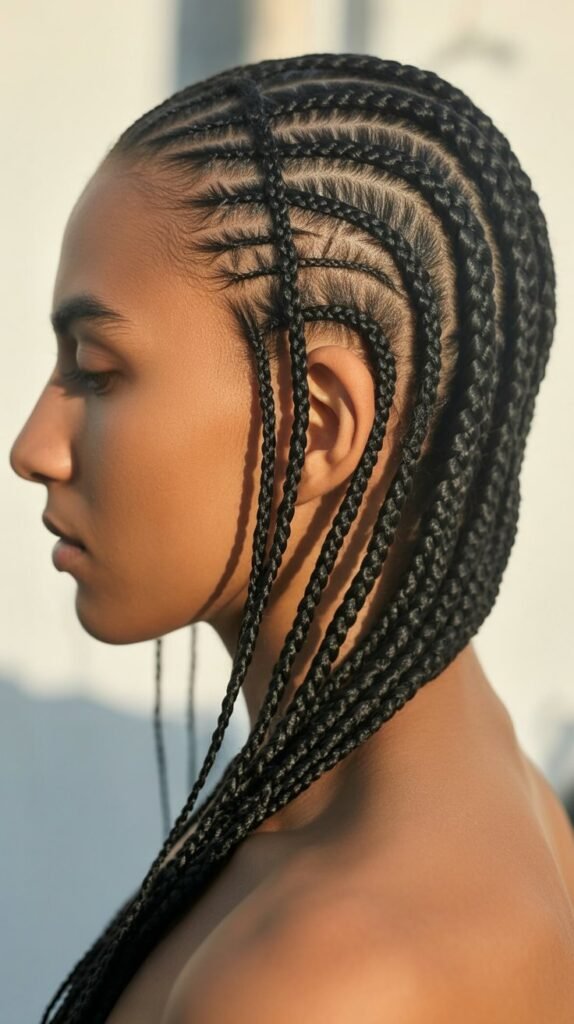
Straight-back tribal braids honor traditional African braiding patterns while incorporating modern styling techniques and contemporary aesthetic preferences.
- Tribal braids often feature varying thicknesses within the same style, creating visual interest through the alternation of thick and thin braids.
- These styles frequently incorporate specific patterns and designs that hold cultural meaning within various African communities and diaspora populations.
- The braiding technique emphasizes clean, geometric patterns that showcase the braider’s skill and understanding of traditional methods.
- Tribal braids typically use natural black or brown braiding hair to maintain authenticity and connection to cultural roots.
- This styling approach can incorporate symbolic elements such as specific braid counts or patterns that represent family lineage or community affiliation.
- Modern interpretations of tribal braids balance respect for traditional techniques with contemporary fashion sensibilities and individual creativity.
- Installation time varies based on complexity, ranging from 3 to 7 hours for intricate designs that honor ancestral braiding traditions.
7. Straight-Back Braids with Curly Ends

Straight-back braids with curly ends create a beautiful textural contrast that adds softness and dimension to the structured appearance of cornrows.
- This style combines the sleekness of straight-back braiding at the roots with the romantic, voluminous appeal of curly extensions at the ends.
- Curly ends can be achieved using pre-curled braiding hair, water-wave hair, or by curling synthetic braiding hair with hot water methods.
- The length of the braided section versus the curly portion can be customized to create different proportions and silhouettes.
- This hybrid style offers versatility, as the curly ends can be styled into updos, ponytails, or left flowing for a bohemian appearance.
- Maintenance involves protecting the curly ends with a satin scarf or bonnet to prevent frizzing and maintain the curl pattern definition.
- The combination works particularly well for special occasions, adding a feminine and romantic element to protective styling.
- Installation takes slightly longer than standard braids, typically requiring 4 to 6 hours to complete both the braiding and curl attachment.
8. Ghana Weaving Straight Back
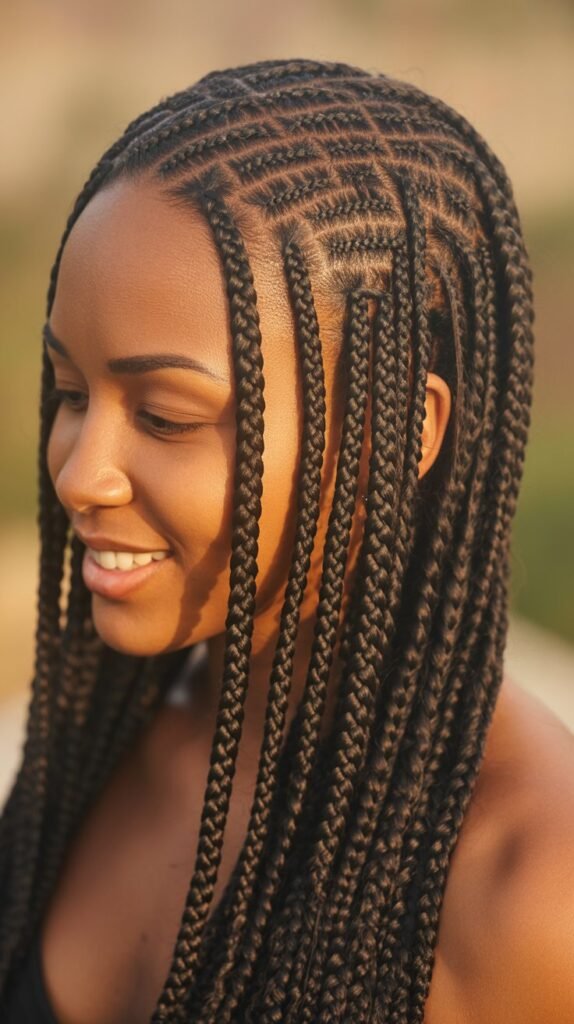
Ghana weaving straight back represents a specific braiding technique that creates raised, rope-like braids with distinctive thickness and prominence.
- Ghana weaving uses an underhand braiding technique that creates braids sitting prominently above the scalp with significant height and dimension.
- This method involves feeding in extensions continuously throughout the braiding process to build substantial thickness and volume.
- The resulting braids appear fuller and more pronounced than traditional cornrows, creating a bold and eye-catching appearance.
- Ghana weaving requires considerable skill to maintain consistent thickness and proper tension throughout the entire length of each braid.
- This style typically features 4 to 8 braids arranged in straight-back patterns, though the number can be adjusted based on personal preference.
- The raised nature of Ghana weaving provides excellent scalp access and ventilation, making maintenance and moisturizing more manageable.
- These braids can last 4 to 6 weeks with proper care, offering a durable protective styling option with impressive visual impact.
9. Straight-Back Box Braids

Straight-back box braids arrange traditional box braid sectioning into linear patterns that flow from the hairline to the nape of the neck.
- Unlike traditional box braids with staggered sections, straight-back box braids feature aligned square sections that create continuous lines across the scalp.
- This sectioning method combines the versatility of individual box braids with the streamlined appearance of straight-back cornrow patterns.
- Each braid can be styled independently, allowing for various ponytail positions, buns, and updos while maintaining the straight-back pattern at the roots.
- The installation process typically takes 4 to 8 hours depending on the size of individual braids and the overall density desired.
- Straight-back box braids can last 6 to 10 weeks with proper maintenance, providing an extended protective styling period for natural hair.
- This style works well for those who want the flexibility of loose braids with a more organized and intentional appearance at the scalp.
- The square sectioning at the roots creates clean, geometric patterns that add visual interest even when the braids are styled into updos.
10. Straight-Back Braids with Shaved Sides

Straight-back braids with shaved sides create a bold, edgy contrast that combines traditional braiding with contemporary undercut styling trends.
- This style features braids concentrated along the top and crown area while the sides and sometimes the nape are cut very short or shaved completely.
- The contrast between braided sections and shaved areas creates dramatic visual interest and emphasizes facial features and bone structure.
- Shaved sides reduce overall styling time and make the braided portion easier to maintain and manage throughout the wear period.
- This look pairs well with various braid thicknesses, from jumbo styles to micro braids, each creating different aesthetic effects.
- The shaved portions require regular maintenance every 1 to 2 weeks to maintain the clean, sharp contrast between sections.
- This style works particularly well for those with oval, heart-shaped, or diamond face shapes, as it draws attention upward.
- The edgy appearance makes this option popular among fashion-forward individuals and those in creative professional fields seeking distinctive personal styling.
11. Lemonade Braids Straight Back

Lemonade braids straight back feature side-swept cornrows that eventually transition into a straight-back pattern, creating a unique asymmetrical design.
- This style gained widespread popularity through celebrity influence and offers a contemporary twist on traditional straight-back braiding patterns.
- Lemonade braids typically begin with a deep side part, with cornrows sweeping from one side across the head before continuing straight back.
- The asymmetrical element creates visual interest and allows for creative variations in braid thickness and spacing throughout the design.
- Installation requires skilled technique to manage the directional change from side-swept to straight-back while maintaining consistent tension.
- This style typically takes 3 to 6 hours to complete, depending on the number of braids and the intricacy of the pattern.
- Lemonade braids can incorporate various braid thicknesses within the same style, creating dynamic visual texture and dimension.
- The versatility of this pattern allows for numerous styling options, including high ponytails, side-swept looks, and half-up configurations.
12. Straight-Back Braids with Highlighted Extensions

Straight-back braids with highlighted extensions incorporate multiple colors to create depth, dimension, and visual interest within the braiding pattern.
- Color highlights can be achieved using pre-colored braiding hair in shades that complement your natural hair color or create bold contrast.
- Strategic color placement can enhance facial features, create the illusion of movement, and add personality to traditional braiding styles.
- Popular color combinations include natural browns with caramel highlights, black with burgundy or red tones, and bold fashion colors like blue or purple.
- The blending technique involves mixing different colored extensions within the same braid or alternating colors between different braids.
- Highlighted braids work particularly well with feed-in techniques, as the gradual addition of hair allows for seamless color transitions.
- This styling option provides an opportunity for creative expression without applying permanent color to your natural hair underneath.
- Maintenance remains similar to single-color braids, though colored extensions may fade with sun exposure and require replacement during reinstallation.
13. Straight-Back Braids with Yarn

Straight-back braids with yarn offer a lightweight, colorful alternative to traditional synthetic braiding hair with unique textural qualities.
- Acrylic yarn provides a softer, lighter alternative to synthetic braiding hair while offering an extensive range of colors and textures.
- Yarn braids create less tension on the scalp and hairline, making them an excellent option for those with sensitive scalps or fine hair.
- The installation process involves wrapping yarn around natural hair rather than traditional three-strand braiding, creating a unique wrapped appearance.
- Yarn braids typically last 4 to 8 weeks and can be removed more easily than traditional synthetic braiding hair extensions.
- This style allows for bold color experimentation, including ombre effects, multicolored patterns, and neon shades rarely found in braiding hair.
- Yarn is more affordable than synthetic braiding hair, making this an economical protective styling option for budget-conscious individuals.
- The lightweight nature makes yarn braids particularly comfortable for extended wear, reducing neck strain and headaches associated with heavier styles.
14. Straight-Back Knotless Braids
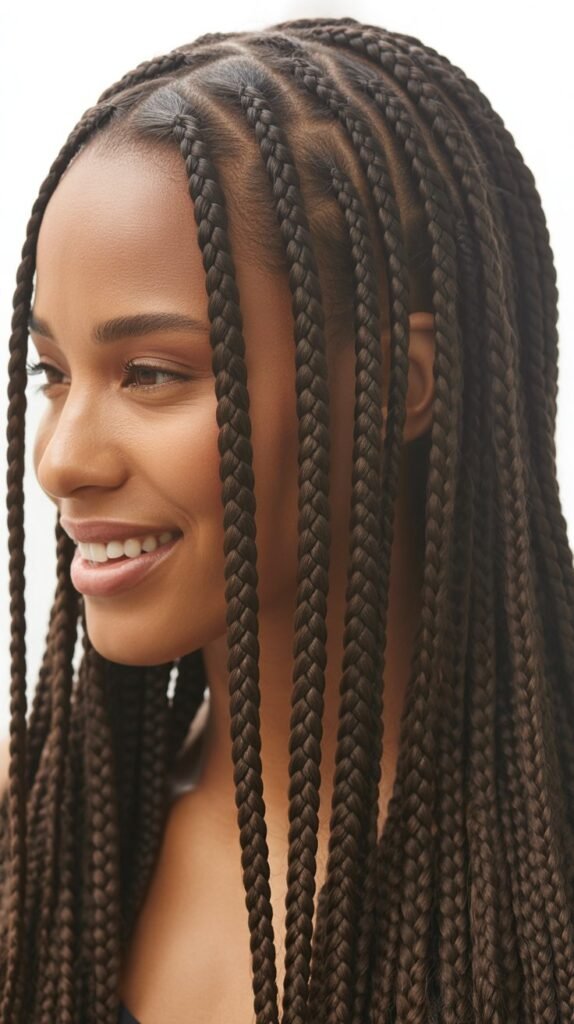
Straight-back knotless braids eliminate the traditional knot at the base, creating a more comfortable and natural-looking protective style.
- The knotless method begins with your natural hair and gradually feeds in extensions, eliminating the bulky knot typically found at the root of traditional braids.
- This technique significantly reduces tension on the scalp and hairline, making it one of the most scalp-friendly braiding methods available.
- Knotless braids lie flatter against the scalp and create a more natural appearance, especially along the hairline and visible parting areas.
- Installation requires advanced skill and typically takes 5 to 8 hours, as the gradual feeding process demands precision and patience.
- These braids can last 6 to 10 weeks with proper maintenance, offering extended wear time while maintaining comfort throughout.
- The reduced tension makes knotless braids ideal for those recovering from hair damage or experiencing hairline thinning.
- This method works beautifully for all braid sizes, from micro to jumbo, maintaining the same comfort benefits regardless of thickness.
15. Straight-Back Braids into a Ponytail

Straight-back braids into a ponytail combine structured scalp braiding with a gathered, versatile tail section that offers styling flexibility.
- This style features cornrows or feed-in braids across the scalp that converge at the crown or nape, where they’re gathered into a single ponytail.
- The ponytail section can consist of loose braiding hair, box braids, or other braid variations, providing textural contrast with the scalp work.
- This design offers excellent versatility, as the ponytail can be positioned high, low, or to the side based on personal preference and occasion.
- The sleek braided foundation creates a polished appearance suitable for professional environments, while the ponytail adds a casual, youthful element.
- Installation typically takes 3 to 5 hours, depending on the complexity of the scalp braiding and the length of the ponytail section.
- This style works particularly well for active lifestyles, keeping hair securely off the face and neck during physical activities.
- The ponytail can be styled in various ways—wrapped, curled, or accessorized—allowing for multiple looks from a single base installation.
16. Zigzag Parting Straight-Back Braids
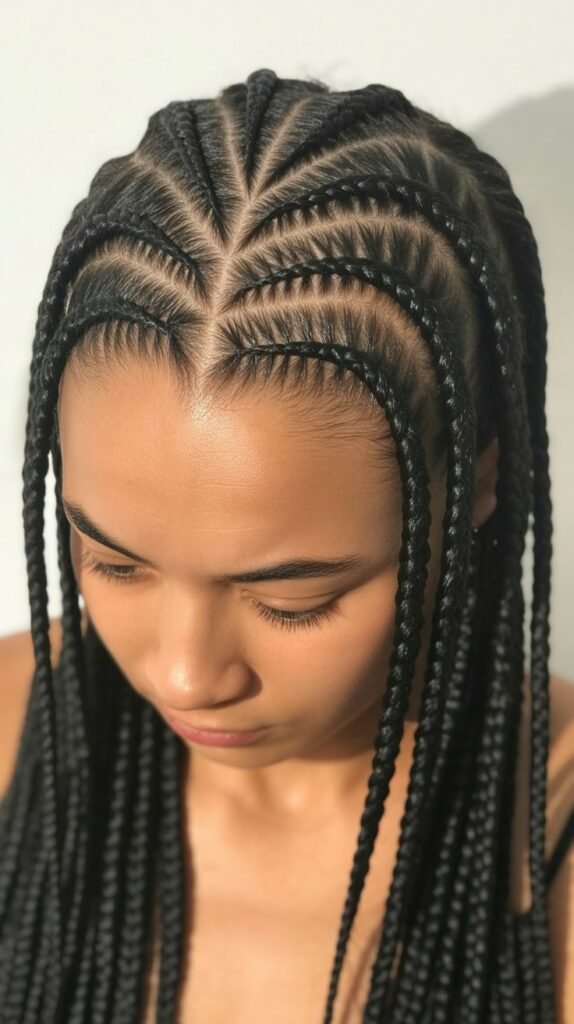
Zigzag parting straight-back braids incorporate creative parting patterns that add visual interest to traditional linear braiding designs.
- Instead of straight linear parts, zigzag patterns create angular, geometric divisions between braids that catch light and create dimension.
- This parting technique requires precision and skill to maintain consistent angles while ensuring braids still flow straight back from the hairline.
- Zigzag parts can be subtle or dramatic depending on the amplitude of the pattern and the thickness of the braids themselves.
- The creative parting adds an artistic element that distinguishes your style from standard straight-back braids without requiring additional time or materials.
- This design works well with various braid thicknesses, though it’s most visible with medium to jumbo-sized braids that create wider part spaces.
- Installation time increases slightly compared to standard parts, typically adding 30 minutes to 1 hour to the overall styling process.
- Zigzag parting provides an opportunity for braiders to showcase their technical skill and artistic vision within traditional braiding frameworks.
17. Straight-Back Braids with Gold Thread

Straight-back braids with gold thread incorporate metallic strands that add shimmer, luxury, and visual interest to traditional braiding patterns.
- Gold thread is woven into braids alongside hair extensions, creating a shimmering effect that catches light with movement.
- This embellishment transforms simple protective styling into occasion-appropriate looks suitable for weddings, parties, and special events.
- Thread can be incorporated throughout the entire length of braids or concentrated at specific sections for strategic accent placement.
- Various metallic colors are available beyond gold, including silver, copper, and rose gold, allowing for customization based on personal preference.
- The addition of thread doesn’t significantly increase installation time but does require careful attention to maintain consistent integration throughout each braid.
- Thread-wrapped braids should be handled gently during maintenance to prevent the metallic strands from loosening or creating tangling issues.
- This styling option works particularly well for those seeking an elevated, fashion-forward appearance without permanent color commitment.
18. Straight-Back Braids with Natural Hair Out
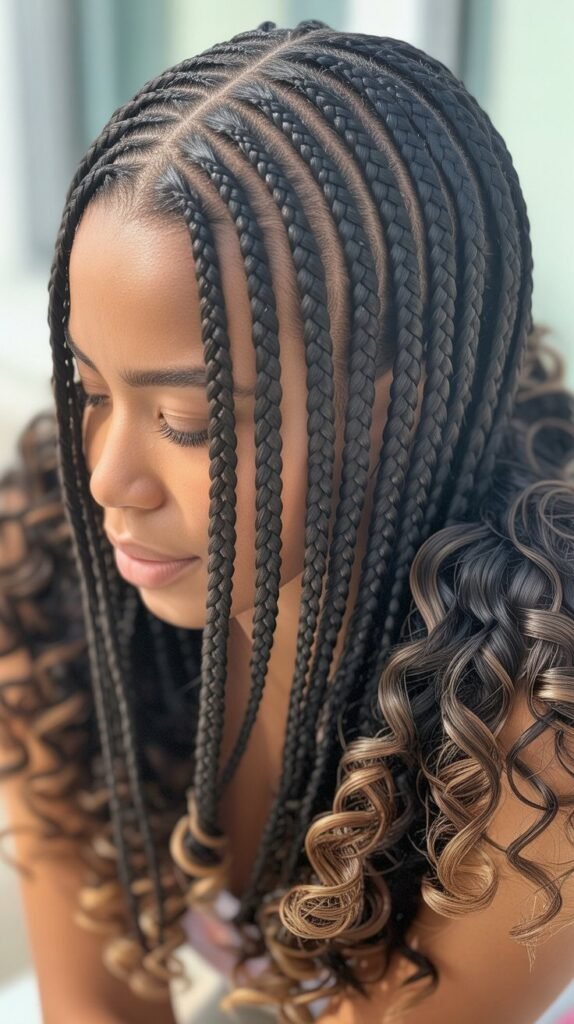
Straight-back braids with natural hair out combine protective braiding at the roots with a section of natural hair left loose for styling versatility.
- This hybrid approach braids the majority of the hair straight back while leaving the front edges, top section, or perimeter hair in its natural state.
- Leaving natural hair out allows for styling versatility through blending different textures and creating soft, framing elements around the face.
- The exposed natural hair can be styled with twist-outs, braid-outs, flexi-rods, or left in its natural curl pattern for organic texture.
- This method requires diligent maintenance of the loose natural hair to prevent tangling with the braided sections and maintain definition.
- Leaving hair out works best when the natural texture is well-moisturized and healthy, as it will be more exposed to environmental elements.
- This styling approach offers a balance between protection and accessibility, allowing easier manipulation of some hair while most remains secured.
- The combination creates a softer, more romantic appearance compared to fully braided styles while still providing significant protective benefits.
19. Straight-Back Goddess Braids
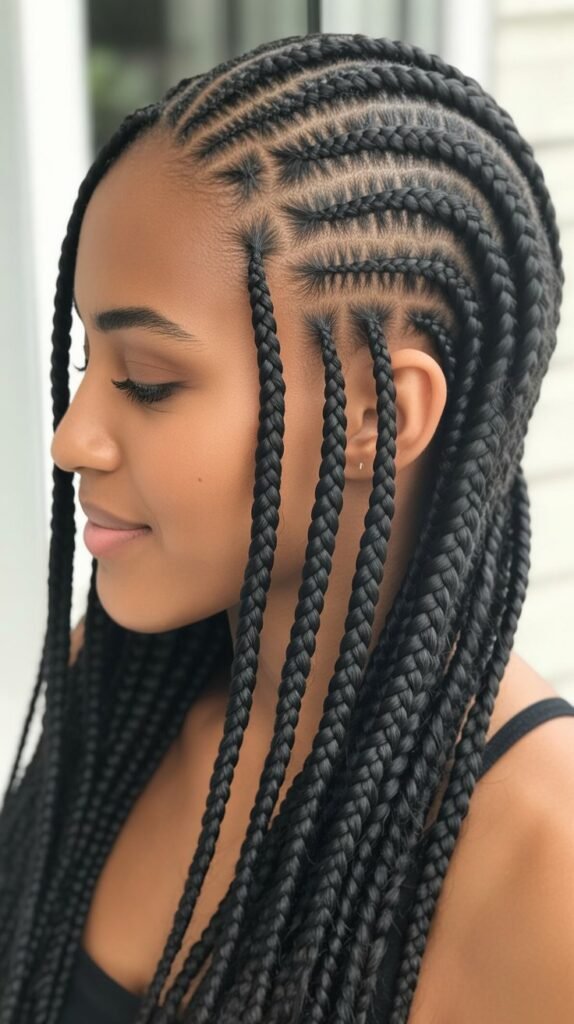
Straight-back goddess braids create thick, rope-like braids with a softer, looser texture compared to traditional tight cornrows.
- Goddess braids are characterized by their larger size and looser braiding tension, creating a softer, more relaxed appearance than standard cornrows.
- These braids often incorporate wavy or curly hair extensions that add texture and dimension throughout the length of each braid.
- The installation process uses less tension at the scalp, making goddess braids more comfortable and gentler on hairlines and edges.
- Typically, this style features 4 to 8 large braids arranged in straight-back patterns that create a bohemian, romantic aesthetic.
- The looser construction means goddess braids typically last 2 to 4 weeks before requiring reinstallation, shorter than tighter braiding styles.
- This style works beautifully for special occasions, photoshoots, or when seeking a softer, more feminine interpretation of traditional braiding.
- The textured extensions used in goddess braids create movement and flow that standard smooth braiding hair cannot achieve.
20. Straight-Back Braids with Cornrow Designs
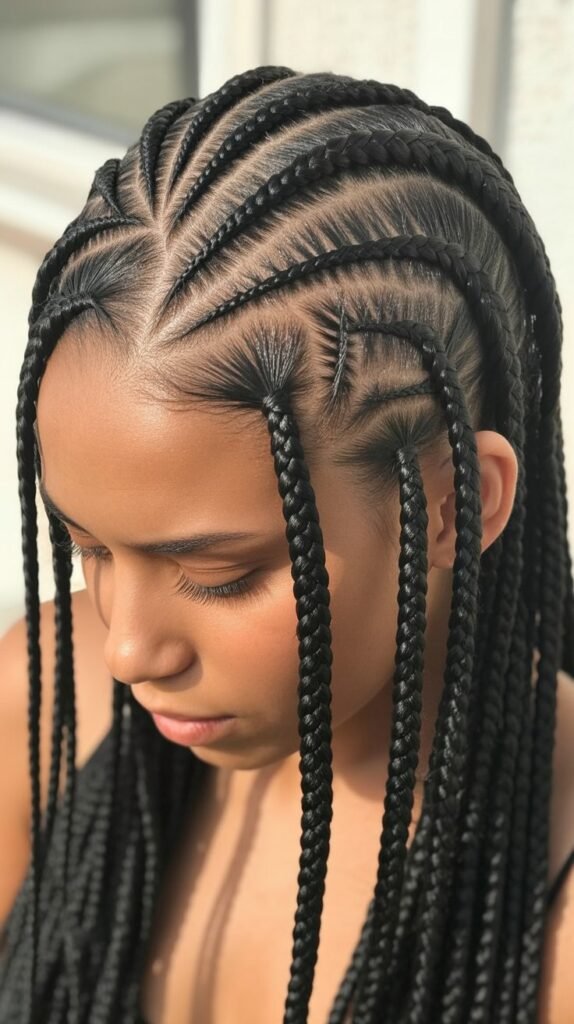
Straight-back braids with cornrow designs incorporate intricate patterns within the straight-back framework for added artistic expression.
- This approach combines the streamlined appearance of straight-back braiding with decorative elements like curves, swirls, or geometric shapes at specific sections.
- Design elements are typically concentrated near the hairline, crown, or other visible areas where they can be appreciated without disrupting the overall flow.
- Common design additions include hearts, initials, tribal patterns, or abstract artistic expressions integrated into the parting and braiding structure.
- Creating designs within straight-back braids requires advanced braiding skills and significantly increases installation time by 1 to 3 hours.
- The designs should be planned before beginning the braiding process to ensure proper sectioning and appropriate hair distribution for pattern execution.
- This styling option allows for personal expression and transforms functional protective styling into wearable art that reflects individual creativity.
- Photographing or documenting design work helps preserve the artistic achievement, as these patterns evolve and fade as braids age.
21. Straight-Back Braids with Cuffs
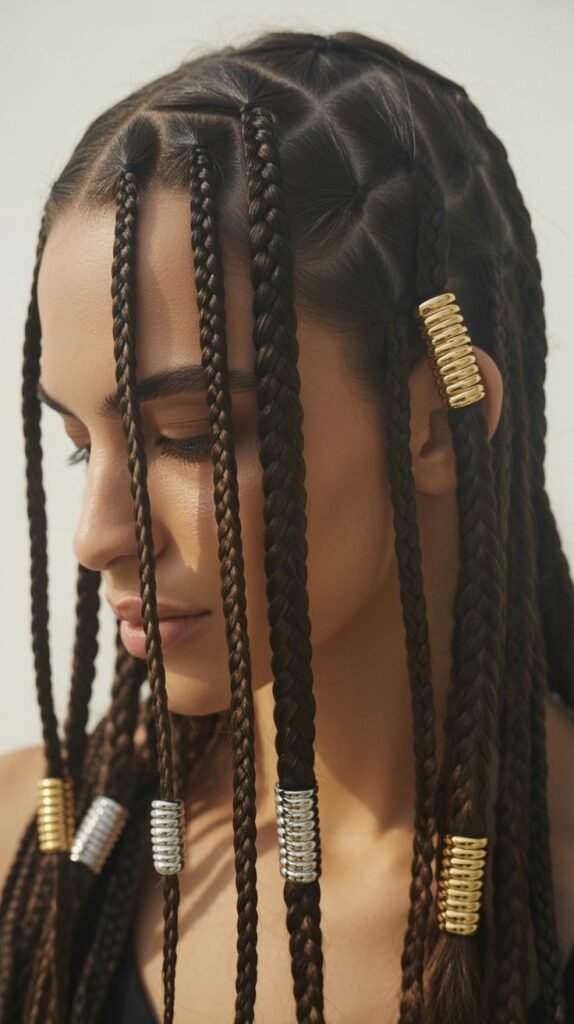
Straight-back braids with cuffs incorporate metallic rings or decorative bands positioned along the length of braids for embellishment.
- Metal cuffs come in various styles including simple rings, ornate designs, coils, and decorative bands that slide onto individual braids.
- Strategic placement of cuffs can create patterns, emphasize certain braids, or concentrate accessories at specific areas like mid-length or ends.
- Cuffs should be loose enough to avoid creating tension points but secure enough not to slide excessively during daily activities.
- This accessorizing method allows for easy style changes, as cuffs can be added, removed, or repositioned throughout the wear period of the braids.
- Mixing different metal finishes like gold, silver, and copper creates an eclectic, bohemian appearance popular in festival and creative styling.
- Cuffs work best with medium to jumbo braids that have sufficient thickness to support the accessories without excessive weight.
- Removing cuffs before sleeping prevents tangling and discomfort while extending the lifespan of both the accessories and the braids themselves.
22. Straight-Back Feed-In Braids with Baby Hair
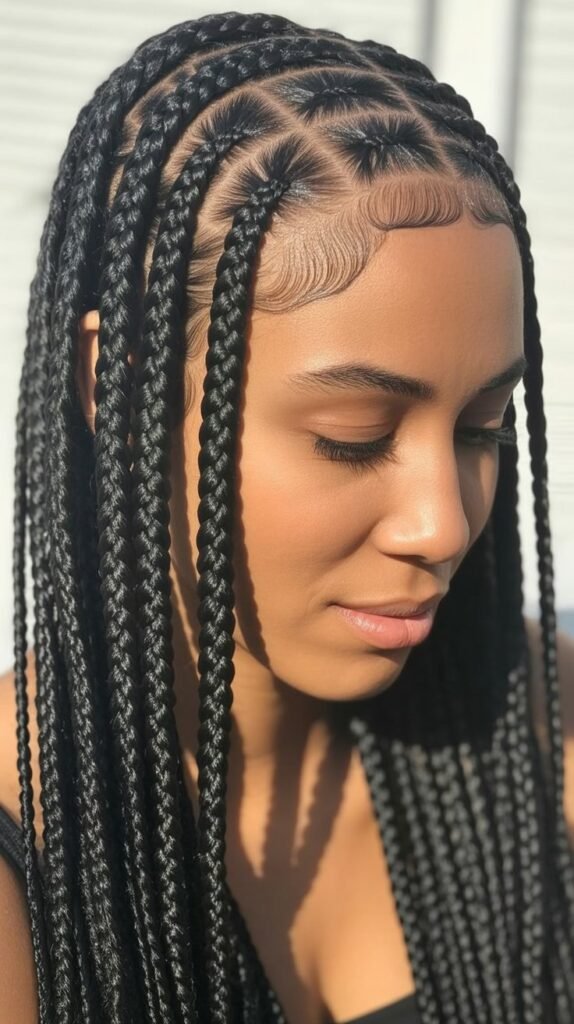
Straight-back feed-in braids with baby hair combine protective braiding with styled edges for a polished, contemporary appearance.
- Baby hair refers to the fine hair along the hairline that’s left out and styled into decorative patterns using edge control products.
- Styled edges complement the sleekness of feed-in braids while adding feminine details and frame the face with deliberate design elements.
- Common baby hair patterns include simple swoops, waves, curves, or more intricate designs that coordinate with the overall aesthetic.
- Proper edge styling requires quality edge control gel or pomade that provides hold without flaking or causing product buildup.
- The combination of protective braiding and styled edges creates a fashion-forward look popular on social media and among younger demographics.
- Maintaining styled baby hair requires nightly application of edge products and wearing a silk or satin scarf to preserve the style.
- Care should be taken not to over-manipulate or apply excessive tension to baby hair, as these delicate strands are vulnerable to breakage.
23. Straight-Back Braids with Middle Part
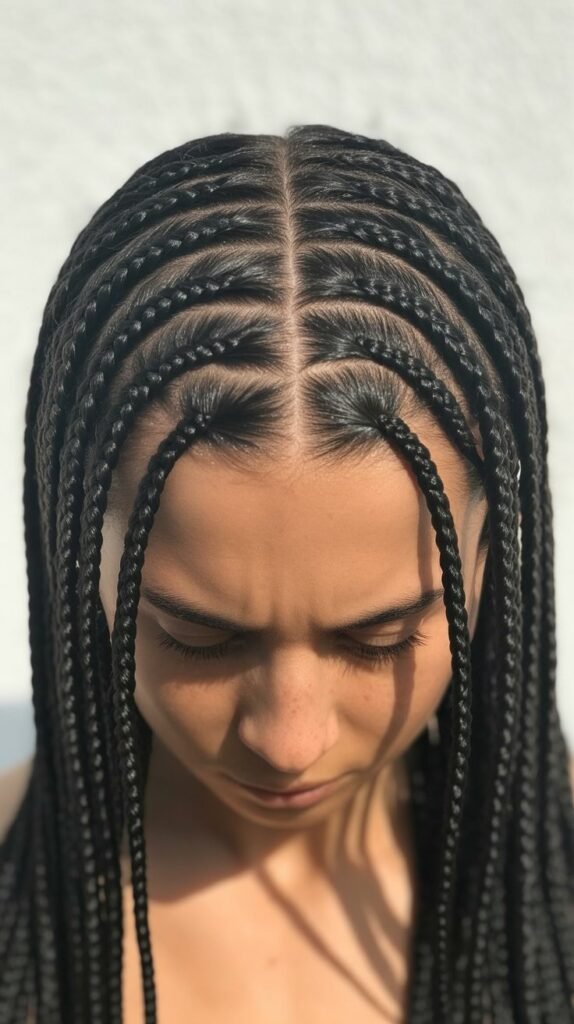
Straight-back braids with middle part create a symmetrical, balanced appearance by dividing the hair down the center before braiding backward.
- The middle part divides the hair into two equal sections, with braids flowing straight back on each side from the central division.
- This symmetrical design flatters oval and heart-shaped faces particularly well by creating balanced proportions around facial features.
- Middle parts can be precise and straight or slightly zigzagged for added visual interest while maintaining overall symmetry.
- Braid counts should be even on both sides to preserve the balanced appearance and ensure consistent tension distribution across the scalp.
- This parting style works with various braid thicknesses and techniques, from classic cornrows to feed-in braids and knotless methods.
- The middle part provides versatility in styling options, as braids can be gathered into twin ponytails, swept to one side, or left flowing naturally.
- Installation requires careful measurement and marking to ensure the part is truly centered and creates the desired symmetrical effect.
24. Straight-Back Braids into a Bun
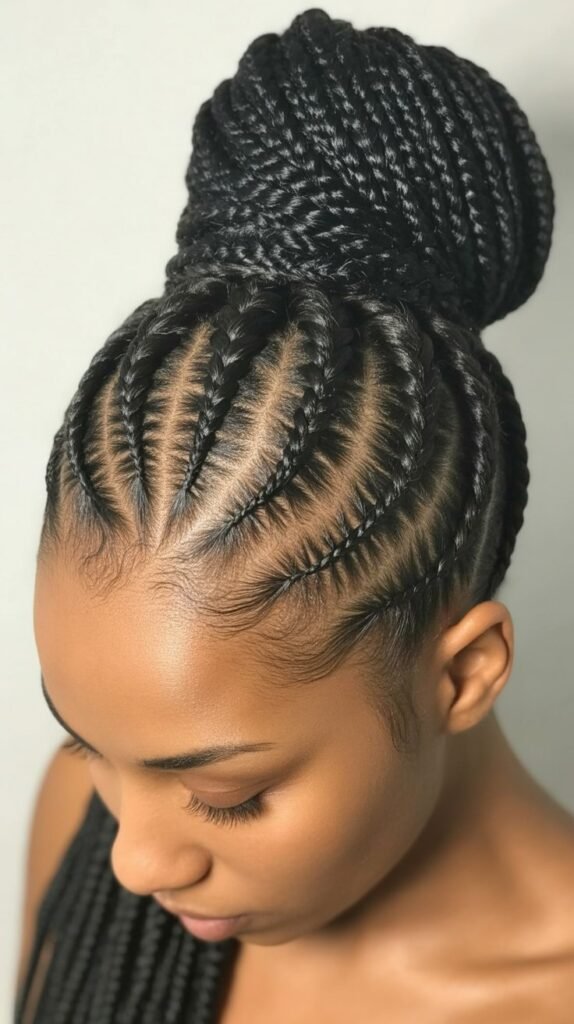
Straight-back braids into a bun combine scalp braiding with an elegant gathered updo suitable for formal occasions and professional settings.
- This style features cornrows or feed-in braids that flow from the hairline to the crown or nape, where they’re gathered and secured into a bun formation.
- The bun can be positioned high on the crown, low at the nape, or to the side depending on desired aesthetic and face shape considerations.
- Various bun styles are possible including twisted buns, wrapped buns, braided buns, or simple gathered buns held with hairpins or elastics.
- The sleek braided foundation creates a polished, sophisticated appearance appropriate for weddings, business environments, and formal events.
- Installation typically takes 3 to 5 hours, with the bun formation adding minimal time once the braiding foundation is complete.
- This style effectively keeps hair completely secured and protected while creating an elegant silhouette that emphasizes neck and shoulder lines.
- The bun can be dressed up with accessories like decorative pins, flowers, or hair jewelry for special occasions and celebrations.
25. Straight-Back Braids with Ombre Color
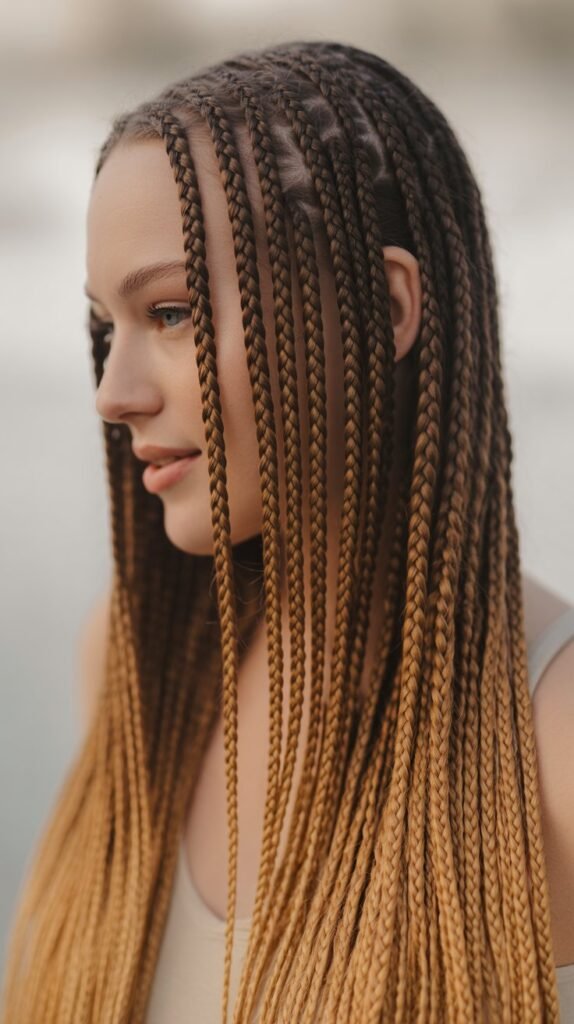
Straight-back braids with ombre color feature graduated color transitions from dark roots to lighter ends for dimensional visual interest.
- Ombre coloring creates a gradual transition between two or more colors, typically moving from natural darker shades at roots to lighter tones at ends.
- This coloring technique adds depth and dimension to braided styles without requiring uniform color throughout the entire length.
- Popular ombre combinations include black to burgundy, brown to blonde, black to blue, and natural browns to pastel shades.
- The color transition can be abrupt for bold contrast or gradual and blended for a softer, more natural-looking gradient effect.
- Pre-colored ombre braiding hair is available in numerous color combinations, or colors can be custom blended during installation.
- The visual lengthening effect of ombre coloring can make braids appear longer and create interesting movement as hair shifts with motion.
- This coloring approach allows for creative expression and trendy styling without applying permanent dye to natural hair underneath the braids.
26. Straight-Back Braids with Side Part

Straight-back braids with side part create asymmetry and visual interest by dividing hair off-center before braiding flows backward.
- Side parts can be positioned anywhere from slightly off-center to dramatically deep, creating varying degrees of asymmetry and volume distribution.
- This parting style adds dimension and works particularly well for those with round or square face shapes by creating diagonal lines.
- The side with more hair typically features more braids or thicker braids, creating a fuller appearance that can be styled forward or back.
- Side-parted straight-back braids can be swept across the forehead for dramatic effect or pulled straight back for a sleeker appearance.
- This styling choice adds contemporary flair to traditional straight-back braiding and aligns with current fashion and beauty trends.
- The asymmetrical nature allows for interesting styling variations, including side-swept looks, angled ponytails, or volume concentration on one side.
- Installation time remains similar to center-parted styles, though extra attention must be paid to maintaining consistent tension with unequal sections.
27. Straight-Back Senegalese Twist

Straight-back Senegalese twists arrange two-strand rope twists in linear patterns from hairline to nape for a distinctive textured appearance.
- Senegalese twists use a two-strand rope-twisting technique rather than three-strand braiding, creating a different texture and visual appearance.
- When arranged in straight-back patterns, these twists create clean lines across the scalp with a smoother, rope-like finish compared to traditional braids.
- The twisting method generally creates less tension than tight braiding, making this a comfortable protective styling option for sensitive scalps.
- Senegalese twists typically last 6 to 8 weeks with proper maintenance, offering extended wear time comparable to or exceeding standard braiding.
- This style works beautifully with various hair textures and can incorporate extensions for added length, volume, or color variation.
- Installation takes 4 to 8 hours depending on the size of twists, with smaller twists requiring more time but lasting longer.
- The smooth texture of Senegalese twists creates an elegant, refined appearance suitable for both casual and formal occasions.
28. Straight-Back

The Straight-Back hairstyle is a classic and timeless braiding style that has deep cultural roots and modern appeal.
It’s characterized by cornrows (braids) that are neatly braided straight back from the front hairline to the nape of the neck.
This simple yet striking style is known for its clean lines, versatility, and protective qualities.
28. Straight-Back Braids with Underhand Technique
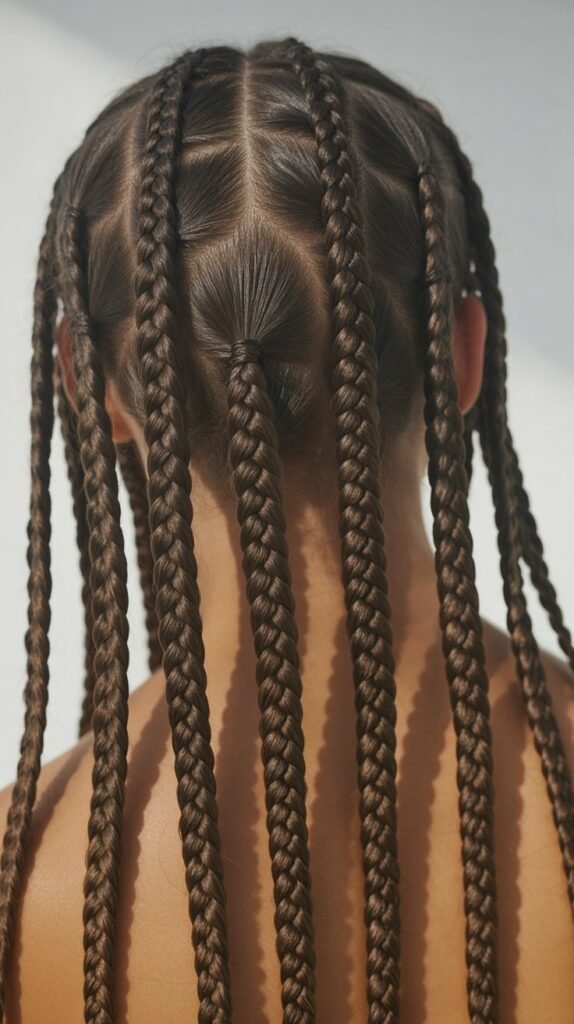
Straight-back braids with underhand technique create raised, prominent braids that sit distinctly above the scalp for enhanced dimension and texture.
- The underhand braiding method involves crossing hair strands under rather than over, causing braids to rise above the scalp with pronounced definition.
- This technique creates a more dramatic, sculptural appearance compared to overhand braiding, with braids appearing fuller and more substantial.
- Underhand braiding provides better visibility of the braiding pattern itself, making intricate work and design elements more noticeable.
- The raised structure allows for excellent air circulation around the scalp, promoting healthy scalp conditions during the protective styling period.
- This method requires consistent technique throughout each braid to maintain uniform height and appearance from roots to ends.
- Underhand straight-back braids typically last 3 to 6 weeks depending on hair texture, maintenance routine, and environmental exposure.
- The technique works particularly well with feed-in methods, as the gradual addition of hair enhances the dimensional, raised effect throughout the braid length.
29. Straight-Back Braids with Twisted Sections
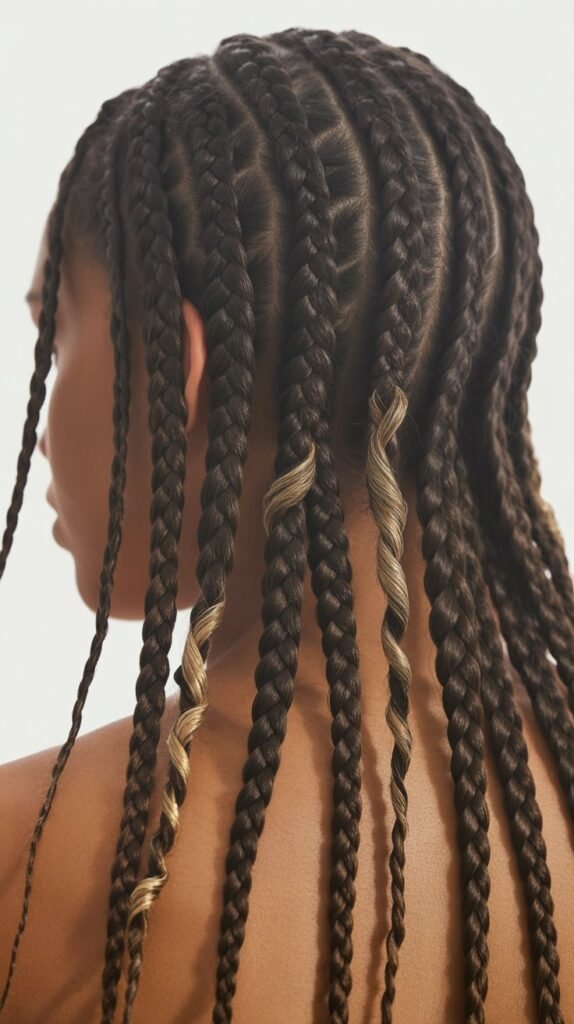
Straight-back braids with twisted sections combine traditional cornrows with rope-twist elements for varied texture and visual complexity.
- This hybrid style alternates between three-strand braided cornrows and two-strand rope twists arranged in straight-back patterns across the scalp.
- The textural contrast between braids and twists creates visual interest and dimension that single-technique styles cannot achieve.
- Alternating patterns can follow various sequences—every other row, groups of two braids then two twists, or custom arrangements based on preference.
- This combination approach allows braiders to showcase versatility and technical skill while creating unique, personalized styling outcomes.
- Installation time increases slightly compared to uniform braiding, typically adding 1 to 2 hours to accommodate technique transitions.
- The mixed technique provides a distinctive appearance that stands out from standard straight-back braiding while maintaining protective benefits.
- Both braided and twisted sections should maintain similar tension and sizing to create cohesive, balanced visual rhythm across the entire style.
30. Straight-Back Braids with Scalp Design Patterns

Straight-back braids with scalp design patterns incorporate artistic line work and geometric shapes visible in the parting areas between braids.
- Scalp designs transform the negative space between braids into artistic canvases featuring geometric patterns, tribal designs, or custom illustrations.
- These patterns are created through precise parting techniques that leave specific scalp areas visible in intentional shapes and arrangements.
- Common design elements include diamonds, triangles, curves, zigzags, stars, and personalized symbols that hold meaning for the wearer.
- Creating scalp designs requires advanced technical skills and artistic vision to execute clean lines while maintaining proper hair distribution for braiding.
- The designs are most visible when braids are freshly installed and the scalp is clearly exposed, gradually becoming less distinct as hair grows.
- Installation time increases significantly, often adding 2 to 4 hours depending on design complexity and the number of intricate elements incorporated.
- Scalp design patterns elevate straight-back braids from functional protective styling to wearable art that showcases both technical skill and creative expression.
- Photography and documentation of scalp designs help preserve the artistic work, as these patterns naturally evolve and fade as the style ages.
Hair Care During Braided Styles
- Maintain adequate moisture by applying light oils directly to the scalp using an applicator bottle with a nozzle tip for precise distribution.
- Protect braids during sleep by wearing a silk or satin bonnet that covers all braids completely, preventing friction against cotton pillowcases.
- Cleanse the scalp weekly using a diluted shampoo mixture applied with a spray bottle, focusing on the scalp rather than the braids themselves.
- Avoid excessive manipulation and pulling on braids, as this can cause tension on the hairline and lead to traction alopecia over time.
- Keep braids hydrated by using a moisturizing braid spray containing water and natural oils, applied every 2-3 days or as needed.
- Address itching immediately by applying witch hazel, tea tree oil, or specialized scalp relief products rather than scratching, which damages both scalp and braids.
- Monitor the condition of edges and hairline regularly, loosening or removing braids if any signs of excessive tension or hair loss appear.
- Limit the time between braid installations by allowing your natural hair to rest for 1-2 weeks before reinstalling protective styles.
For additional guidance on protective styling and natural hair care, visit Naturally Curly and The Mane Choice for expert advice and product recommendations.
Conclusion
The world of 30 Stylish Straight-Back Braided Hairstyles offers boundless opportunities for personal expression, cultural celebration, and practical hair protection.
Throughout this comprehensive exploration, you’ve discovered diverse options ranging from classic cornrows and feed-in braids to contemporary variations featuring colors, accessories, and innovative techniques.
Each style presents unique benefits, from the time-saving convenience of jumbo braids to the intricate artistry of scalp designs and micro braiding.
The versatility of straight-back braided hairstyles ensures there’s a perfect option for every hair type, lifestyle requirement, and aesthetic preference.
By understanding proper installation techniques, maintenance requirements, and styling possibilities, you can confidently choose and care for straight-back braids that enhance your natural beauty while protecting your hair’s health.
Whether you’re seeking a bold fashion statement, a professional appearance, or a comfortable everyday style, these 30 options provide inspiration and practical guidance for your braiding journey.
Remember that healthy hair begins with proper care, so always prioritize gentle techniques, adequate moisture, and regular maintenance to ensure your straight-back braided hairstyles remain beautiful and your natural hair underneath stays strong and thriving.